The moment it showed up
For a sport that has spent a decade talking about data, the arrival of genuine artificial intelligence in cricket happened almost without anyone noticing. No launch event, no press release — just a link, shared across a few WhatsApp groups and posted to a handful of timelines in late May.
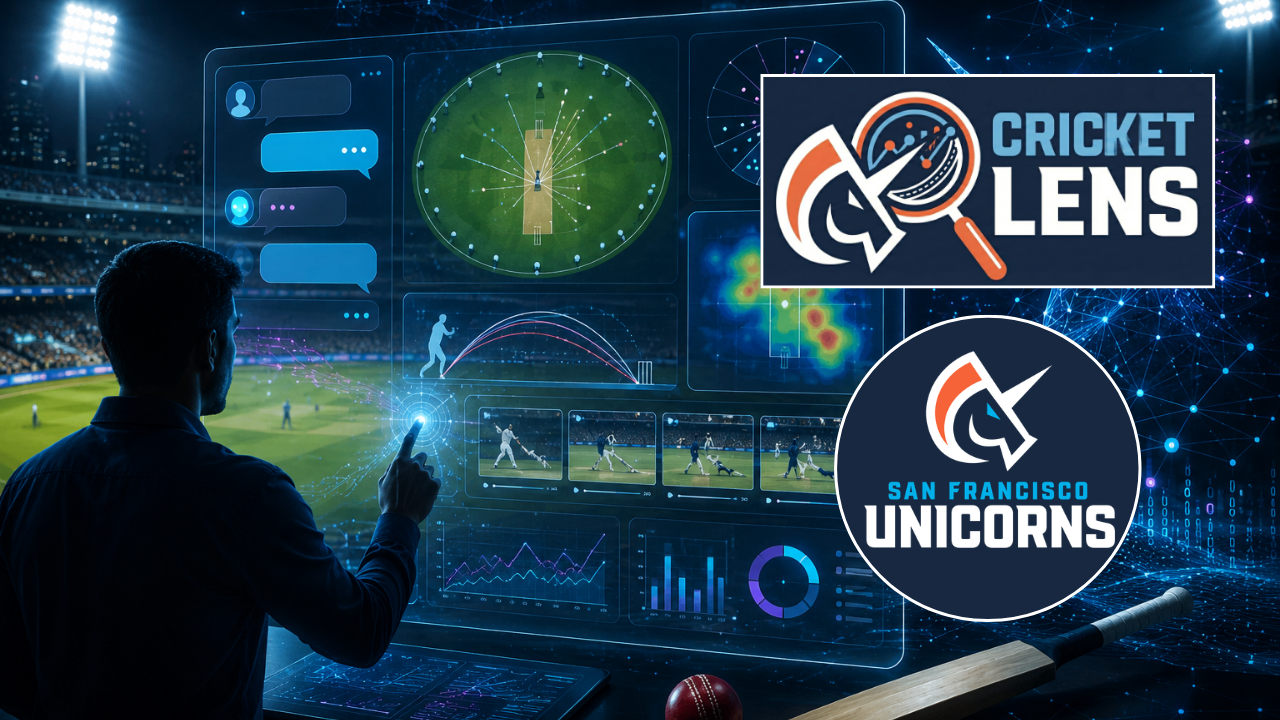
Behind that link is Cricket Lens, a conversational AI built by the San Francisco Unicorns that lets anyone — a head coach, an analyst, or a fan on a sofa — ask a cricket question in plain English and get a real answer back. Ask it how a particular bowler sets up a particular batter, or to pull every time a player has nicked off driving outside off stump, and it answers, reasons, and argues back. It is, as far as its creators can tell, the first tool of its kind in the sport.
‘”As far as I know, there’s nothing like this out there,” says Vishal Misra, who led the team that built it. That is not an idle boast. Misra is the RKS Family Professor of Computer Science and Vice Dean of Computing and AI at Columbia University, a Fellow of both the IEEE and the ACM, and — more than thirty years ago, as a graduate student — a member of the original team behind Cricinfo, where he wrote the first live scorecard system on the internet. He is also, by his own cheerful admission, a cricket fanatic. Few people on earth are better placed to sit at the intersection of the two.

What makes Cricket Lens worth a feature is not only that it works. It is that the Unicorns, having built something that gives them a competitive edge, have chosen to hand a version of it to everyone. The reasons they give for that decision — and their clear-eyed view of where the real, durable advantage actually lives — say a great deal about how cricket’s data era is about to change.
A walk in Central Park
The story does not begin with a product. It begins, in the way most of the Unicorns’ best decisions seem to, with two Silicon Valley founders treating a cricket team like a startup.
The franchise is co-owned by Anand Rajaraman and Venky Harinarayan, lifelong business partners who met as graduate students at Stanford and have since built two companies and two venture funds together. Their résumés read like a history of the consumer internet: co-founders of Junglee, acquired by Amazon; co-founders of Kosmix, acquired by Walmart; early angel investors in Facebook; co-inventors of the concept behind Amazon’s Mechanical Turk; today founding partners at Rocketship.vc, which uses big data and algorithms to pick startups. When Rajaraman and Harinarayan bought into Major League Cricket, they did so as self-described fans with, in Rajaraman’s telling, “the least background” of anything they had ever attempted. What they did bring was a conviction that the team of Silicon Valley should be built like one.
“We are the team of Silicon Valley, so we should be a team that pushes forward on our technology,” Rajaraman says. The logic was also competitive. “Some of the other teams that we are competing against have bigger budgets and bigger brand names and better access to players. So we needed something to level the playing field for us.”
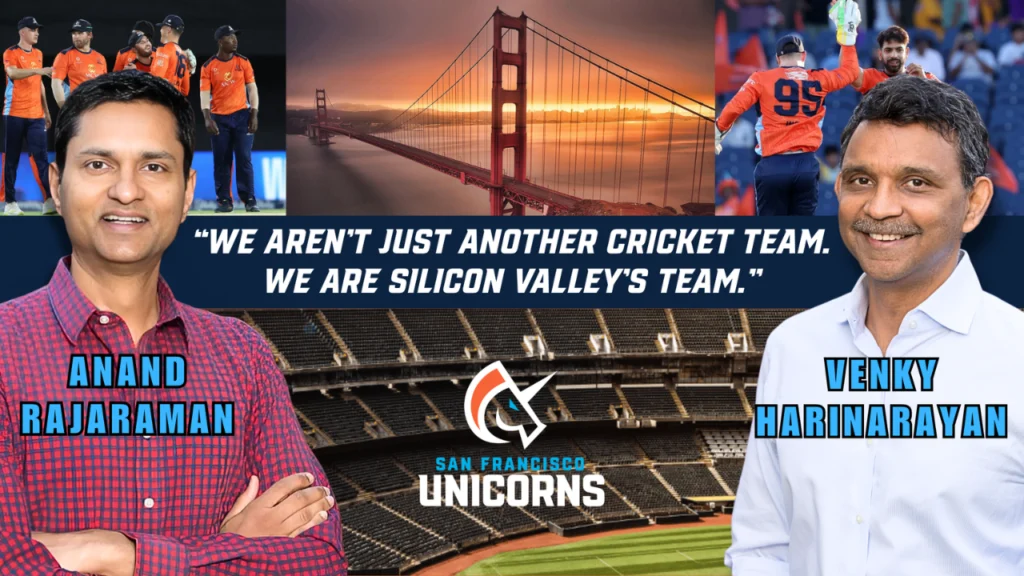
That instinct led him, eventually, to Misra — and Rajaraman is keen to correct the record on how. “I did not call Vishal. I flew to New York and met Vishal, and we walked around in Central Park,” he recalls. “That’s how I really got him in, over a long walk.” The timing was deliberate: it was the summer of 2024, around the India–Pakistan fixture in New York at the ICC Men’s T20 World Cup. By the time the two had finished pacing the park and, later, sat down over dinner, Misra was in.
He was not walking into an empty room. Rajaraman had already started assembling a small group of engineers around the franchise — “crazy Stanford PhDs who wanted to do stuff related to cricket,” as Misra describes them, with obvious affection. His own skepticism didn’t survive their first audition. Years earlier, Misra had written a technical paper — “in 2018 or 2019,” full of simulations and measurements — that he suspected could be applied to the team. He handed it over. “They flew back, and four days later they had actually implemented the paper,” he says. “They hand-wrote code. And I got very reassured that I’m not walking into some complete amateur shop. I said ‘you guys are crazy, but you’re also good.’”
Misra’s formal title with the Unicorns is Dean of Cricket Analytics; he is also part of the ownership group, and helps run the team’s analyst operations — facts the franchise has acknowledged publicly before. But the more useful way to understand his role is the one Rajaraman offered: “I want my team to be driven by data and AI,” Misra recalls him saying. “He asked me to come and oversee and guide the team, and lay out the roadmap for how we can do data and AI in all aspects of our operations.”

From a paper to the playing field
Long before there was a consumer app, there was a team trying to win cricket matches with mathematics — and, true to the Unicorns’ stated DNA, the first place the data showed up was in choosing players.
The franchise’s draft decisions have been shaped by its models. By Misra’s account, the data pushed the Unicorns to retain Finn Allen, to insist on drafting Hassan Khan — who went on to be named a domestic player of the tournament — and to sign young talents such as Cooper Connolly. “In the draft phase, the data has been working well,” he says. The same machinery feeds pre-game preparation — who should play, given the matchup — and increasingly, decisions inside the game itself. Cricket Lens, in that sense, is not a departure. “This is a consumer version of what we are doing internally,” Misra says.
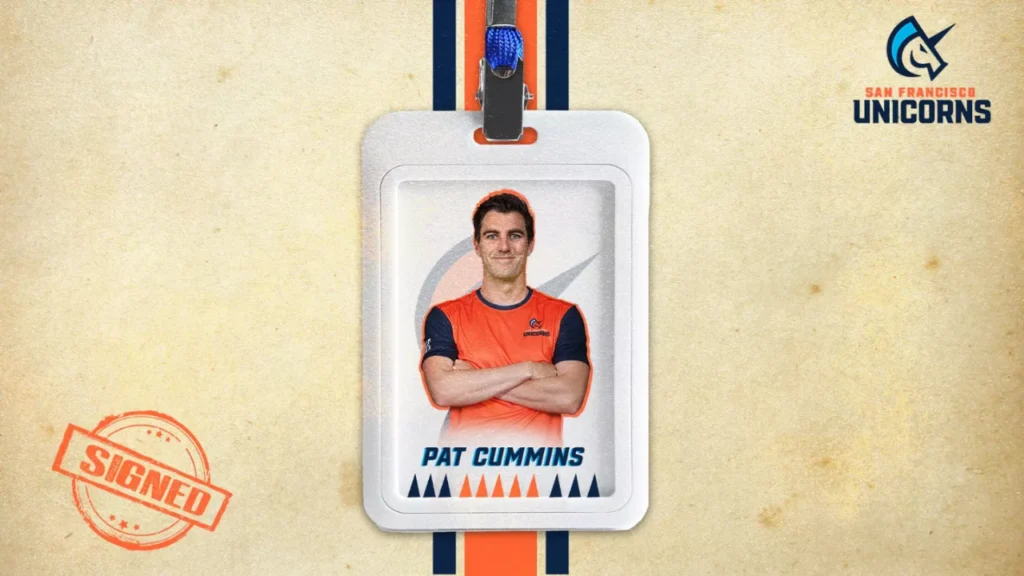
The internal version earned its credibility on the field. When the Unicorns’ coaching staff — drawn from the franchise’s high-performance partnership with Cricket Victoria in Australia — arrived before the season, Misra and the AI team pitched them on using the tools in-game. “They bought into it. And we started using that tool during games,” he says. One believer in particular carried it further: Pat Cummins, the Unicorns’ marquee signing and one of the world’s best fast bowlers, was impressed enough to set up a meeting with Cricket Australia’s head coach about it. For a stretch, Misra says, the Australian white-ball side used the tool too.
It is one thing for an owner to want a data culture. It is another for champion cricketers and an international coaching setup to actually pick it up. That buy-in, Rajaraman argues, is itself a form of moat. “A lot of proprietary advantage is about not just the tools being available, but how you use them and how you make them part of your culture,” he says. “For us, we made it a whole part of our culture. Our coaches are completely bought in. We make that part of our ethos. For others, the coaching staff do what they do, and the data sits as an add-on.”
Teaching cricket to talk
The idea for Cricket Lens came, fittingly, from watching expensive analytics go unused.
“We have access to a lot of data,” Misra says. “But I realized that the coaches were not directly interacting with the data.” The bottleneck was the interface. A coach with a question had to route it through an analyst, wait for the query to be run, and get an answer back — sometimes the next day. “All that data was available,” Misra says, but the friction was throttling it. “This was taking an unnecessary delay.”
Misra had solved a version of this problem once before. In 2021, he built AskCricinfo for ESPNcricinfo — “the first real natural language interface application on the internet using LLMs,” as he puts it, launched fifteen months before ChatGPT made the idea famous. It let people ask the sport’s vast statistical database questions in everyday words. It was, by his own assessment, “great for its time, but very basic.” The models, however, had since improved enormously. “I got the idea that maybe I could build something for the coaching staff, where they could interact with all the data that we had, but in natural language,” he says. “Build a conversational interface.”

So that is what he did — first for the Unicorns’ coaches, then, once the agentic systems underneath grew capable enough, in a public-facing version for everyone else. The division of labor was clean: Misra wrote almost all of the cricketing logic and AI, using the extensive data set assembled by the Unicorns AI team, while his former PhD student Hanhua Feng built much of the underlying infrastructure.
The internal product still carries features the public one does not — advanced scouting that can surface, say, the exact sequence of deliveries a bowler uses to dismiss a certain type of batter, plus video the franchise can’t show publicly. But the consumer release is no toy. “You can ask questions in natural language. You can go deep. You can go wide,” Misra says. “Then we decided: let’s go public with it and make it available for everyone.”
Moneyball, in the AI era
For Rajaraman, Cricket Lens is the latest expression of an idea cricket has flirted with but never fully industrialized.
“Everybody thinks about Moneyball,” he says — the first reference point anyone reaches for when a sports team starts talking about data. “What this team is really doing is bringing Moneyball into the AI era.” The distinction he draws is between picking individual undervalued players, which is where most cricket analytics still stops, and something broader: “not just selecting players, but also doing squad composition, and on-field strategies.”
He has watched the analytics revolution play out at close range before. The Unicorns’ models have already delivered the kind of early wins that, in baseball, took years to prove out — the draft hits, the in-game calls, a runner-up finish in 2024. And Rajaraman is candid that the team’s competitive edge, like Oakland’s on-base-percentage edge two decades ago, will not stay exclusive forever. The history of the analytics era in baseball, he notes, is a history of inefficiencies being found, exploited, and then competed away once everyone catches on.
That does not worry him. If anything, it clarifies the mission. “This is at the level of human civilization. I don’t think you can keep these kinds of ideas completely contained,” he says. “We’d rather propagate them far and wide and be the agents of change rather than just trying to contain it.”
Why they’re giving it away
Which brings the story to its most interesting decision: the choice to put a powerful tool in the hands of the people the Unicorns compete against, and the fans who watch them.
Misra frames the public mission in language that echoes his Cricinfo days. “Just like Cricinfo democratized access to some level of data — scorecards, stats — everyone could get access to it for free,” he says. “Before that nobody had access and we made it available for free. This is the next level.” Where Cricinfo opened up the numbers, Cricket Lens opens up the analysis. “Now you can get access to public stats and an agentic analysis, and it does some really cool stuff,” he says. “It’s for fans to get more engaged with the game, and to popularize the game more — both here and elsewhere.”
There is, he acknowledges, a corporate logic running alongside the civic one. The public release doubles as proof of concept and as a statement of identity. “This is a branding exercise — that, yes, we can do this,” Misra says. “And let’s take this idea beyond cricket.”
Rajaraman sees the same horizon. The platform beneath Cricket Lens, he points out, is not really about cricket at all. “The underlying platform is sports-agnostic. It’s cricket for now, but why not do the NFL, football and soccer, and many other sports? The team is thinking through that.” The longer arc, he says, could see the franchise’s AI group — currently in the business of helping one team win — spun out into something larger. “Hopefully it might be a precursor, in the longer term, to making it an independent company that can stand on its own and not just service one team,” he says. “We are just one team. But you could do much more in the broader sports space.”
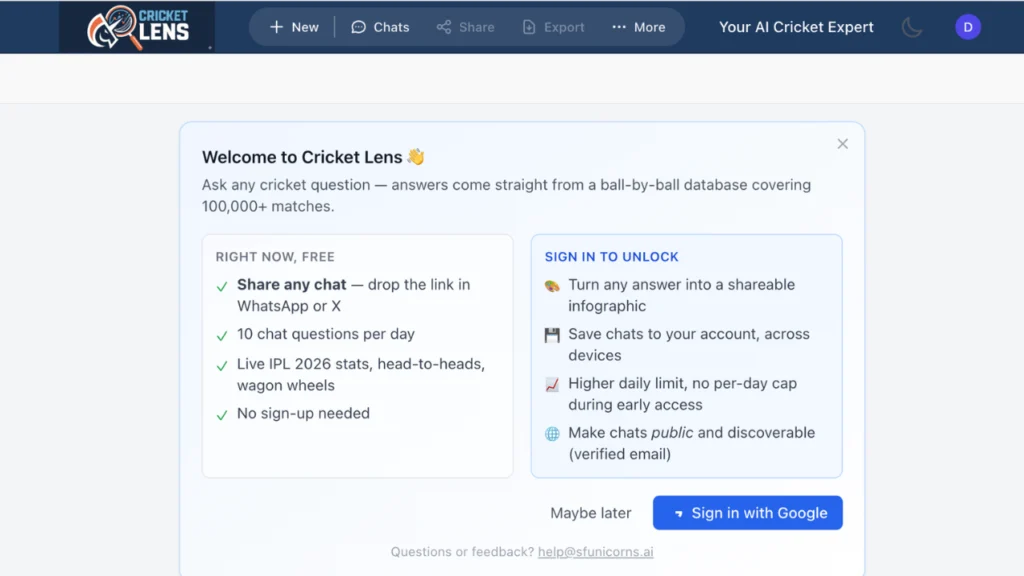
For now, the early reaction has done little to dampen the ambition. Without any real public push, Misra says, thousands of logins have been recorded, and the use cases run from the casual to the genuinely sophisticated. “People are doing it for all kinds of things, from simple questions to real, deep tactical and strategic analysis,” he says. Some users have had extended sessions, “going really deep into the analysis, asking deep questions, coming up with insights, arguing back and forth with Cricket Lens.” The feedback he most enjoys repeating is the comparative kind: messages suggesting that the big broadcasters’ own on-air “ask AI” gimmicks look threadbare next to it. “We’re getting messages like: ‘Google should be using this instead of those ‘ask AI’ things you see on TV,’” he says. A few have gone further and declared it could replace cricket analysts altogether — a claim Misra is quick to wave off. “That’s not true. But it can help them.”
The part the AI can’t fake
If the generosity is striking, the confidence underneath it is more so. The Unicorns are giving away a version of their tool partly because they believe the hardest, most defensible part of what they’ve built is something a rival cannot simply copy — and the reasoning is a genuinely original argument about why sport is different than many other domains when it comes to AI.
Start with the hype. Misra, who has spent his career modeling complex systems, is unromantic about how far large language models have actually come. “It’s extremely easy to put up a very good-looking demo over a weekend,” he says. “But to take that demo to production-level reliability, robustness and performance takes a lot of hard work. There is a lot of hype around AI. It’s getting really good, but there’s still a long way to go.” The proof, he says, is in the field: better-resourced AI labs have tried to build sports tools, and the results have been underwhelming, because raw model horsepower is not the binding constraint. “You need a lot of domain knowledge, and you need to put in a lot of work to make these things really good.”
Here is the deeper point — the one that explains where the Unicorns’ moat really comes from. In a field like software, an AI can improve itself in a tight, closed loop: write code, run it, see if it works, iterate, all without ever leaving the digital world. Cricket offers no such luxury. “Coding is not just writing programs — you need to know what kind of program to write, the intricacies, the corner cases,” Rajaraman says. “But often it’s a closed domain. You can find code, run it, test it, iterate, all within the confines of the digital world. In sports, that’s not possible. If you make a prediction, you have to test it on the field, take the learnings. The AI just can’t be in a self-learning loop and improve the way it can in coding.”
That single asymmetry reframes the whole project. A robust cricketing AI cannot be conjured by a clever model talking to itself; it has to be educated, slowly, by the real world — by matches played, by feedback gathered, by people who have actually done the thing at the highest level. “These kinds of features only come from really talking to people who know the sport,” Misra says. He offers an example a model would never dream up on its own. “You can ask Cricket Lens to look at the four balls before the one a batter was dismissed on — how did the bowlers set him up? AI doesn’t invent that question. But a coach will tell you: you don’t just dismiss a batter on the ball you get him out. You set him up. You prepare for it. And building those kinds of features comes from talking to people who know the sport. These guys are champions for a reason. You can be a keyboard warrior, but you cannot replicate what they have.”
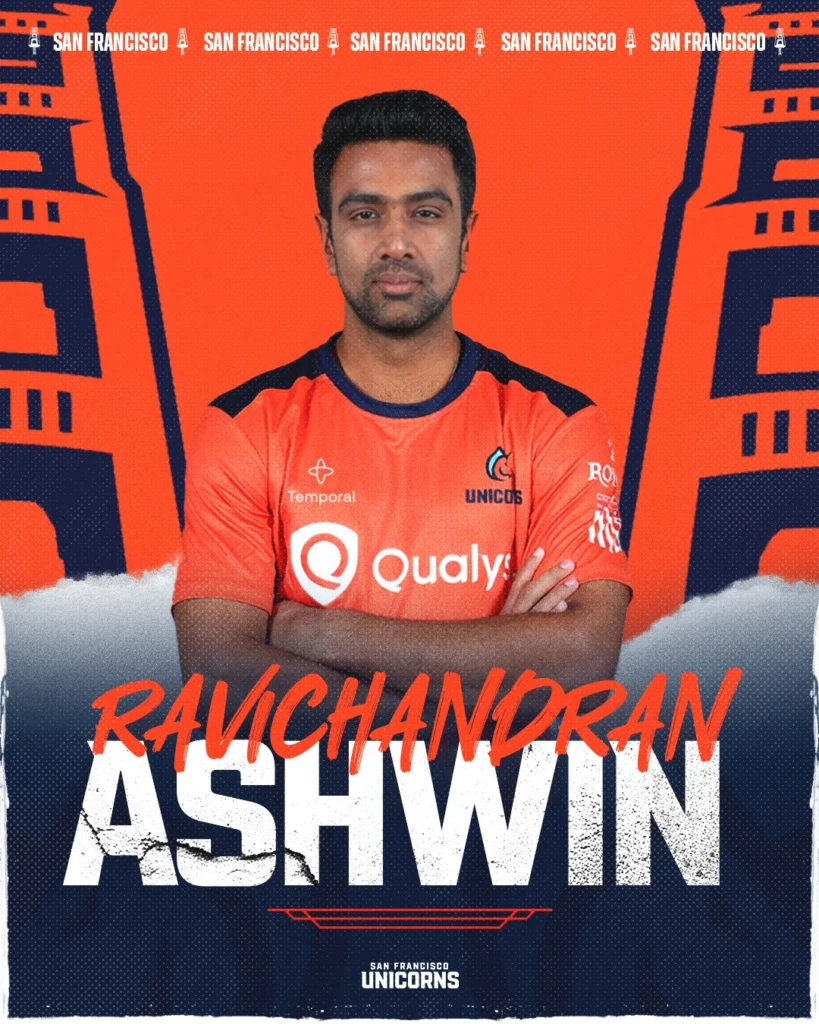
This is where the Unicorns’ partnerships stop being a line in a press release and start being the product. The franchise’s high-performance relationship with Cricket Victoria means the tool is being used, season after season, by professionals on the ground. And Rajaraman has steadily routed cricketing minds toward it. Anil Kumble, brought in by the franchise, has shaped the roadmap simply by describing what a coach actually looks for. This year, Ravichandran Ashwin (himself an engineer) will be a playing member of the squad — and, Misra notes, “Ashwin has already contributed to improving the product.” Each of those conversations is a piece of knowledge that no amount of computation can shortcut. “AI might be growing exponentially,” Rajaraman says, “but the acquisition of these learnings can only happen season after season.”
In other words: the algorithm can be copied. The two decades of cricketing instinct now being poured into it cannot. The same logic that made sabermetrics matter in baseball applies here, Misra argues — “everything you see is really athletes who are going out there and performing.” The data is downstream of the game, not the other way around.
The next innings
It would be easy to read Cricket Lens as a single team’s gadget. It is better understood as a marker — the point at which cricket’s long, halting flirtation with data crossed into something that can think alongside the people who play and watch the sport.
The Unicorns are betting on both halves of an idea that initially sound contradictory. They want an edge, and they have one: a culture of data their rivals haven’t matched, a tool already shaping drafts and in-game calls, and a moat made of accumulated cricketing knowledge that compounds with every season. And they are betting that the surest way to protect that edge is to keep moving faster than anyone can copy them — while letting the rest of the sport benefit in the bargain. “The goal is to elevate the sport,” as the conversation kept returning to: make the thinking sharper, the analysis richer, the game better, and capture whatever advantage you can while you’re out in front.
For a franchise that built its identity on betting early — on a head coach taking his first job, on young players before they became household names, on a name the league told them would never fly — putting cricket’s first real AI into the world feels entirely in character. The Unicorns approached a sport they barely knew from first principles and decided its future would be built like a startup. Cricket Lens is what that wager looks like when it ships.
Cricket Lens is currently available to the public in its consumer version: https://cricket-lens.sfunicorns.ai/