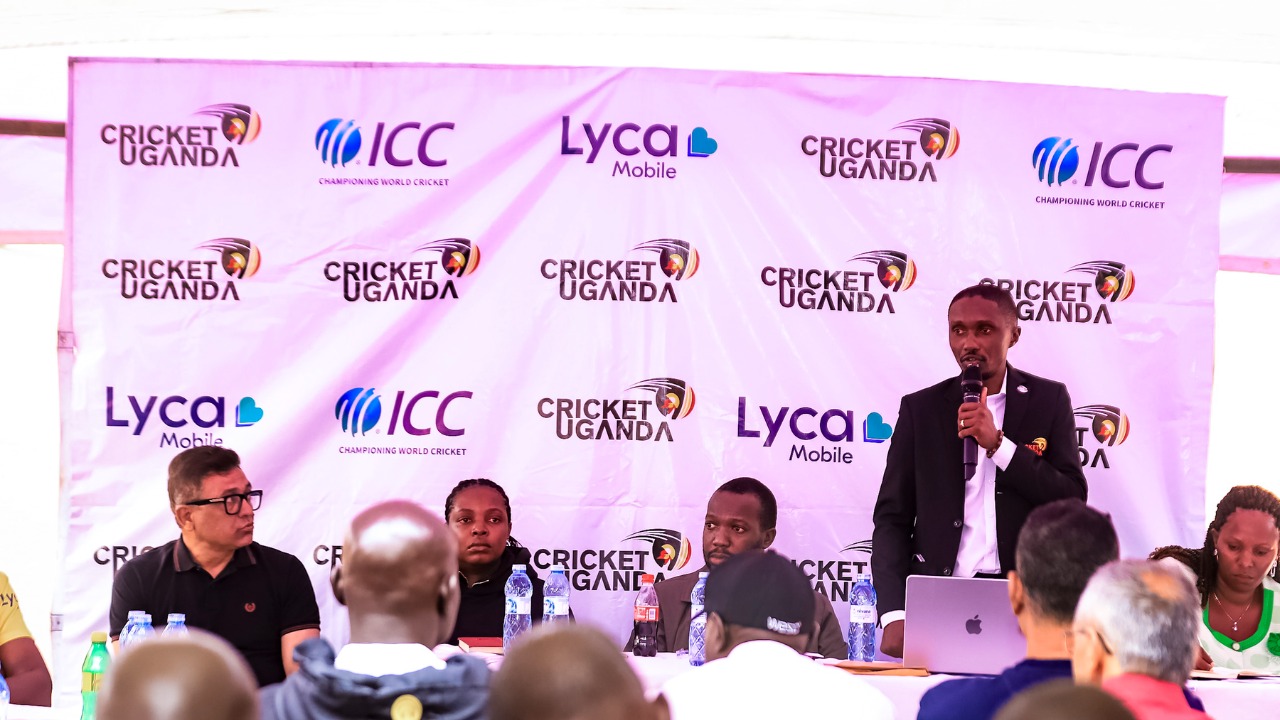
LUGOGO — Cricket Uganda officially adopted its new constitution during a Special General Meeting (SGM) held yesterday at the Uganda Olympic Committee (UOC) offices in Lugogo on Saturday,18th July.
The session, which ran from 2:00 PM to 5:00 PM, was fully constituted following a formal notice issued by Honorary Secretary Denis Musali.
The assembly took place under the watchful eye of National Council of Sports (NCS) official Sarah Chelangat, ensuring absolute alignment with the state’s regulatory expectations and compliance pathway.
A historic turning point for the meeting was the massive turnout of over 120 delegates representing District Sports Associations from all corners of the country.
Observing the unprecedented crowd, NCS official Sarah Chelangat remarked:
“I want to confirm that today I have seen a big, big, big delegation that attended the special general meeting. A total of 120 people attended the special general meeting which is really commendable. It has never happened for Cricket Uganda. I’ve attended several general meetings of Cricket Uganda where you find only eight clubs, which was contrary to the law.”
A New Era of Legal Compliance and Modernisation
The newly adopted Constitution formally establishes Cricket Uganda as the sole licensed and recognised national sports federation responsible for the governance, development, management, and regulation of the sport.
This framework effectively replaces the older governance model of the Uganda Cricket Association in strict accordance with the National Sports Act, Cap. 151 (2023) and the National Sports Regulations, 2025.
Reflecting on the structural shift, Cricket Uganda President Jackson Kavuma explained the regulatory necessity behind the SGM:
“This exercise was purely geared at us ratifying our leadership as required by National Council of Sports but also to try and have that nationwide coverage that they had requested us to try and address. The regulator had asked us to answer or respond to the four queries which were the voting rights of the members, its leadership, the national coverage and the issues of national disputes… Cricket has been a little bit stubborn I would say because we have been run by only eight member clubs… but at the end of the day cricket now has become a national sport.”
The Two-Tier Membership Model: Clubs & Regions
In an effort to transition from a purely club-centric model to a nationwide hybrid structure, the new constitution introduces a revolutionary Two-Tier Membership Model designed to balance elite cricket with grassroots expansion:
Tier 1: Full Member Clubs
The historic foundation of competitive cricket is preserved through the recognition of eight founding clubs: Africa Cricket Club (ACC), Jinja Association of Cricket Club (JACC), Kampala Institute of Cricket Club (KICC), Tornado Cricket Club (TCC), Tornado Bee Cricket Club (TBC), Nile Cricket Club (NCB), Premier Cricket Club (PCC), and Wanderers Cricket Club (WCC).
- Governance Weight: Each Full Member Club sends two delegates to the General Assembly, with each delegate carrying a vote (totalling 2 votes per club).
- Future Entrance: New clubs wishing to attain Full Member status must satisfy rigorous criteria, including 10 years of active cricket participation, legal registration, operational development programs, and a membership comprised of at least two-thirds Ugandan citizens or legal residents.
Tier 2: Regional Cricket Associations
To satisfy the geographical reach mandated by national law, five regional associations have been established: Central, Eastern, Northern, Western, and Southern.
The shift was highly commended by the NCS, with Chelangat noting:
“The sports act provides that the special general meeting or the general meeting must be addressed by Ugandans that come from all the districts of the country to prove that the sport is being played in those districts which is… cricket is on the right trajectory to achieving or aligning with the sports law.”
Executive Board Modernisation & Historic Regional Elections
The Executive Board undergoes a significant corporate overhaul, capping the number of voting directors at 15.
To reinforce transparency, the constitution introduces a four-year operational electoral cycle with a strict two-term limit, defined fiduciary duties, monthly board meetings, and rigorous conflict-of-interest standards.
First Regional Directors Elected
Putting the new constitution into immediate effect, the 5 Regional Cricket Associations selected their 2 voting representatives at the General Assembly, who in turn cast their votes to elect the first-ever Regional Directors to the Executive Board.
The history-making directors selected to represent the regions are:
- Marjorie Nankinga (Western Region): Representing Mityana District.
- Allan Ssemakula (Central Region): Representing Luweero District.
Following her election to the board, Marjorie Nankinga summarised her new strategic mandate:
“We are required by legislation to ensure that we have presence even on our regional levels… My role today is to make sure that on a strategic level we are able to support the regional on the game on the regional level and that includes all sorts of decisions including infrastructure, logistics, just to better the game of cricket. So our role today is to rally the rest of the regions to find all sorts of challenges to ascertain what we can do at whichever level, whether operational, whether strategic, to make sure that we’re taking the game forward.”
While Cricket Uganda acknowledges that implementation costs and administrative capacity building for the new regional and district structures will require substantial effort, the adoption represents an essential, modernised pathway.
President Kavuma expressed immense gratitude to the wide network of leaders who travelled from all corners of the country – including Kabale, Fort Portal, Maracha, and Yumbe – to formalise the transition, looking ahead to a broader, unified future.