
Hours before Major League Cricket crowned its champion, the people trying to build the American game gathered for lunch in Oakland. The setting was Eve’s Waterfront; the occasion was the second annual Cricket Impact Lunch, co-presented by the San Francisco Unicorns and the Seattle Orcas; and the mood, by design, had shifted from the year before.
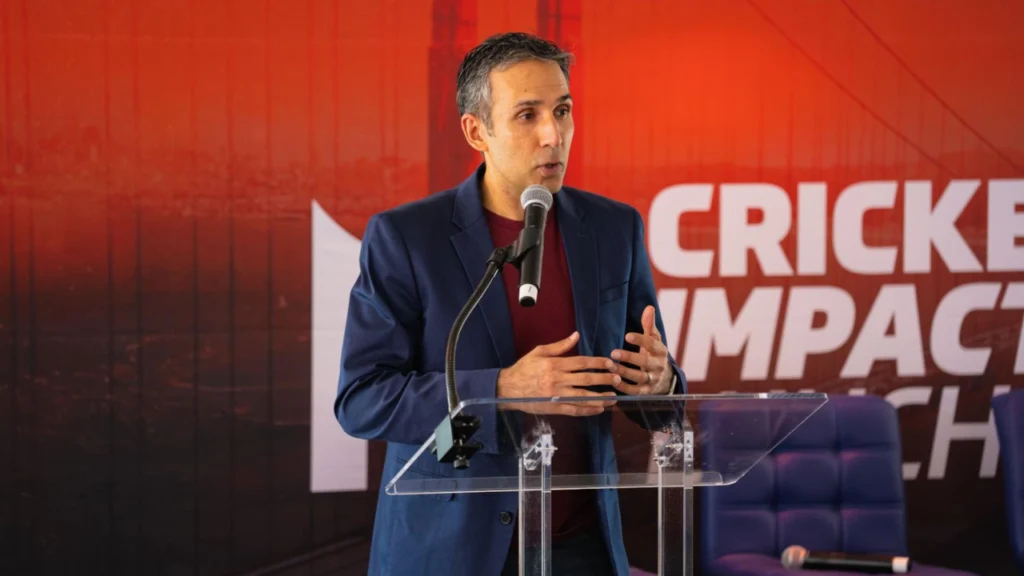
“Last year was about a question,” Adam Hall, chief executive of Cricket Impact Group, the day’s hosts, told the room — whether cricket, business, technology and investment could be pulled around one table and one ambition. This year, he argued, the answer was already visible in the partnerships and investment that had followed. “This year is not about potential,” he said. “It is about progress.”
And the afternoon’s clearest evidence of that came in what CIG chose to announce next.
The largest schools program in American history
Hall used the lunch to launch Cricket Impact Play, the largest schools cricket program in American history. The ambition is stated in round numbers: by 2031, the initiative aims to introduce 500,000 young people to cricket across 400 schools, beginning with a pilot in 2027 before scaling into major cities across North America.
The reasoning is the base-of-the-pyramid logic that underpins every serious sports-development play, and Hall made little attempt to dress it up. Without participation there is no pathway; without young people discovering the game there is no sustainable future. Growth, in other words, has a ceiling unless someone invests at the bottom.
What CIG is betting will make the difference is the removal of cost. Cricket Impact Play is designed to reach schools at no charge — not a dollar from a school budget or a family’s pocket — funded instead through corporate partnerships, with sponsors offered measurable data on participation, retention and student outcomes in every city. It is built to be a complete program rather than a one-off visit: teacher training, full equipment kits and curriculum resources, wrapped around a framework the organization calls “Play. Learn. Lead.” – which pairs the sport with structured lessons in confidence, teamwork, resilience and leadership.
The pitch, then, is not simply that more children will play cricket, but that cricket becomes a vehicle for the things schools already want — and that American cricket’s professional rise means little without a foundation beneath it. CIG is now courting founding partners for the first phase.

Legends, and the business of building a market
If Cricket Impact Play was the afternoon’s headline, the programming around it was built to make the case that the American game is worth investing in — starting with the people who have played it at the highest level.
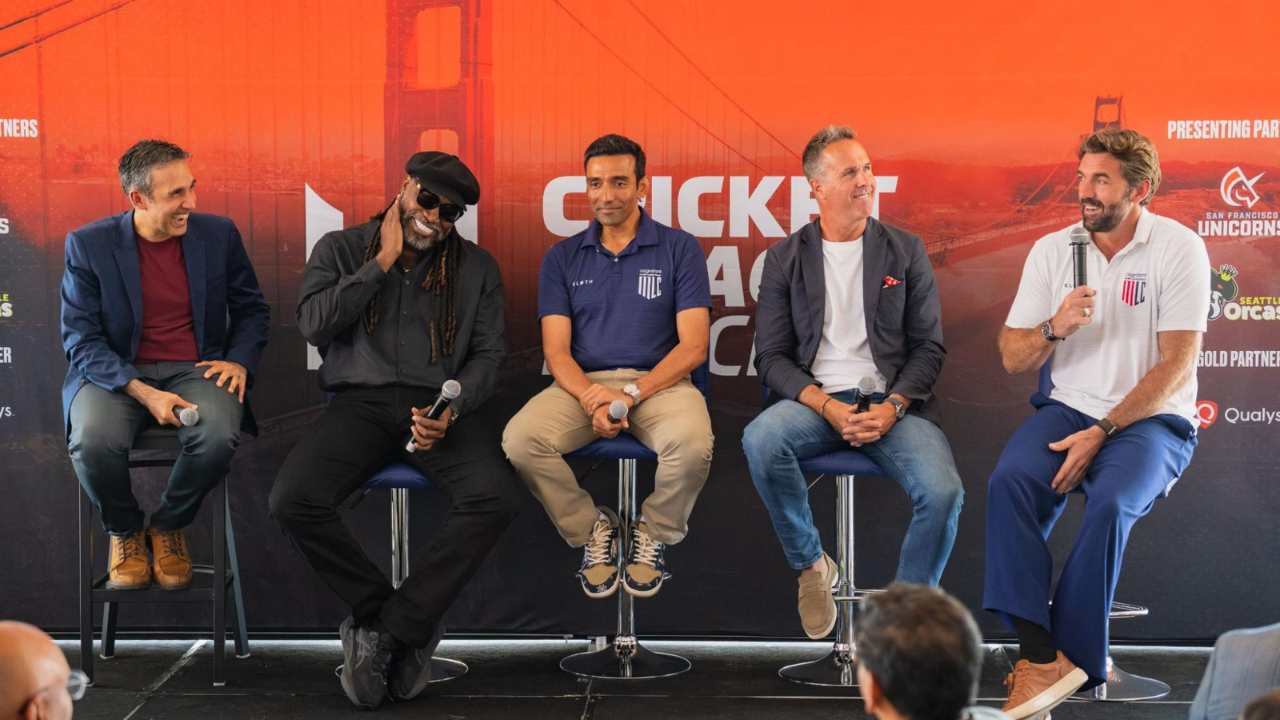
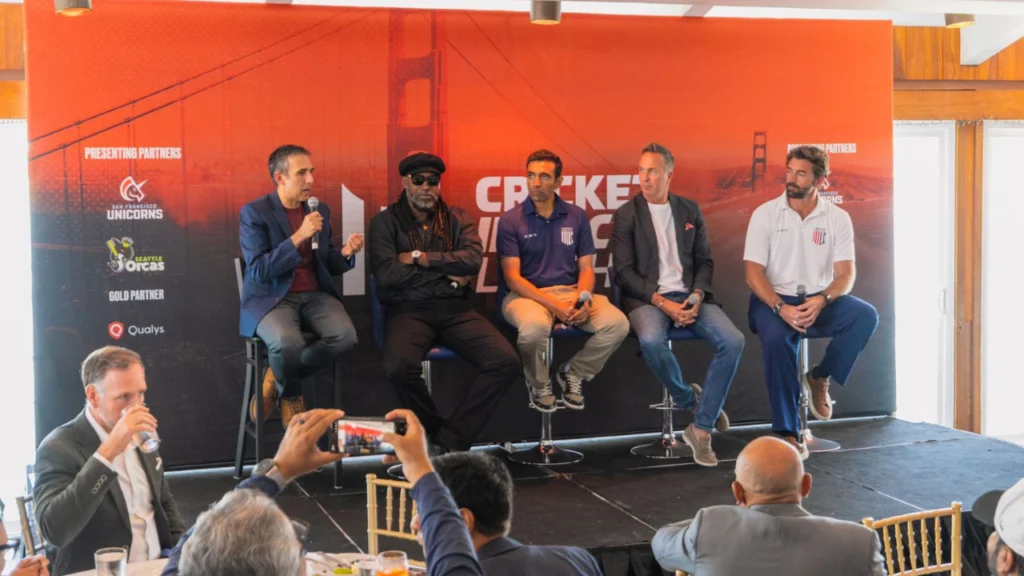
The first panel, moderated by Zee Zaidi, founder and publisher of cricexec, brought together a group whose careers span generations of international cricket: former England captain Michael Vaughan, West Indies great Chris Gayle, India’s Robin Uthappa and England World Cup winner Liam Plunkett. Their read on the American game carried some weight. Uthappa, who now commentates on MLC, and Vaughan, in the country for the first time, both came away impressed by the quality of the product on show.
But it was the storytelling that held the room. Uthappa and Gayle walked the audience through Gayle’s astonishing 175 not out in the 2013 IPL — the innings recounted from an unusual vantage point, since Uthappa was keeping wicket for the opposition that day and saw every blow from a few feet away. Plunkett spoke about what Vaughan was like as a captain; Vaughan, in turn, traced Plunkett’s development as a bowler. Plunkett and Uthappa traded memories of facing one another as young debutants in their national sides. Uthappa and Gayle reflected on the aggressive mindset they had adopted in the early, formative years of the IPL. And Vaughan returned to 2005, and England’s Ashes triumph — and the turnaround that followed a chastening defeat in the opening Test. Beneath the anecdotes ran the panel’s real subject: what it will actually take to make cricket mainstream in the United States.
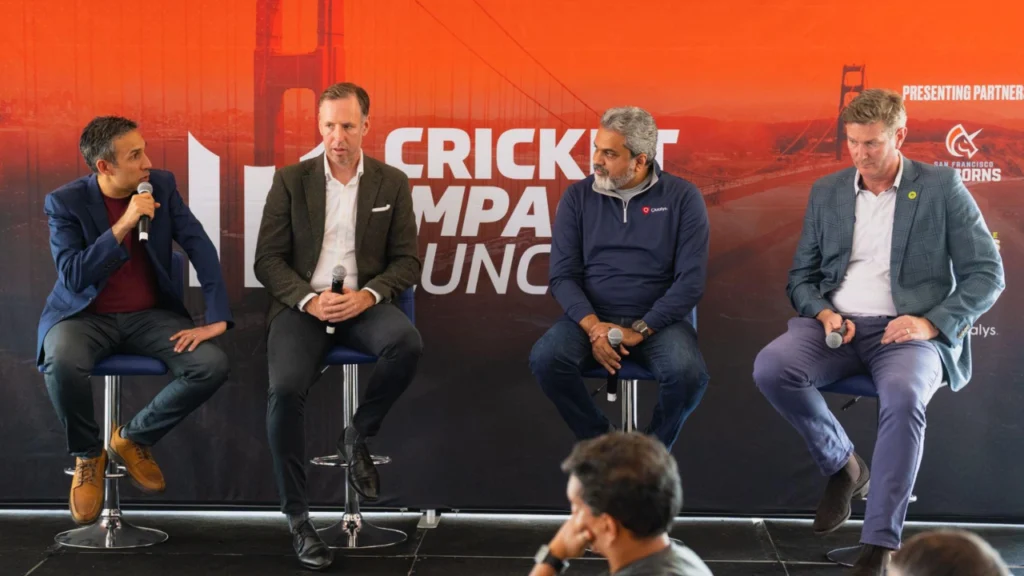
The second panel, also moderated by Zaidi, turned to the machinery. David White, chief executive of the San Francisco Unicorns, was joined by Sean Cary, his counterpart at the Seattle Orcas, and Sumedh Thakar, president and chief executive of cybersecurity firm Qualys — a Unicorns sponsor and the lunch’s gold partner.
Their starting point was that the product itself is no longer the problem. “Watching these games is no different than watching any ICC T20 game anywhere in the world,” White said. “It is top notch, top class.” Cary, three months into the Orcas job and fresh off his first MLC season, agreed the cricket on the pitch was as good as any in the world — and argued that the next evolution lies off it, in the fan experience: getting people into seats and suites, and converting a global audience into local supporters.
For Cary, that means going beyond cricket’s built-in South Asian following. In Seattle — “a very parochial sporting city,” in his description, with a Super Bowl-winning NFL franchise and a rising WNBA team — the Orcas are partnering with the local sports commission to cross-promote with established teams and get cricket in front of fans who have never seen it. Give an American sports fan a format built on big, repeated hitting, he suggested, and the game will do the rest. “We just need to get it in front of them.”
Sponsorship, everyone agreed, is the lifeblood of the sport in a market that does not yet have the television numbers to match. White described the Unicorns’ approach as deliberately bespoke — some partners want brand exposure, others hospitality, others business-to-business access — with the franchise building each deal around what the sponsor actually wants. Qualys, he noted, was a case of several layers at once.
Thakar offered the rarer view from the other side of that table. A lifelong cricket fan who had nonetheless never heard of MLC or the Unicorns until his own team pitched him, he described being won over in twenty minutes by something “completely unique.” His logic was less about sport than about differentiation. “If you do exactly what the other person did, the maximum you can do is what they did,” he said. “If you want to do something different, you have to really think different.” A small logo on a NASCAR car that nobody sees held little appeal; a ground-floor stake in a sport arriving in America was another matter.
His broader thesis doubled as an argument for the whole enterprise. Americans have not embraced cricket, he said, for one simple reason: “It’s not genetic. It’s just exposure.” Provide that exposure early, and the opportunity is enormous — and the way to do it, he argued, is to stop approaching the problem backwards. “Right now, we are thinking of bringing America to cricket,” he said. “I think the success is going to come when we bring cricket to America.”
Technology threaded through the conversation on the field as well as off it. Both franchises described leaning heavily on AI — the Unicorns on data and analytics for opposition scouting and player acquisition, the Orcas on operations. Cary said the club now runs “eight or nine AI agents working together simultaneously” across the MLC season, absorbing the roughly 80 percent of back-office time once swallowed by logistics and freeing staff to spend it on culture and players instead.
For all the talk of technology and sponsorship, both executives kept returning to community. White was blunt about the constraints of a young franchise — “We are a scrappy startup,” he said — and argued that a small organization grows only by working through the people around it. In the Unicorns’ case, that increasingly runs through the Unicorns Sports Foundation, whose head, Pradeep Nair, spoke at the lunch about its work.
A game for everyone, and an award for one pioneer
That foundation, White said, is “distinctly focused on women and girls” — a deliberate choice rooted in simple math. A game that reaches only men is capped at half its potential; the other half, he argued, is where the real growth lies. The Unicorns have backed the Bay Area organization Aspire for two years to get more girls playing; the Orcas, Cary said, see the women’s game as the single greatest upside in the country and are staging a women’s T20 exhibition to begin building a pathway. His framing was pointed, with an eye on 2028: “It would be embarrassing not to have the USA women’s team participating in the LA28 Olympics. So we need to start something now.”
The afternoon’s most personal moment belonged to the Orcas. Co-owner Sanjay Parthasarathy used the stage to announce the Soma Somasegar Legacy Award, established in memory of the franchise co-owner who recently passed away. The award, he explained, will recognize “individuals whose leadership, service and measurable impact advanced cricket in the United States, while embodying the passion, commitment and compassion that defined Soma’s life.”
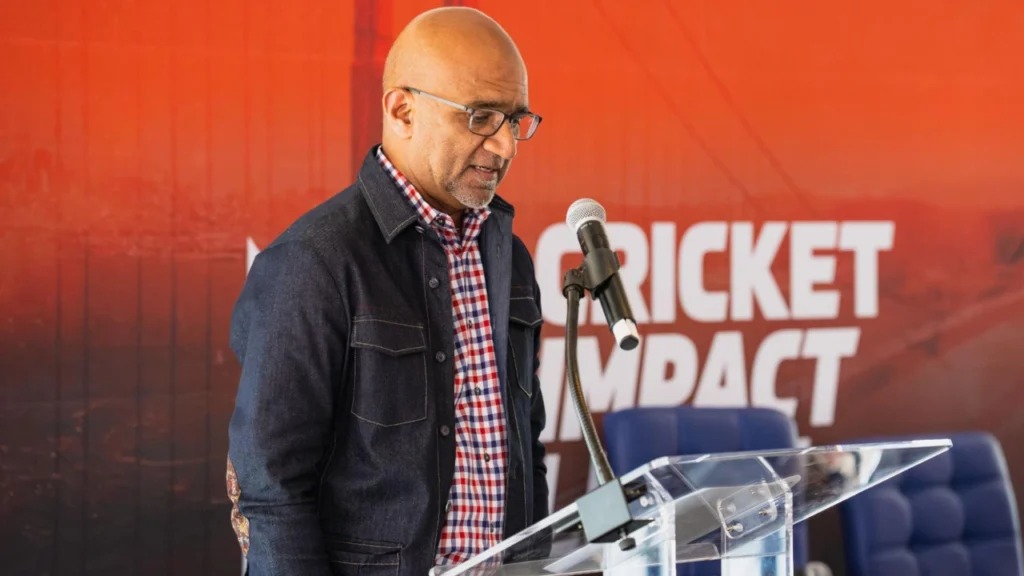
There is, deliberately, no first recipient yet; Parthasarathy said the Orcas wanted to build it “the right way,” announcing it now and hoping to name an inaugural honoree — someone who has helped grow cricket beyond the field of play — at next year’s lunch. In the years ahead, he said, he hopes the award will recognize people not only for their achievements but for the communities they build and the opportunities they create for others. “The passion, the belief, the community that we have for cricket in the USA,” he said, “is what’s going to sustain us in future.”
The window
It was a fitting note on which to gather a room like this one. Cricket returns to the Olympic program in Los Angeles in 2028; MLC has four seasons behind it; and the sport remains, globally, one of the most watched on earth while reaching almost none of the American schoolchildren who might one day carry it forward.
That gap is the opportunity Cricket Impact Group is trying to seize before the professional game outruns its own foundation. A league can be built quickly. A generation of players, fans and community leaders cannot. Cricket Impact Play — backed by the franchises, sponsors and legends who filled the room in Oakland — is a bet that the two can be built at once, and that the window to do it, with the Olympics on the horizon and cricket’s American moment finally arriving, will not stay open forever.


