A night India will never forget
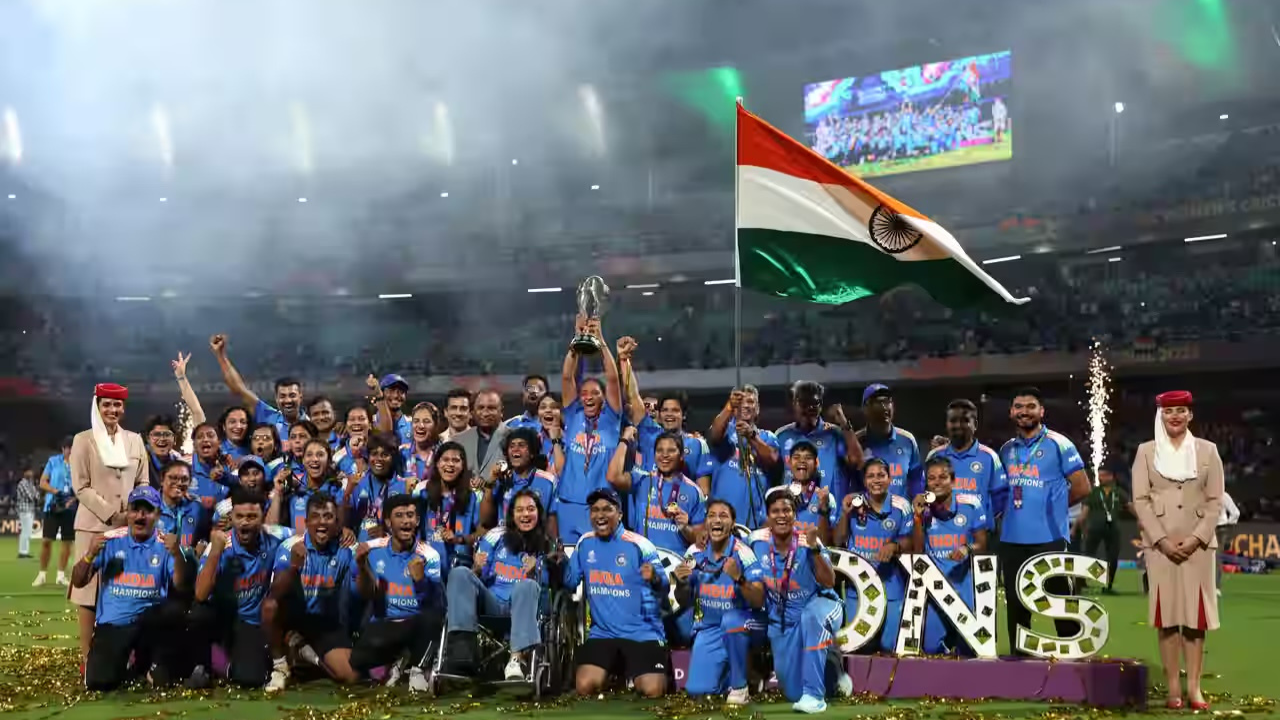
As the final delivery was bowled under the floodlights at DY Patil Stadium, Harmanpreet Kaur stood still for a moment. The crowd roared, teammates sprinted in, and tears came quickly. For India’s women’s team, this wasn’t just a victory — it was the culmination of years of heartbreak, rebuilding, and unshakable belief.
At the post-match press conference, Kaur reflected on the long road to this moment and her journey alongside vice-captain Smriti Mandhana.
“I’ve played many World Cups with her. Every time we lost, we went home heartbroken and stayed quiet for a few days. When we returned, we always said, ‘we have to start again from ball one’. It was heartbreaking because we played so many World Cups, reaching finals, semifinals, and sometimes not even that far. We were always thinking, when will we break this?”
They had come close before — most recently in 2017 — but this time felt different, even before the first ball.
“We felt we could win from the first ball itself,” Kaur said.
From self-belief to strategy: how India turned heartbreak into dominance
India’s confidence was forged not in dominance, but in adversity. After losing three matches in the group stage — including a crushing defeat to England — the campaign appeared to be slipping away. But inside the Indian camp, something shifted. What followed was a complete transformation, led by mindset and unity.
“Because the way our team was playing in the last three games, a lot of things changed for us, especially our self-belief. We knew what we could do as a team. It didn’t matter that we lost the toss. We knew there would be tough conditions for batting, but credit goes to Smriti and Shafali; they handled the first 10 overs very well,” said Kaur.
She credited the turning point to their mental preparation and the words of head coach Amol Muzumdar, whose calm but firm guidance reshaped their approach after the England loss.
“The last month has been very interesting. It’s very rare that things don’t go according to your plan, and yet you stay so positive. After losing the England match, we were really heartbroken. Sir said that night, ‘You can’t make the same mistakes again and again. You have to cross that line.’ After that day, a lot changed for us. We started visualization and meditation. Everyone took it seriously and started enjoying it. That showed we were here for something, and this time we had to do it,” Kaur continued.
The transformation wasn’t only tactical — it was structural. For years, India had cycled through coaches with little continuity. Muzumdar changed that.
“His contribution in the last two and a half years has been amazing. Before that, coaches were changing frequently; we didn’t know how to bring things forward. But after Sir came, everything became stable and smooth. He gets a lot of credit for building this team,” Kaur added.
Injuries, tears, and a team that held together
India’s title run wasn’t without setbacks. The squad endured critical injuries at crucial moments — first to Yastika Bhatia in training camp, then to the in-form Pratika Rawal midway through the tournament. For most teams, these would have been major blows. For India, they became moments of collective strength.
“I think it’s all destiny, I really believe in that. And we didn’t want Pratika to face any such thing. When she got injured, everybody was crying. Even before that, when Yastika [Bhatia] got injured during our training camp, everybody was crying because this team is very special. They pray for each other. They stay together in ups and downs,” Kaur said.
Pratika’s injury opened the door for Shafali Verma — left out at the start of the tournament — to return. Her inclusion could have created tension. Instead, the team embraced her with open arms.
“But when Shafali came, we didn’t want her to feel that she came in under an injury cloud. Even Pratika was so positive. I think everyone took everything positively. They didn’t think, ‘Why is this happening to us?’”
That unity translated to the field. Even during South Africa’s threatening chase, the captain’s message was steady and clear.
“I was just telling them, keep faith. We’ve worked really hard for this. Opportunities will come, and we have to grab them. ODI cricket is long, there are many phases you have to tick off again and again. When we went in, we thought we just need 10 good balls, 10 wickets, and that’s exactly what happened,” Kaur told reporters.
For those who walked before them
This win wasn’t just for the present squad — it was for every Indian woman who had worn the jersey before. Kaur made it a point to include past legends in the celebrations, and she credited them for shaping her path.
“Jhulan [Goswami] Di was my biggest support. When I joined the team, she was leading it. She always supported me in my early days when I was very raw. In the initial days, Anjum [Chopra] supported me a lot. I learnt a lot from her and passed it on to my team. I’m very grateful that I got to share a special moment with them.”
This was more than a title — it was validation for years of near-misses, quiet progress, and the hope that one day India would arrive.
“We’ve been talking about this for many years, we’ve been playing good cricket, but we had to win one big tournament. Without that, we couldn’t talk about change. We were waiting badly for this moment, and today we got a chance to live it,” Kaur said.
In fact, the switch of venue from Bengaluru to DY Patil Stadium in Mumbai gave the squad a sense of destiny.
“As soon as we got to know that our venue had been changed to DY Patil Stadium, we all got so happy because we’ve always played good cricket there. The biggest thing is the crowd, it’s always so supportive. So, when the venue changed from Bangalore, we all started messaging in the group. We were manifesting. We said, ‘the final is going to be there, we won’t leave it now.’ As soon as we reached Mumbai, we said, ‘We’ve come home now, and we’ll start fresh.’ We didn’t want to look back at previous World Cups, we left them there. The new World Cup had just started,” Kaur added.
Delivering when it mattered most
India’s innings in the final was a showcase of intent and control. The batting group knew they couldn’t afford to overthink the situation — they just had to play their game and build pressure, ball by ball.
“Our aim was simple – we knew that if we thought of a big target, we would come under pressure. The main thing was to keep batting and keep playing our game. We tried to score 300 runs on the board; we were one run short. But after that, I think we came onto the field as a strong unit. Whenever we needed it, we got a breakthrough. It was a very good match. It seems easy to say now, but there was a lot of tension in between when they were batting. Laura (Wolvaardt) barely gave us a chance,” Kaur said.
That tension didn’t rattle the team. They trusted their core strength — spin bowling — to tilt the match in their favor.
“We knew our spinners have always been our biggest strength. As soon as Deepti (Sharma) and Shree Charani came, we would start getting wickets. When we went in, we thought we just needed 10 good balls. We just need 10 wickets. Don’t look at the scoreboard, because if you do, you’ll feel pressure. Just think — we have to deliver 10 good balls, take 10 wickets, and the job is done. And that’s exactly what happened. We focused on wickets. We knew there would be partnerships — they have also come to play hard cricket — but we would only look for wickets. And as the wickets came, we kept talking — three more to go, two more, one more— and kept believing.”
Tears, numbness, and the mindset of champions
The moment the final wicket fell, emotion flooded the field. The crowd erupted. Players cried. For Harmanpreet Kaur, the weight of history and years of waiting finally gave way to something almost indescribable.
“I’m just trying to express what I’m feeling. I’m numb, I’m not able to understand,” she admitted.
But beneath the emotion was a steel thread of focus — one that had run through the squad all tournament.
“So, it’s just that there were ups and downs, but the team had self-belief. I’ve been saying this since day one. We weren’t looking to the left or right. We were only looking at our main end goal.”
The pain of past tournaments, especially the England loss earlier in this campaign, became a trigger for change.
Reflecting on the internal change that took place after the England match, Kaur emphasized the mental shift that reshaped their campaign:
“The last month has been very interesting. It’s very rare that things don’t go according to your plan, and yet you stay so positive. After that day [the loss against England], a lot changed for us. Every time, we cannot go on repeating the same things. We had to come with a strong mind,” Harmanpreet Kaur added at the post-match press conference.
“The last month has been very interesting. It’s very rare that things don’t go according to your plan, and yet you stay so positive. After that day [the loss against England], a lot changed for us. Every time, we cannot go on repeating the same things. We had to come with a strong mind.”
That night had a permanent impact.
“That night changed a lot for us. It had an impact on everyone. We were more prepared for the World Cup. We started visualisation and meditation. That showed we were here for something, and this time we had to do it.”
And after everything, as the trophy finally came home, Kaur spoke simply:
“We’ve been waiting for this moment. The celebration will go on all night. And then let’s see what BCCI is planning for us,” Kaur stated.
Recognition, rewards, and a grateful nation
As the celebrations unfolded, the Board of Control for Cricket in India moved quickly to announce its own gesture of gratitude — independent of ICC prize money.
“Definitely, we have to thank Jay Shah, who is the chair of ICC, because just one month prior to this tournament, they increased the prize money of the ICC Women’s World Cup. That is, there is an upshot of about 300 per cent of the prize money,” BCCI secretary Devajit Saikia said, while speaking to ANI.
“That is for the teams to receive it, but as a wonderful performance today in DY Patil Stadium when they have defeated South Africa to win the championship, BCCI is elated and without touching anything from the ICC’s kitty, BCCI on its own is going to pay as a reward of 51 crores to the Indian team, that amount will go to the players, the selectors as well as the support staff headed by Amol Muzumdar,” Saikia added.
The BCCI, according to a Sportstar report, received a formal invitation from the Prime Minister’s Office following the final, with the players expected to travel from Mumbai to New Delhi to meet Prime Minister Narendra Modi before returning to their respective homes.
While fans flooded the streets of Mumbai and other cities, there was still uncertainty around an official victory parade.
“Nothing like a victory parade is planned as of now. I’m leaving for Dubai to attend the ICC meeting. Several officials are heading there as well, so once we return, we will plan accordingly,” Saikia told IANS
Still, the pride and gratitude flowed in waves. Nita Ambani, who embraced Harmanpreet Kaur on the field after the final, offered her own emotional tribute:
“At the stroke of midnight, our girls have won the first ever ICC World Championship. I think you have made the whole nation swell with pride, the way you have played with courage, conviction and confidence. We are all so proud of you and I want to say thank you, thank you, dhanyavad and Jai Hind,” Nita Ambani, in a video shared by Reliance Foundation on X.
Mrs. Nita M Ambani: Our girls have made the whole nation swell with pride
Mrs. Nita M. Ambani, who was in attendance and cheering for the Indian women’s cricket team as they scripted history by winning their first ever World Cup in Navi Mumbai, congratulated and thanked the team… pic.twitter.com/YvAemdg7pe
— Reliance Foundation (@ril_foundation) November 3, 2025
A chorus of admiration: from icons to the Prime Minister
India’s win ignited responses across the cricketing world — from legends, teammates, and national leaders alike. Former India opener and current men’s team head coach Gautam Gambhir led the chorus with a message about legacy on X.
“You have not just created history, you’ve created a legacy that will inspire generations of girls!”
You have not just created history, you’ve created a legacy that will inspire generations of girls! #LegendsForever 🇮🇳🇮🇳🇮🇳 pic.twitter.com/51k29fIAO4
— Gautam Gambhir (@GautamGambhir) November 3, 2025
Ravichandran Ashwin praised the team and its leadership:
“Congratulations @BCCIWomen, that was one hell of a campaign. Well done to the girls and the entire support staff led by @amolmuzumdar11.”
Congratulations @BCCIWomen , that was one hell of a campaign.
Well done to the girls and the entire support staff led by @amolmuzumdar11 👏
— Ashwin 🇮🇳 (@ashwinravi99) November 2, 2025
Irfan Pathan singled out key performers:
Many congratulations to @BCCIWomen for winning the World Cup. Brilliant play. Deepti Sharma, what a player you are. Shafali, well done.”
Many congratulations to @BCCIWomen for winning the World Cup. Brilliant play. Deepti sharma what a player you are. Shafali well done 👏
— Irfan Pathan (@IrfanPathan) November 2, 2025
Virat Kohli captured the spirit of national pride, posting on Instagram:
“The girls have created history, and I could not be prouder as an Indian to see the hard work of so many years come to life finally. They deserve all the applause and a big congratulations to Harman and the whole team for achieving this historic feat. Also congratulations to the whole squad and the management for the work behind the scenes. Well done india. Enjoy the moment to the fullest. This will inspire generations of girls to take up the sport in our country. Jai hind.”
And Prime Minister Narendra Modi, speaking at a public event in Saharsa, Bihar, offered praise that reflected the scale of the moment:
“Yesterday in Mumbai, India’s daughters have created history. India has won the Women’s Cricket World Cup for the first time. After 25 years, the world has got a new world champion, and India’s daughters have given this pride to the entire nation. This victory isn’t just limited to the sports field. It’s also a symbol of India’s daughters’ newfound confidence,” Modi said.
“These are daughters from small villages and towns; these are daughters of our farmers, labourers, and lower middle-class families. I’m proud of them; the entire nation is proud. I also extend my heartfelt congratulations to the parents of these champion daughters,” he added.
Ashwin later reflected on the social impact of the win:
“I would truly rate this as an even bigger and more colossal achievement than any other World Cup that we have won, because it inspires girls to play the game and consider the sport as a career option.”
The coach behind the calm: Amol Muzumdar’s moment of redemption
As the confetti settled at DY Patil, one man stood quietly at the edge of the celebrations — Amol Muzumdar. For years, he was a name associated with unfulfilled promise, having scored more than 11,000 first-class runs without ever playing for India. But on this night, he had helped script something even bigger.
“I’m speechless. Absolutely proud. They deserve every bit of this moment,” Muzumdar said after the win.
He knew how far they had come.
“The hard work, the belief — they’ve made every Indian proud.”
Throughout the tournament, Muzumdar had emphasized resolve over regret.
“We never let early setbacks define us.”
And he knew exactly what had shifted to turn India’s campaign around.
“We dominated most matches but just needed to finish better. Once we did that, there was no looking back.”
It wasn’t about skill — it was about belief.
“We weren’t losing because we were poor — we were losing because we had forgotten how close we were to winning.”
His role, as he saw it, was to remind the players what they already had.
“They had the talent; they just needed to rediscover the purpose.”
Even after three straight losses in the league stage, he and Harmanpreet kept the team focused.
“Losing three games in a row with narrow margins dented our morale. But Harman and I knew we were inches away from something special.”
Before the players walked onto the field for the final, Muzumdar gathered them in the dressing room and delivered a message that echoed like a script from destiny:
“Seven hours we cut out all the noise. We cut them out of our lives; we create our own bubble here. Seven hours create our own bubble, and we step into it, and we finish that, and we write our own story, no more stories from the outside. We write our own story. You will write your own story. Let’s stay in that bubble for the next seven hours. Let’s create history,” Amol Muzumdar said while speaking in ICC video.
Before the final, Muzumdar gathered the squad at DY Patil and gave them one task:
“Close your eyes. Imagine what it will look like, what it will feel like.”
When the moment finally came, it felt exactly as they had envisioned — and more.
“This is a watershed moment for Indian cricket.”
He made sure to clarify what made it special:
“It’s not just about winning a trophy; it’s about the evolution of our game. This team has shown the world what Indian women’s cricket can be.”
And with that, India’s women didn’t just lift a trophy — they lifted the sport itself into a bold new era.