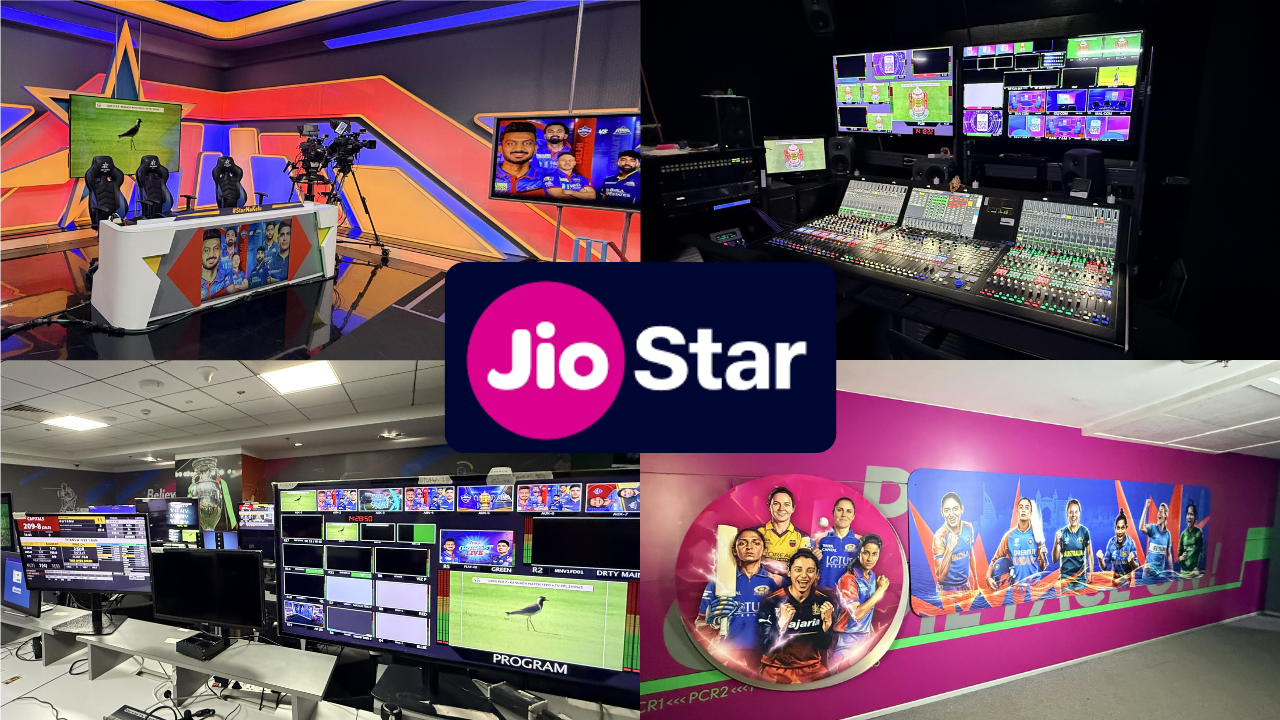
One of the first things Prashant Khanna brings up, walking through JioStar’s Mumbai broadcast headquarters, is the global reach.
“This facility is connected to all major cricket stadiums in the world,” he says: the West Indies, the United States, the United Kingdom, the UAE, and Southeast Asia. From a single building, his team can originate match production for cricket being played almost anywhere.
In 2024, the facility produced the ICC Men’s T20 World Cup in nine languages out of Mumbai, while the tournament itself was staged across the United States and the West Indies.
Khanna is JioStar‘s Head of Sports and Live Experiences – Production Services and Production Technology. Before the November 2024 merger, he led production technology at Disney Star and founded the company’s broadcast R&D unit, Star Lab.
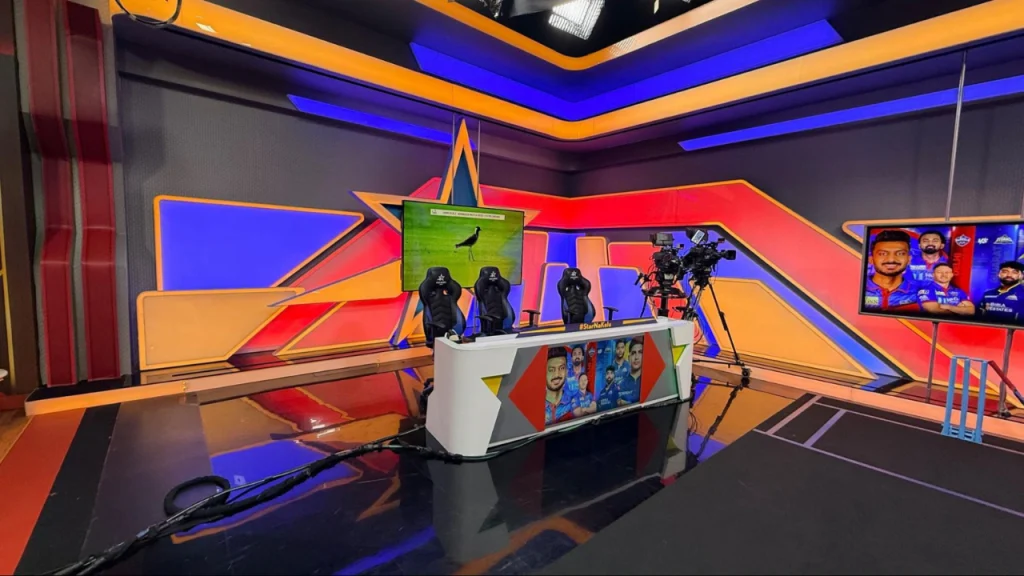
The facility he is walking us through — one of two main JioStar broadcast headquarters in Mumbai’s Lower Parel neighbourhood — operates at a scale that has no parallel in cricket and perhaps not in global sports broadcasting overall. There are twenty production studios, twenty control rooms, and more than fifteen smaller studios and commentary booths across both facilities.
From this single building, JioStar produces half of its twenty-five-plus feeds in twelve-plus languages, including vertical formats and a sign-language descriptive commentary feed. This is not for one tournament a year, but as routine.
Khanna describes the operation as “a mini IBC compared to a FIFA World Cup or the Olympics” — a reference to the temporary ‘International Broadcast Centre’ built for such events. The difference here is that this IBC is permanent, and runs cricket and other sports like kabaddi and football in multiple languages.

No Off-Season
Most major sports broadcast operations are built around a peak. The Olympics arrive every four years. The World Cup is quadrennial. The Super Bowl, for all its scale, ends in a day.
JioStar’s Mumbai operation has no such relief.
The IPL lasts roughly nine weeks. JioStar produces it at IBC scale for all sixty-five-plus days, then often an ICC event in the same year, followed by international and domestic cricket, and then the next IPL. The cycle resets every year. The tournaments change, but the tempo does not.
That schedule has shaped how the buildings are used and constantly reconfigured.
“All of our international counterparts change their studios every few years,” Khanna says.
“We change ours many times a year — in both design and output.”
Three weeks before this year’s IPL, the same studios were dressed for a World Cup. Soon after the IPL final, several will be redressed again for the ICC Women’s T20 World Cup.
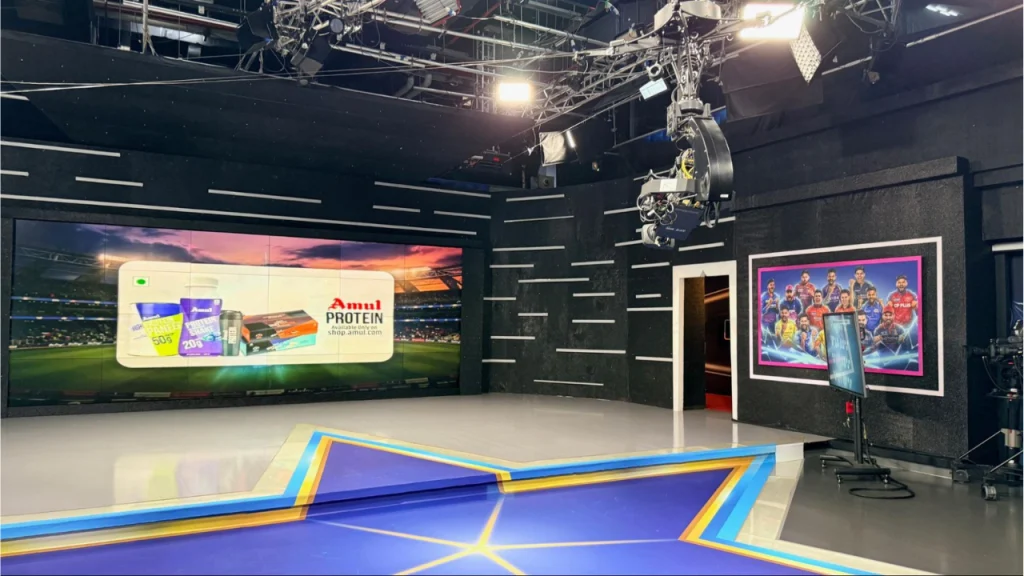
The set walls remain; almost everything else — lighting, graphics, and branding changes per tournament, per language, and per audience.
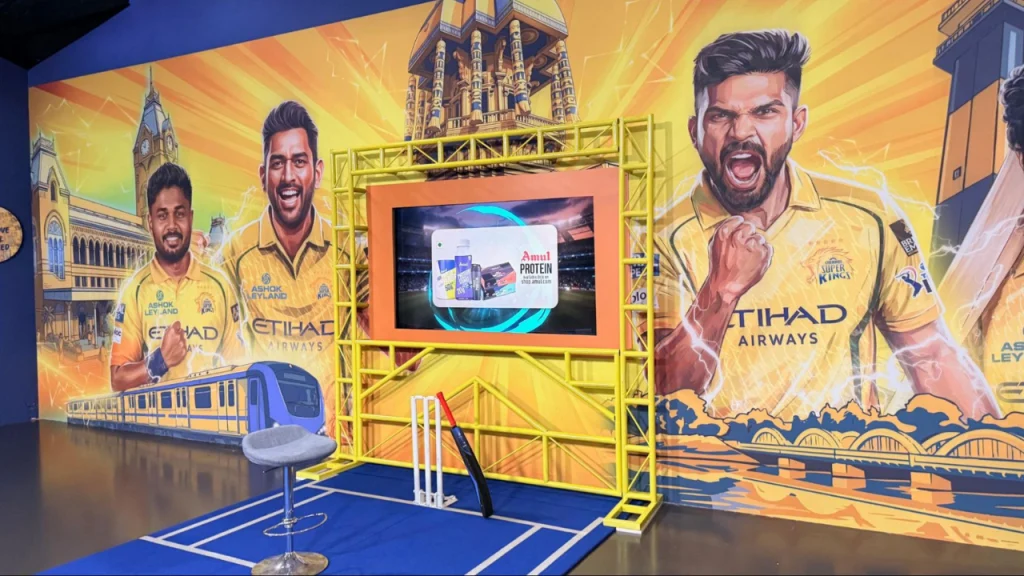
The Telugu-language studio leans into orange for Sunrisers Hyderabad. The Tamil studio reflects Chennai Super Kings. This is not incidental — it is editorial differentiation, not localisation.
Beyond Translation
The most consequential thing JioStar produces is not a feed — it is twelve-plus distinct ways of telling the same match.
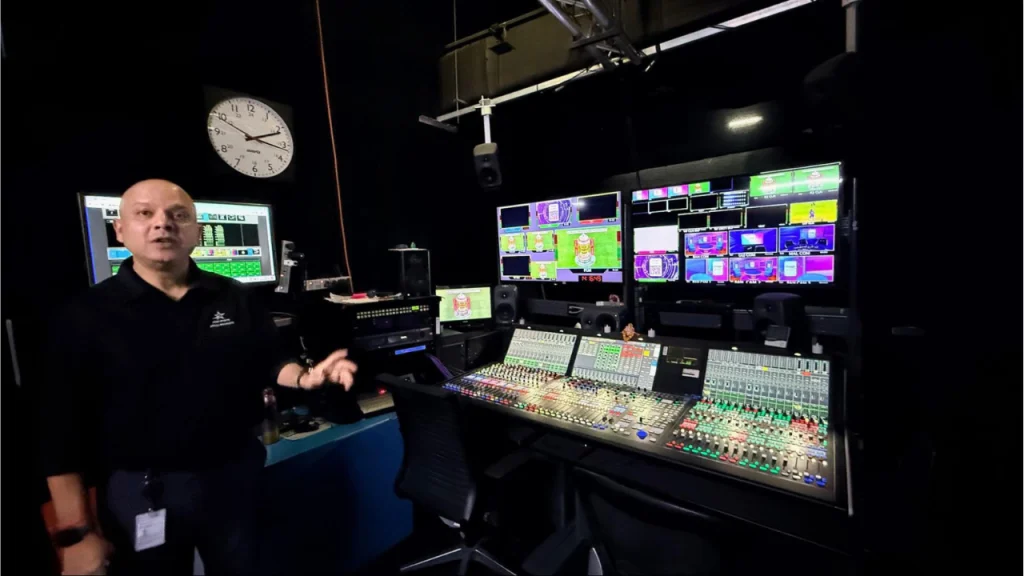
Audio is mixed in a Dolby Atmos production room where every microphone from the venue is brought back independently and remixed per language.
“English is levelled for an international audience. Hindi is more cinematic. Tamil and Telugu are equally elevated for their audiences,” Khanna says.
Each language does not just sound different. It experiences the match differently.
The visuals follow the same principle. Graphics, narratives, and break content are built separately for each language, not translated.
“A Hindi feed will be very different from an English feed during a break,” Khanna says.
This output is driven by editorial teams across language groups, supported by dozens of Vizrt graphics engines, making JioStar one of the largest Vizrt customers in India.
Not to mention: the total daily headcount across the facility, partner sites, and venues hits roughly eleven hundred during a major event. That includes more than a hundred and twenty commentators across the language roster, which is unparalleled scale in broadcasting.
The Technology Stack
JioStar was one of the first sports broadcasters in Asia to deploy Unreal Engine into live cricket production, going live in 2019.
Studios and broadcast workflows feature cutting-edge innovation, both on-platform and off-platform. Innovation remains central to the operation, subtly evolving to enhance how fans experience every event.
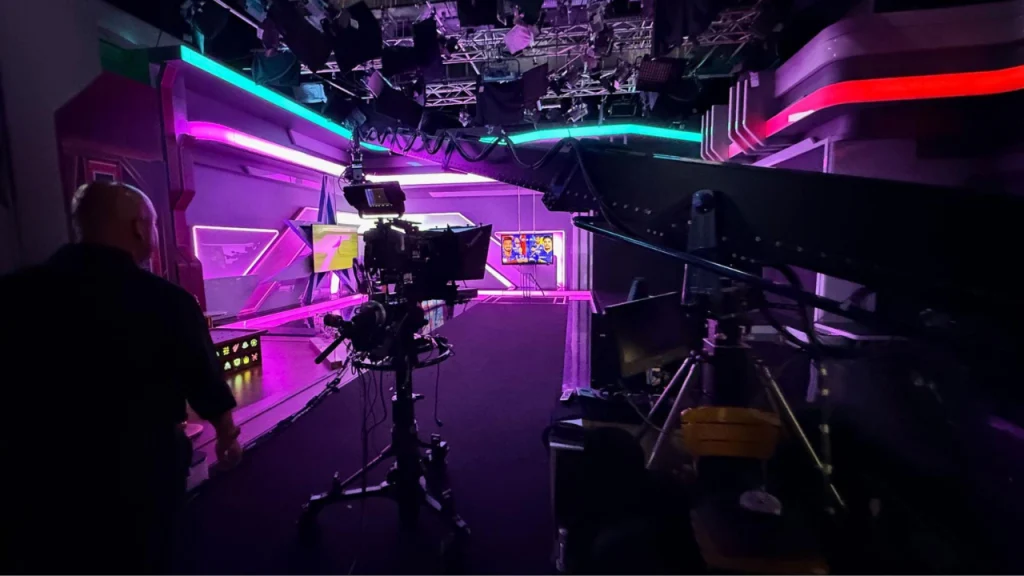
Virtual environments including the Star studios set next to a CG Empire State Building, the London Bridge backdrop, and a virtual Sydney Opera House — are rendered live, with real-time weather tracking and accurate shadow movement.
The studios also incorporate mixed-reality environments, an indoor spider cam, and Hawkeye data integrated directly into studio analysis.
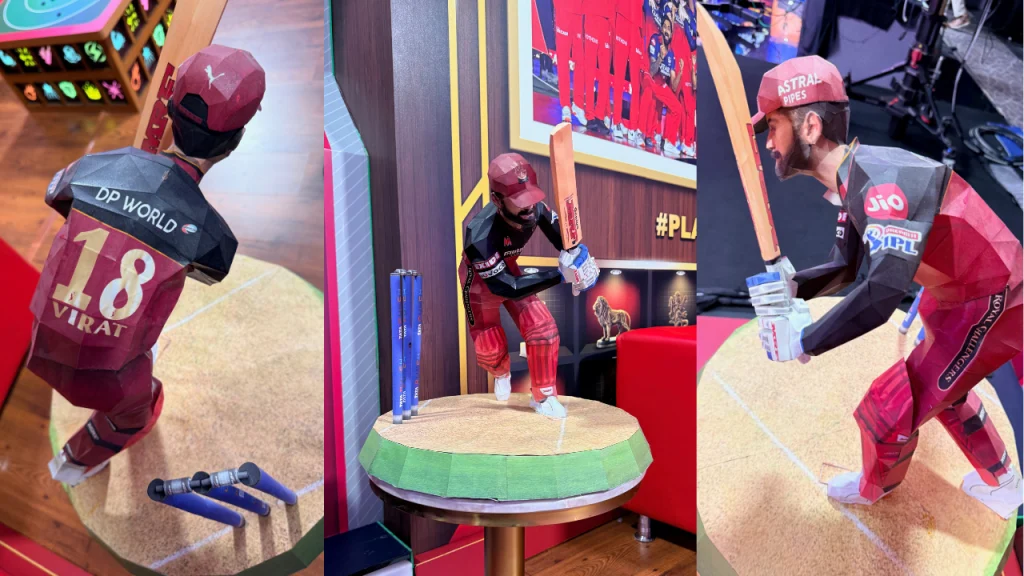
Alongside this sits something more tactile — a Mumbai-based artisan creating intricate paper-crafted set elements, including a Virat Kohli figure. Both digital and handmade elements coexist within the same production language.
Lighting across the studios is film-grade, with each fixture controllable across a wide colour range through an iPad-based system. LED walls replace static graphics, allowing rapid visual changes across shows.
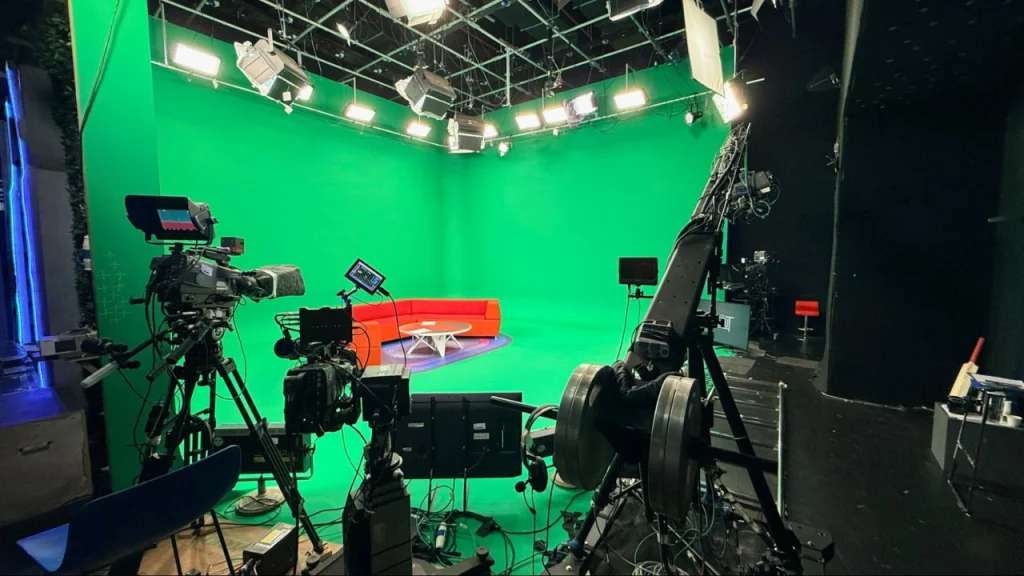
In green-screen studios, a green-on-green script projection system allows presenters to read prompts invisible to the viewer — a small detail with significant operational impact.
Four Milliseconds of Latency
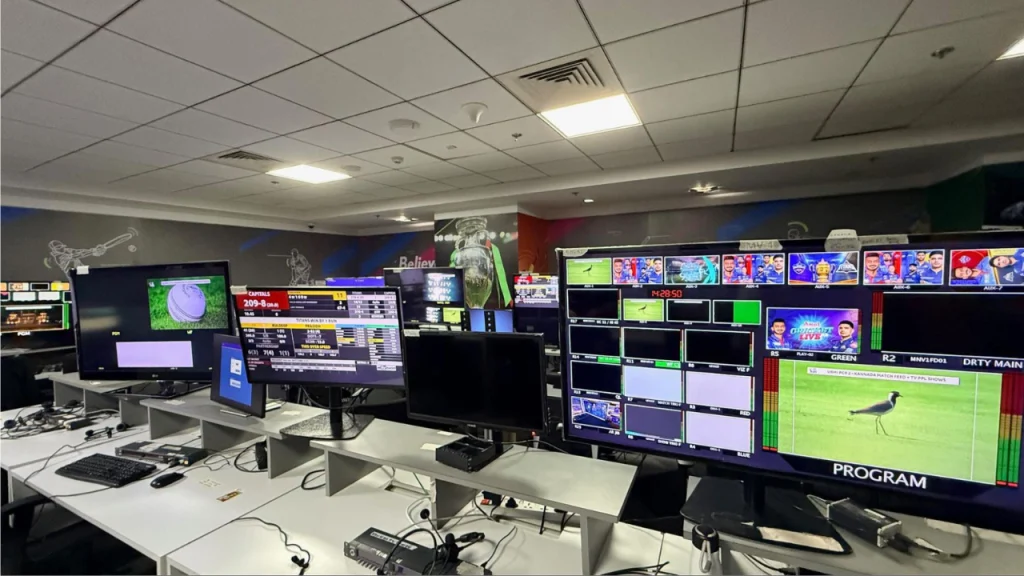
Inside master control, the delay between a ball being released and appearing on a monitor in Mumbai is roughly four milliseconds – staggeringly quick.
At times, this has been faster than event host broadcasters of a tournament.
This latency enables remote commentary to function as if it were on-site. Commentary booths in Mumbai mirror venue conditions, allowing commentators to call matches happening anywhere in the world in real time.
In effect, JioStar has separated where the match is played from where it is produced.
The bowler is in New York, in Bridgetown, in Dubai, or in Lauderhill. The producer is in Mumbai. The four-millisecond figure is what makes that decoupling editorially viable. By the time the picture has reached the producer’s monitor, it is, for all practical purposes, simultaneous with the moment of release.
On the Floor
The character of the facility emerges between rooms.
A live social listening system feeds real-time audience sentiment into editorial decisions. Replay operators, graphics teams, Hawkeye systems, and language-specific editorial units operate side by side.
Talent collaborates with analysts moments before going on air, building insights from live data and replays.
Pre-production teams begin early in the day. Live production ramps up by evening. Broadcast runs past midnight. Then the cycle repeats — often for nine consecutive weeks during the IPL.
JioStar also produces studio programming for ESPNcricinfo, with talent including Ambati Rayudu, Faf du Plessis, Dale Steyn, Cheteshwar Pujara, and Anil Kumble.
Underwriting all of it is a foundational editorial principle Khanna returned to more than once during the tour. “The fan should never have to come to us. We will go to the fan at any point in time, make it as frictionless as possible,” he said.
“Today, we deliver to devices ranging from a five thousand rupee phone to a one lakh fifty thousand rupee phone. You can imagine the number of bit rates that actually go into that to make sure the match is visible across those platforms.”
MWeb, mobile, connected TV, linear DTH, linear cable — each platform receives its own encoding profile. Every match is engineered for every device, in every language, simultaneously. All of it is engineered upstream, in Mumbai.
The Center of Gravity
To talk about cricket broadcasting today is increasingly to talk about Mumbai — and within it, this facility.
Hindi, English, Tamil, Telugu, Kannada, Malayalam, Bengali, Marathi, Gujarati. Sign-language descriptive commentary. Multiple formats. Hundreds of events each year.
This is the result of over a decade of sustained investment and operational learning.
We asked Khanna how the operation feels at full scale.
He paused.
“Orchestrated chaos,” he said – capturing both the magnitude of its undertakings as well as the scale of coordination and planning needed to achieve all of this this.
For most of global sport, IBC-scale broadcasting is temporary.
JioStar built it — and never turned it off.