
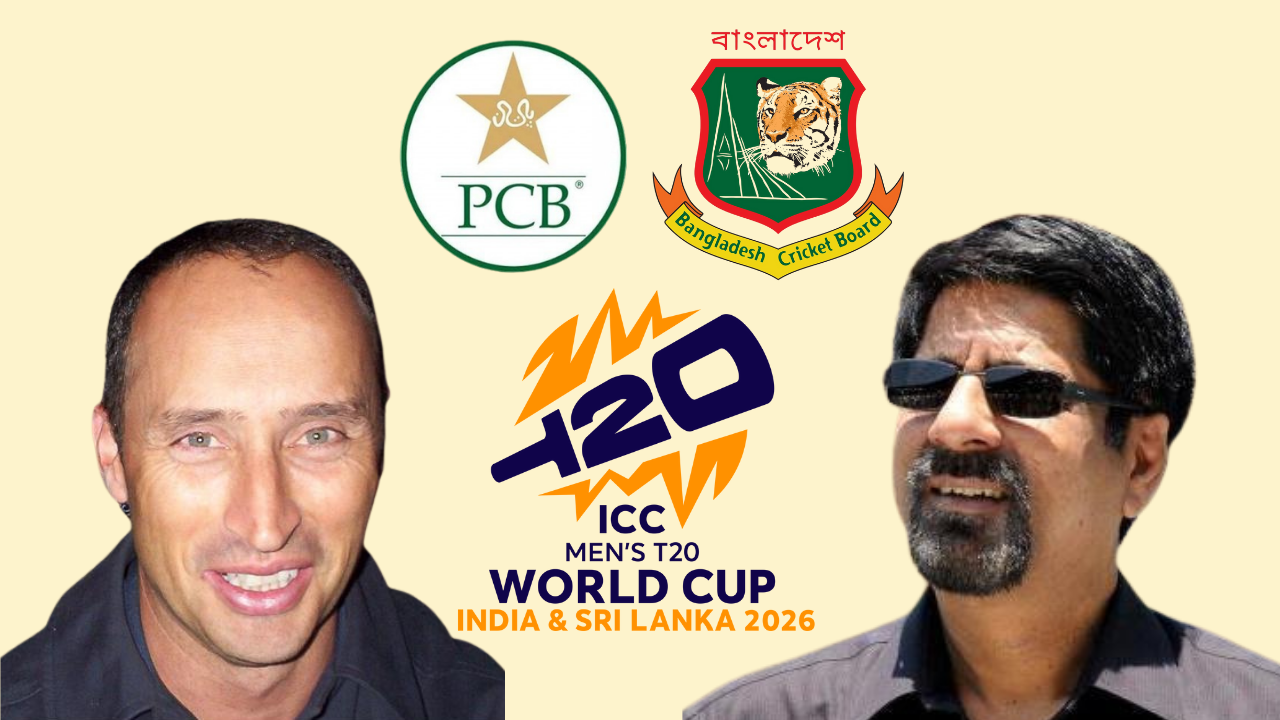
A fresh flashpoint in the India-Pakistan cricket rivalry has spilled into the boardroom — and onto YouTube.
Former India captain Kris Srikkanth has hit back strongly at ex-England skipper Nasser Hussain following comments around the India-Pakistan standoff ahead of the ICC Men’s T20 World Cup.
The row was triggered after Bangladesh withdrew from the tournament and Pakistan initially signalled it would boycott its group-stage clash against India. Hussain, meanwhile, suggested that the International Cricket Council (ICC) was effectively influenced by the Board of Control for Cricket in India (BCCI) and called for equal treatment across teams.
Srikkanth’s response was pointed — and rooted in history.
Srikkanth invokes 2003 World Cup controversy
Drawing parallels with the ICC Cricket World Cup, Srikkanth accused Hussain of inconsistency, referencing England’s decision at the time not to travel to Zimbabwe and Kenya during the tournament.
“He was the captain in 2003 World Cup when England refused to go to Zimbabwe and Kenya. Why does he want to talk now? Last moment even Australia agreed. England were kicked out and that’s how Kenya came to the quarterfinals. You have one rule, we have one rule. That time England was ruling,” Srikkanth said on his YouTube channel.
Srikkanth’s remarks underline a long-running tension within global cricket governance — where political decisions, bilateral relations and commercial realities often intersect.
He doubled down on what he sees as a double standard in how such disputes are judged.
“That time they were shouting. It’s not fair. If England or any other team do it, it is okay. No one wants to do arm-twisting. End of the day, ICC’s big revenue is from Indian fans across the globe, so India has a little bit of an edge. It happens in phases.”
ICC, revenue power and cricket’s commercial balance
At the heart of the debate lies a familiar issue in cricket’s political economy: India’s financial weight.
The ICC’s broadcast and sponsorship revenues are heavily driven by Indian viewership, giving the BCCI significant influence within the global ecosystem. Srikkanth did not deny that dynamic — instead, he framed it as a structural reality.
For cricket executives, the episode is another reminder of how revenue concentration shapes tournament planning, geopolitical negotiations and fixture commitments. India-Pakistan matches, in particular, remain among the most commercially valuable properties in global sport.
Pakistan reverses decision as high-stakes clash preserved
Following ICC intervention, Pakistan’s government reversed its earlier position and confirmed the team would play India in the group stage.
Srikkanth welcomed the development, emphasising the broader impact on the global game.
“I am happy that Pakistan has agreed to play and the match is happening. It is very important. It is very crucial for world cricket. Don’t go anywhere else, just from the subcontinent population, you will get so much viewership,” Srikkanth said.
The subcontinent’s scale — and its appetite for India-Pakistan contests — makes such fixtures critical not only for ticketing and broadcast numbers but also for sponsor activation and host-nation economics.
Srikkanth also issued a blunt warning about the commercial consequences had Pakistan stuck to its boycott.
“Pakistan would be the biggest loser if they did not play. Even viewers and fans, how many of them would have gotten tickets. And even the hosting nation. End of the day everyone would ignore Pakistan. Tomorrow, if India have a directive to England or Australia not to play Pakistan, even that can happen,” he added.
With the 2026 T20 World Cup already ongoing, the spotlight is firmly on how cricket’s most valuable rivalry is managed in real time — and how power is exercised within the sport’s global framework. For the business of cricket, the India-Pakistan fixture isn’t just another match. It is a cornerstone asset — commercially, strategically and symbolically.


