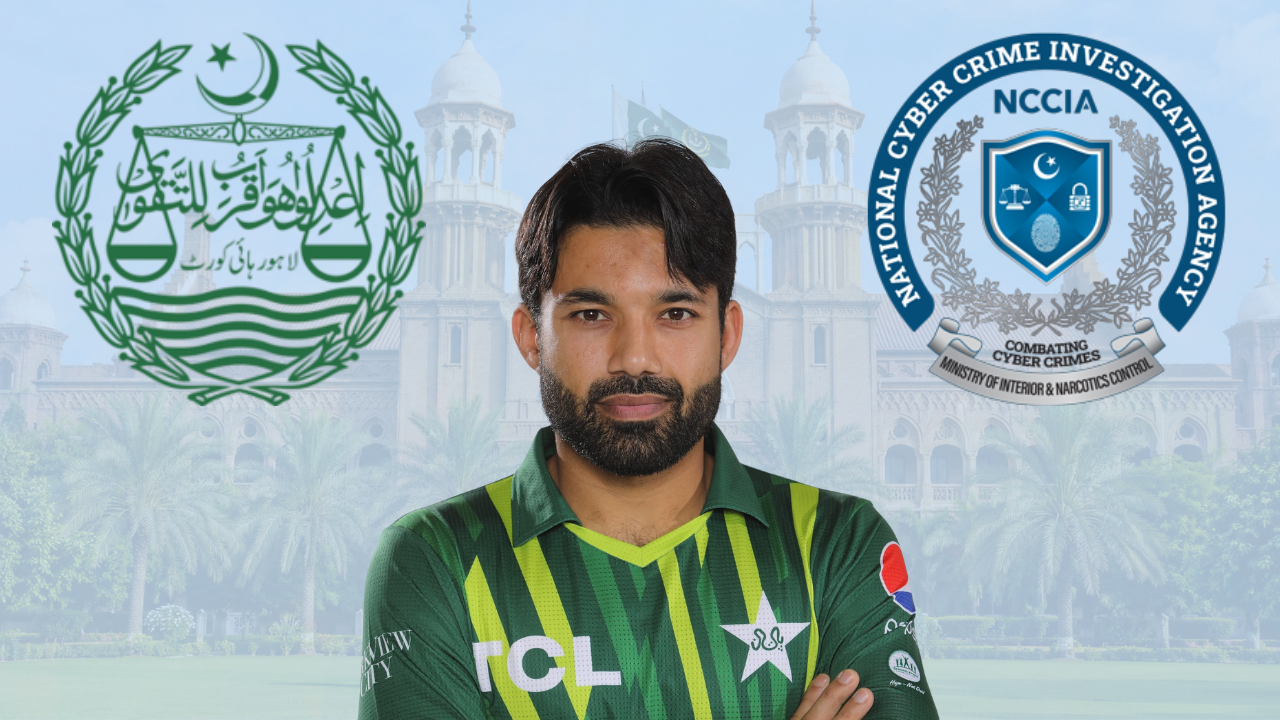
The Lahore High Court has ordered the National Cyber Crime Investigation Agency (NCCIA) not to harass or unnecessarily inconvenience Mohammad Rizwan while directing the Pakistan cricketer to cooperate with the agency’s ongoing inquiry.
According to a report by Geo News, Lahore High Court Chief Justice Aalia Neelum issued the directions in a written order dismissing Rizwan’s challenge to the NCCIA proceedings. The inquiry, which concerns alleged online betting and gambling-related activities, will be allowed to continue, but the agency has been instructed to conduct the process strictly in accordance with law.
Court sets conditions as NCCIA inquiry proceeds
The written order provides further detail on the court’s decision to allow the investigation to continue while placing safeguards around how Rizwan is treated during the process.
The court determined that the NCCIA inquiry was neither outside the agency’s jurisdiction nor motivated by bad faith. It also declined to intervene while proceedings remain at a preliminary stage, leaving Rizwan able to pursue appropriate legal remedies if he has objections to the eventual outcome.
Chief Justice Neelum said in the written court order: “A call-up notice is merely a procedural mechanism for gathering information and does not by itself amount to an accusation of wrongdoing.”
Rizwan has been instructed to participate in the inquiry and cooperate with the NCCIA. The court separately said he could approach the appropriate court regarding the return of any items seized or taken into possession during the proceedings.
Court considers legal basis for inquiry
The NCCIA’s investigation involves allegations being examined under Section 14 of the Prevention of Electronic Crimes Act (PECA) 2016, a provision relating to unlawful financial benefit.
Deputy Attorney General Rafaqat Ali Dogar told the Lahore High Court that the allegations arose from information “arising from information said to have been obtained through cyber patrolling that connected the petitioner to the matter.”
The court concluded that the relevant authorities should be permitted to investigate the matter before any determination is made over whether further action is warranted.
ICC framework does not prevent state inquiry
Rizwan’s legal challenge had also raised the role of the International Cricket Council’s Anti-Corruption Unit, with his counsel arguing that the ICC’s anti-corruption framework was the appropriate mechanism for dealing with such allegations.
The court found that the ICC’s disciplinary system did not prevent domestic authorities from acting under applicable laws. Referring to Section 1.11 of the ICC Anti-Corruption Code, Chief Justice Neelum said in the written court order that it did not “operate to prejudice or undermine the application of applicable laws — participants remain bound to comply with them at all times”.
The order further noted that the ICC framework itself provides for cooperation with prosecuting or regulatory authorities, supporting the court’s conclusion that the existence of cricket’s disciplinary process does not bar an authorised state agency from conducting an inquiry.
Rizwan had previously challenged NCCIA notices
As previously reported by Cricexec, Rizwan approached the Lahore High Court after appearing before the NCCIA on September 10 alongside Pakistan batter Imam-ul-Haq. He challenged the agency’s jurisdiction and maintained that he had not been informed of the specific illegal activity he was alleged to have committed.
The court initially declined to intervene in the NCCIA process and dismissed his petition. The subsequent written order provides the court’s detailed legal reasoning for allowing the inquiry to remain ongoing at this stage.