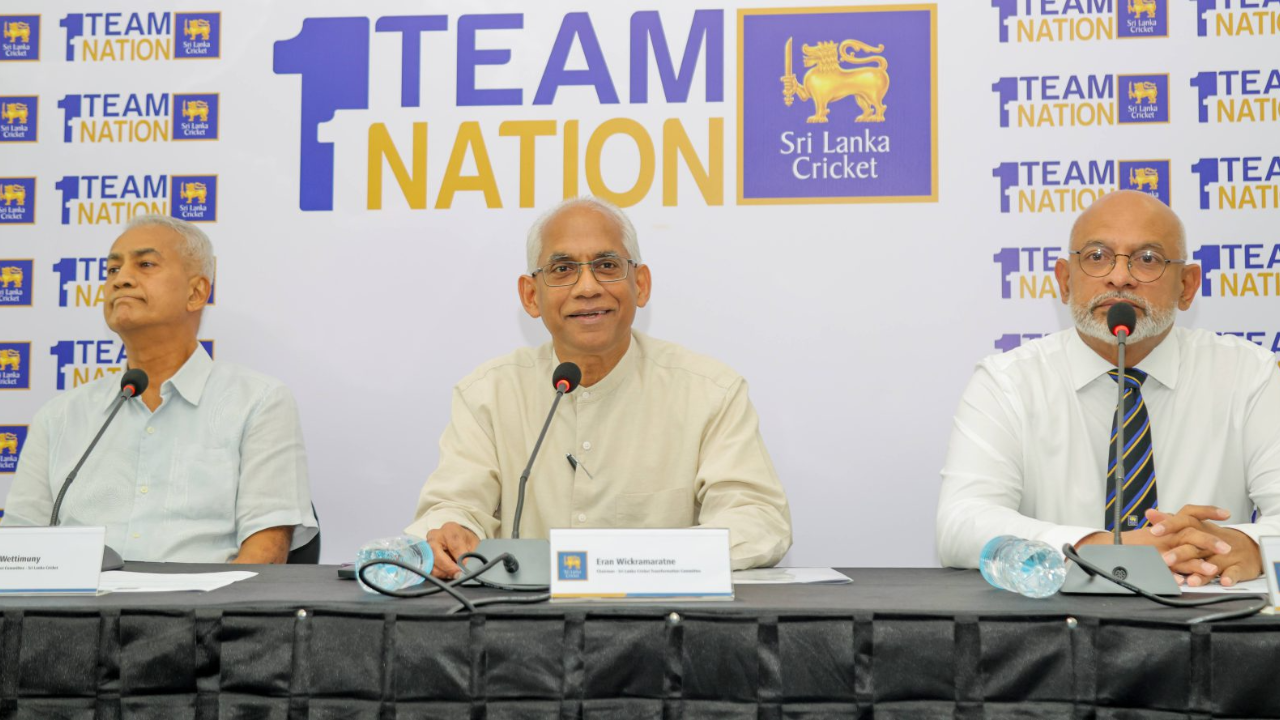
The Sri Lanka Cricket Transformation Committee (CTC), appointed on 29 April 2026 by the Ministry of Sports and Youth Affairs, considers it its responsibility to keep the Sri Lankan public informed of the progress made so far in fulfilling its mandate to transform Sri Lanka Cricket.
The Committee’s mandate is centred on three key areas: establishing good governance, enhancing on-field excellence, and streamlining the day-to-day operations of Sri Lanka Cricket, until an elected administration is established.
Hence the Committee wishes to update the public on the progress made under its purview on the above given mandate.
Governance
In the area of governance, the Transformation Committee completed the drafting of a new Constitution within a period of two months and submitted it to the Government. The Government is now proceeding with the necessary steps towards presenting it to Parliament.
The Committee believes the proposed Constitution, which has been developed to reflect the requirements of the modern game, will provide a stable foundation for the future development of Sri Lanka Cricket. It is also expected to provide a framework that is acceptable to all key stakeholders, including the International Cricket Council (ICC), the Sri Lankan public, and cricket fans.
Domestic Clubs
The Cricket Transformation Committee has decided to reduce the number of Major Tier ‘A’ Clubs from the current 14 to 10 over the next two years, while retaining 12 clubs in Tier ‘B’.
The reduction in the number of Tier ‘A’ clubs is intended to ensure that the country’s best players compete in the highest-level domestic tournament. The Committee is of the view that a more competitive domestic structure will raise the overall standard of domestic cricket and strengthen the feeder pathway to the national teams.
Tournament scheduling
The Cricket Transformation Committee has also decided that the Major Club Tier ‘A’ League Tournament will be played over four days instead of the current three-day format.
The Committee believes that a four-day competition will provide players with better preparation for Test cricket, the ultimate format of the game.
Steps have also been taken to establish a clear and structured domestic cricket calendar, with appropriate rest periods incorporated for players. This will help reduce the risk of injuries and player burnout while giving clubs, coaches and broadcasters sufficient time to plan their activities in advance.
Work is also underway to revamp the Sri Lanka Schools Cricket Tournament, which is an important component of Sri Lanka Cricket’s national pathway for identifying and developing talent for future national representation.
Raising the Standard of Pitches
As part of its efforts to improve the standard of pitches across the country, the Cricket Transformation Committee recruited an experienced National Curator following an independent interview process led by Mr. Andy Atkinson, the former Head Curator of the International Cricket Council.
In addition, all curators working at Sri Lanka Cricket’s international venues are now directly employed by Sri Lanka Cricket. This gives Sri Lanka Cricket greater direct management authority over the curation department and will enable pitches to be prepared in line with the broader vision of developing Sri Lankan cricket to international standards.
Raising the Standards of Coaching
The Cricket Transformation Committee is currently working to raise coaching standards across the District and Provincial coaching structures.
Following a stringent interview process, a new group of District and Provincial Coaches has been appointed. The interviews were conducted with the participation of Mr. Ashley Ross, a globally acclaimed coach developer.
Mr. Ross is also assisting Sri Lanka Cricket in reviewing the structure of the High Performance Centre and the overall coaching set-up, including the available coaching skill sets, with a view to reorganizing the structure where necessary.
The CTC has also taken steps to bring District and Provincial Coaches under the direct employment of Sri Lanka Cricket. This will enable the organization to exercise greater oversight and accountability over coaching processes and outcomes.
Raising Umpiring and Match Referring Standards
Measures have also been introduced to raise the standards of umpiring and match refereeing across all levels of cricket, from schools to the national level.
This initiative is aligned with the Committee’s broader objective of elevating the standards of cricket at every level.
As part of this process, the Committee has recruited Mr. Lyndon Hannibal, a former ICC Umpire, as Umpires Development Manager and Mr. Ruchira Palliyaguruge, a former ICC Umpire as Umpire Coach.
They will work towards developing and elevating the standards of match officials, including umpires and match referees, across the cricketing pathway, beginning with school, club cricket and international cricket.
Raising Sports Medicine and Player Welfare Standards
The Sports Medicine arm of Sri Lanka Cricket is being reorganized with the assistance of Dr. Alex Kountouris, who was part of Sri Lanka’s 1996 World Cup-winning team as a physiotherapist and later at Cricket Australia.
The initiative is aimed at ensuring that athlete care and sports medicine services are developed in line with international standards.
In addition, a Sports Psychologist has been brought into the programme to strengthen the mental skills and psychological preparation of the National Men’s Team.
Raising the Profile of Women’s Cricket
The Cricket Transformation Committee has also taken steps to further develop and raise the profile of women’s cricket.
Training programmes, including media and communication skills development, have commenced as part of a broader effort to support the professional development of women cricketers and strengthen the overall women’s cricket programme.
Operational Streamlining and Financial Management
Steps have been taken to streamline operations and ensure the prudent management of Sri Lanka Cricket’s finances.
A number of measures have been introduced to curtail unwarranted expenditure and ensure that financial resources are used more effectively. These include withdrawing from unnecessary legal proceedings; discontinuing the engagement of unnecessary consultants; streamlining the workforce by removing positions that were retained without clearly defined roles; and reducing the size of an excessively large coaching structure.
The Committee believes that these measures will help reduce financial wastage and enable more resources to be directed towards player development and cricket infrastructure.
Redress
The Committee has also taken steps to provide redress to Sri Lanka Cricket employees and clubs that were in the past, unfairly penalized. This initiative is intended to strengthen mutual understanding and rebuild trust between Sri Lanka Cricket, its employees, member clubs and other relevant stakeholders.
Conclusion
The Cricket Transformation Committee believes that the measures implemented so far represent important steps towards transforming Sri Lanka Cricket and rebuilding the structures required to develop the game at every level.
The Committee’s objective is to lay the foundation for Sri Lanka Cricket to once again become a world-class cricketing organization and a globally respected cricket brand.
Further measures will be introduced as the transformation process progresses.
Sri Lanka Cricket remains committed to maintaining transparency and keeping the public informed of developments. The Committee also welcomes continued engagement with the public on these matters.