

On the last Sunday in August, at Voorburg, where the inaugural European T20 Premier League staged the first half of its group stage, an 18-year-old from the Utrecht satellite town of Houten walked out to conduct the coin toss for the Amsterdam Flames. Later she presented the player-of-the-match award, standing alongside Glenn Maxwell and Scott Edwards.
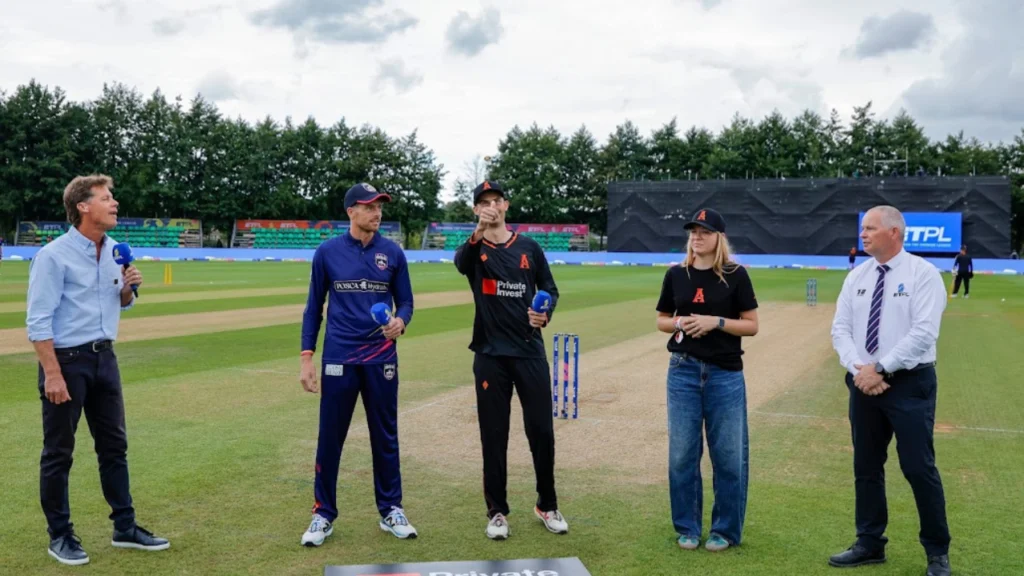
Noor van Rietschote just found out that morning that she was going to South Africa.
She had already been awarded the franchise’s first scholarship — funding for a ten-week stint at the Gary Kirsten Academy in Cape Town this coming February. What she did not have was the full amount. Earlier that day, Tom Bills, the Flames’ Commercial and Partnerships Director, called PrivateInvest, the franchise’s Founding Principal Partner and front-of-shirt partner, to ask whether it would co-fund the scholarship.
“We’ve offered the core scholarship, but what was going to make a difference was a co-funder to cover the full expenses,” Tim Thomas, the Flames’ CEO, said. “It’s a very big financial commitment that her family would have to make.”
The call took minutes. “PrivateInvest heard that she didn’t quite have the funding earlier today, and within a quick phone call they’ve agreed to co-fund the scholarship to make sure that she 100 percent goes to South Africa and does this training camp,” Bills said. “You’ve caught her on a great day,” Thomas added, “because she only found out this morning that PrivateInvest were coming in.”

What a franchise is supposed to build
The ETPL arrived in 2026 with an unusual mandate for a start-up T20 league. It is ICC-sanctioned, owned and operated through a joint venture between Rules Global and Cricket Ireland in partnership with Cricket Scotland and the Royal Dutch Cricket Association (KNCB), and its squad rules oblige every franchise to carry a minimum of eight local players from the three host nations.
For the Amsterdam ownership group, that obligation to build locally was not a constraint to be tolerated. It was, Steve Waugh says, the point.
Waugh is a titan of world cricket. He captained Australia to the 1999 World Cup, played 168 Tests — a world record at his retirement — and won 41 of the 57 he led as captain. At Amsterdam he is co-founder and Chief Cricket Officer as well as co-owner.

“We always wanted to develop talent in the Netherlands and develop young players here, and for them to have role models,” Waugh said. “It was really important to our franchise to have a young Dutch player who the kids can look up to.”
He concedes a first season is necessarily mechanical. “Obviously, you want to get the team right to start with — the management, the business,” he said. “But part of that is encouraging and developing young talent in the Netherlands. We’d love to have as many Dutch players as possible in our franchise.”
The women’s game is where the ownership group believes a franchise can move fastest, and Waugh is direct about what that requires: a visible Dutch player for girls to follow. Van Rietschote, in his framing, “could be the role model for young female cricketers in the Netherlands.”
Bills puts the priority plainly. “We were very keen from the first season to have a strong social impact agenda,” he said, “and one of the things we’re very interested in is promoting the game of cricket in the Netherlands with young females.”
Behind the stumps at a children’s clinic
The scholarship did not begin as a program. It began as an observation.
Some months before the season, the Flames staged a children’s clinic in Amsterdam, delivered by Cover Drive, a one-man Dutch coaching operation. Its founder asked Van Rietschote to help out.
“He was like, ‘Hey, we love your energy, please come help us with these kids, and maybe you’ll get to meet Stevo and Jamie Dwyer,’” she said. “And I was like, yeah, I’m in. I’ll take a day off for that.”
Waugh, there with Dwyer, the Olympic gold medallist and Flames co-owner, was watching out of habit. “I’m big on what I see first. First impressions from players,” he said. “I’m generally pretty good at judging talent.”
His account of the moment is unadorned. “There was a coaching clinic we were involved in, and I was watching the young boys, and there were a couple of girls involved. Noor was keeping behind the boys, and I just watched her for a couple of balls — just the way she moved, how ‘soft’ her hands were,” he said. “I thought, ‘this girl’s got talent.’”
They talked. She told him her ambition was to train through a Northern Hemisphere winter in South Africa or Australia, because the Dutch winter offers almost nothing. “We just don’t have the capacity or the people to set that up,” she said. She also told him, without sugar-coating it, that she could not yet pay for it herself.
“He was like, ‘We’ll see what we can do,’” she said. “And it just snowballed from there.”
Waugh’s version is similarly direct. “Let’s get a scholarship happening,” he recalled deciding. “And she’s a perfect choice for the first one.”
Three and a half years, three jobs, three hours on the train
What makes Van Rietschote an attractive case for the Flames is not just that she needed help. It is how far she had already got without any.
She has been playing cricket for three and a half years. She turned 18 in May. “I started like 15-ish,” she said. “That’s late for cricket. Most cricketers start when they’re three, four. They get their first bat from their parents.”
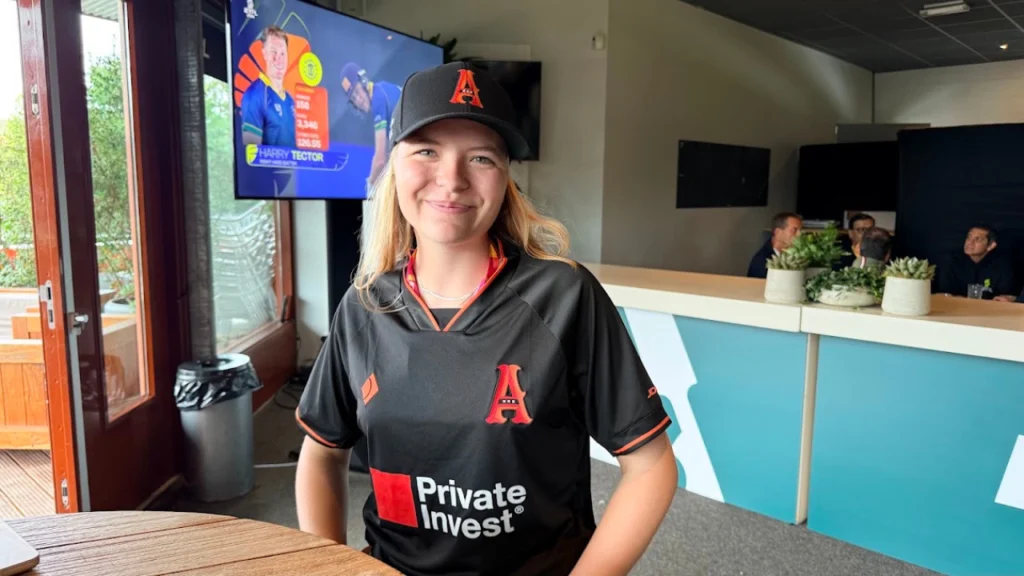
She came to the game through a missed PE lesson. Pulled out of a biology class in her third year of secondary school, she was sent to a schools clinic run by the Dutch cricket association in Amsterdam. The coaches noticed her before she noticed the sport. “They were like, ‘You’re engaging a lot, you have such a big smile on your face, you’re enjoying yourself — come to training,’” she said. “The week after I went and did a training and absolutely fell in love.”
The evening before that clinic, she mentioned it at home. Her father had heard of cricket but knew nothing about it, and told her to call her grandfather.
“He was like, ‘Actually, I’ve played cricket, your great-grandfather played cricket and your great-great-grandfather played cricket,’” she said. “So I’m a fifth-generation cricketer. I had not known that my whole life. It was pretty amazing to learn a bit of history about myself as well.”
She has since moved through the Dutch age-group system. As a Dutch newspaper profile reported this summer, she is one of thirteen players in the national association’s Fairtree Academy, which provides specialist coaching and elite-sport support; she completed her VWO diploma this year, came to cricket from goalkeeping at hockey club HC Houten, where she also coached the club’s young goalkeepers , and wears sports glasses on the field because of limited depth perception. The coaching thread has followed her into cricket: she is halfway through her ICC Level 1 coaching course and intends to work with young players over the coming winter.
She is clear-eyed about the player she currently is. “I am not that explosive a player yet in batting, so I bat four or five — like the anchor of the team,” she said. “When a couple of quick wickets fall, I get them going, starting up again, and get bigger partnerships going.”
She has been funding all of it herself. “Up until now, she’s been working three jobs,” Bills said.
The inventory, in her own accounting: a bakery-restaurant, babysitting and bar shifts at her club. Cricket is a fourth. “That’s a full-time job on its own, because we have training a lot.”
The training is 60 kilometres away. “That’s almost an hour and a half of commuting one way — one and a half there and one and a half back,” she said. “So I always do my homework on the train. Because if you have training you get home at 11.”
The cost of a winter
Thomas is precise about what the franchise is actually funding. “The big part of her dream is just to be better, and she wants to play for the Dutch national team,” he said. “And like many Dutch people, her dream is to go to the Olympics” — a route that becomes real when cricket returns to the Games at Los Angeles in 2028.
The Gary Kirsten Academy was not a name randomly plucked from a brochure. Dutch players have trained at the Cape Town academy before, Kirsten himself consulted to the Netherlands men’s side at the 2022 T20 World Cup, and the Flames’ head coach, Ryan Cook — who stepped down as Netherlands men’s head coach in June after four years — knows the same coaching network. “The Flames know a lot of trainers at Gary Kirsten, and they know they’re good keeping trainers, good batting trainers,” Van Rietschote said.
The logistics were built around her degree. She began at Utrecht University’s College of Pharmaceutical Sciences the day after the Voorburg match, and because Cape Town shares her time zone, the university has agreed to let her study online. “So as well as cricketing six days a week at Gary Kirsten Academy, I’ll also be going to university online,” she said. She travels from February into April, roughly ten weeks.
For Waugh, that combination — self-funded ambition plus a willingness to absorb the workload — is one of the main reasons she was selected. “I’m always happy to encourage talent, and particularly against the odds,” he said. “She’s working a lot of jobs to try and get there, and I think if we can help someone who’s willing to work extra hard to get there, she’s going to benefit from it and learn, and then pass the message back.”
A depth problem, and a hockey answer
The structural case for investing in Dutch women’s cricket is straightforward: the ceiling is high and the base is thin. Bills puts the number of registered female players in the country at around 185. The senior women’s side, meanwhile, qualified for the ICC Women’s T20 World Cup for the first time in its history this year, reaching the tournament in England in June: a national team on the world stage, and a participation base that would fit inside one large club.
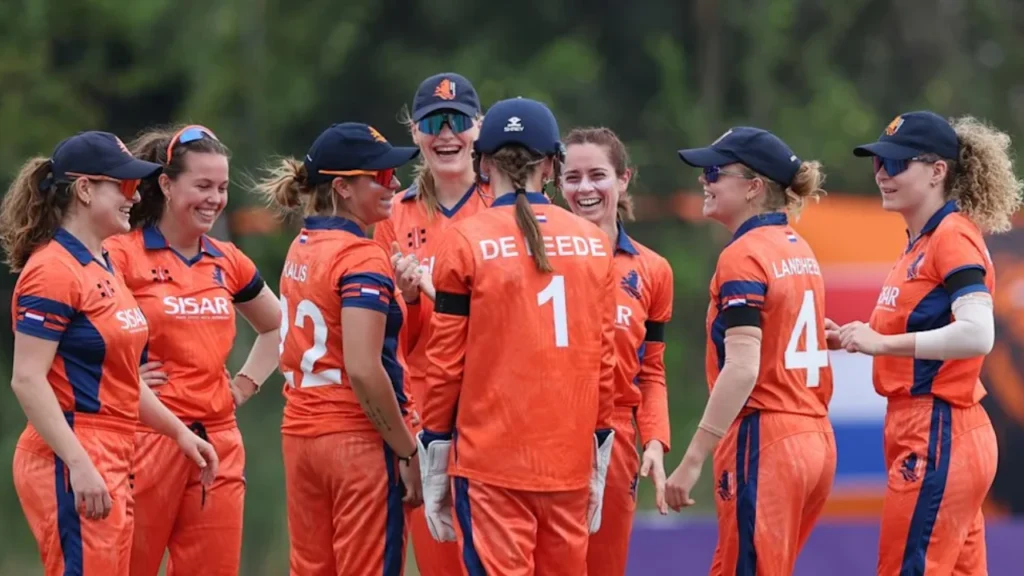
Waugh’s route into that gap runs through another sport. “If you look at the women, they dominate field hockey,” he said. “Jamie tells me that they’ve got two or three teams capable of playing at that top level. At the end of the day, they’ll be professional hockey players, but maybe they can go into being professional cricket players down the track, and that’s a reality.”
The variable that has changed, he argues, is money. “If we can convert some of those people across to cricket, the Netherlands could have a really good team very quickly in women’s cricket,” he said. “It’s definitely a career path, and that’s something that I think would attract talented sports people in the Netherlands — that cricket is now a viable career path, and you can make good money out of it if you’re successful. That’s something that you couldn’t say a couple of years ago, particularly for women.”
Franchise cricket’s expansion into the women’s game has built a global professional circuit that did not exist when the current cohort of Dutch schoolgirls chose between hockey and everything else. Van Rietschote’s own target list reflects it. “They are helping me get to the Netherlands team and hopefully eventually play in a women’s ETPL for the Amsterdam Flames,” she said. “Or in the Hundred, in the Big Bash, in a WIPL.”
The ETPL has no women’s competition in its inaugural season but the founders and stakeholders have expressed a strong desire and intention to launch one in the future.
Social impact as a system, not a gesture
Inside the Flames, the scholarship is positioned as one output of a programme rather than a one-off. “We have a very comprehensive social impact strategy,” Thomas said. “We’ve got Steve’s involvement in the Laureus Sports Academy, where he’s a member. They do about 400 projects around the world.”
He points to Move Forward Foundation, a local charity carried on the playing jersey, as another strand. “We love involving ourselves in things that are going to make a legacy for all the communities that we operate in,” he said. Developing women in Dutch cricket, in his framing, “is just part of a very broad and quite high-impact global social impact program.”
The agenda is also commercial architecture. A franchise owned by an Australian consortium, with Ajinkya Rahane as its marquee signing and Australians at the top of the order, has a legitimacy question to answer in its own market.
“To have that local connection within the Dutch market is incredibly important to us,” he said. “We of course want to become a global brand, but we’ve got to get it right being relevant in this market — and to find inspiring people like Noor to share that story and come on that journey with us, it’s fantastic.”
What comes back in April
The commercial test of the Flames’ first season will be counted in attendance, broadcast reach and renewal rates. The developmental test will take far longer, and will be measured in whether anything returns.
That is explicitly the expectation Waugh has set. “Noor is going to be the flag bearer,” he said. “She’ll come back from the Gary Kirsten academy, hopefully tell 100 other women cricketers: cricket’s a great sport, come and join me, be a part of the movement. We’ve got to start somewhere.” The scholarship, he added, is not a women’s programme in isolation: “We want to develop talent, both boys and girls, women and men.”
Bills frames the ambition in terms of what Van Rietschote does with the platform. “It’s an individual dream, but she feels very passionate about what else she can do to leave a legacy and inspire young girls,” he said.
Thomas, watching her work the toss hours after the sponsor call, put it more simply. “She’s the happiest person on Earth,” he said, “because now she gets to live her dream.” The relationship, he added, is way beyond transactional: “She’s very much part of our family now; part of our DNA.”
Van Rietschote has a narrower and more practical set of objectives: the Dutch national side, a professional contract, ten weeks in Cape Town from February, and a pharmacy degree completed on a laptop in a South African academy dormitory. On the last Sunday in August, she was still processing the morning.
“I’m living the dream right now,” she said. “It’s genuinely a dream come true.”


