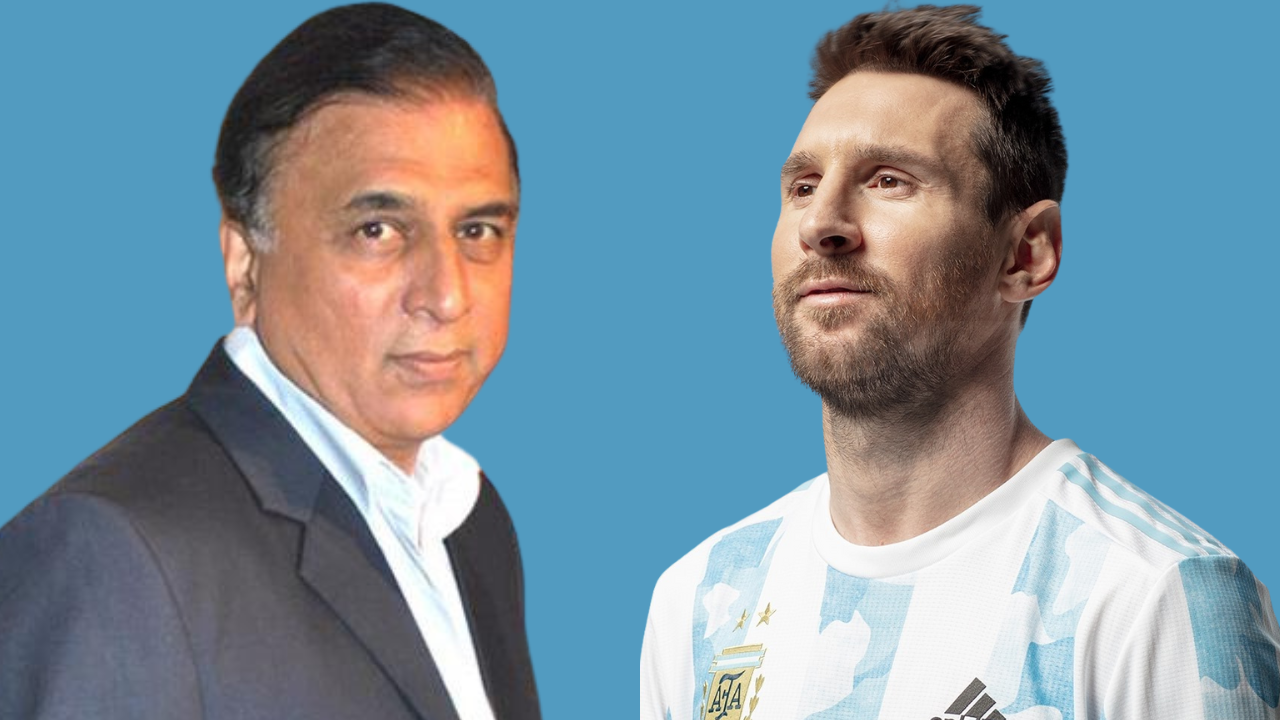
The Salt Lake Stadium event in Kolkata was meant to be one of the most iconic moments of Lionel Messi’s 2025 India visit. Instead, it unraveled into a chaotic disappointment for thousands of paying fans. The fallout prompted many to point fingers at Indian organisers and local authorities. But in a rare intervention, cricket legend Sunil Gavaskar took a sharply different stance — turning the spotlight on Messi himself.
In his column for Sportstar, Gavaskar questioned the narrative that absolved the Argentine star of responsibility, arguing that Messi’s early exit from the event was the primary cause of the unrest that followed.
“Even the recent episode at the Salt Lake Stadium in Kolkata, where the Argentinian footballer Lionel Messi made a far shorter appearance than promised, was blamed on everyone except the person who failed to honour his commitment,” Sunil Gavaskar wrote in his column for Sportstar.
Messi’s shortened appearance led to fan fury
Messi, accompanied by Rodrigo De Paul — his Argentina teammate — and Uruguayan striker Luis Suárez, was scheduled for a two-hour programme in Kolkata.— a city known for its passionate football fanbase. Spectators paid thousands of rupees to witness the global icon in person.
But when the football legend made only a brief 20-minute stop and abruptly left the stadium, fans erupted in frustration. With many unable to catch more than a glimpse of him — thanks to a crowd of VIPs and local dignitaries obscuring the view — the scene turned violent. Bottles were thrown. Property was vandalized. And the local police arrested the event’s chief organiser, Satadru Dutta.
While the aftermath saw widespread condemnation of the organisers, Gavaskar shifted the conversation in a different direction.
“What his agreement was is not public knowledge, but if he was meant to be at the stadium for an hour, then by leaving well before that time and disappointing fans who had paid good money, the real culprit was he and his entourage,” he added.
Security excuse doesn’t hold up, says Gavaskar
In defending Messi’s hasty departure, some claimed there were legitimate safety concerns due to the overwhelming crowd of politicians and VIPs on the field. Gavaskar dismissed that notion entirely.
“Yes, he was surrounded by politicians and so-called VIPs, but there was no security threat to him or his entourage,” he stated.
The former cricketer suggested that a simple, symbolic gesture could have made all the difference to the fan experience.
“Was he supposed to simply walk around the stadium, or do something tangible like take a penalty kick? If it were the latter, those around him would automatically have had to move, and the crowd would have seen their hero do what they had come to watch,” he wrote.
Other Indian cities handled it right
Kolkata was just one of several stops on Messi’s GOAT Tour 2025 across India. His other appearances — in Mumbai, Delhi, and Hyderabad — were reportedly smooth and well-received.
Gavaskar was quick to point out this contrast.
“The other appearances went smoothly because commitments were met,” he continued.
He argued that before laying blame at the feet of Indian organisers, it was worth examining whether both sides had lived up to their responsibilities.
“So before blaming fellow Indians in Kolkata, it might be worth checking whether commitments on both sides were honoured,” he wrote.
A broader pattern of misplaced blame
Gavaskar used the Messi incident as an example of a deeper issue — what he sees as an eagerness within India to criticize its own institutions and people, sometimes unfairly. Drawing on a line from a recent Hindi film, he lamented the tendency of some Indians to undercut the nation’s image for attention or clout.
“We Indians are India’s worst enemies,” he concluded.
A call for accountability — on all sides
As the dust settles on the Kolkata debacle, Gavaskar’s remarks are a pointed reminder that global stars visiting India must also be held to their promises. His column calls for a more balanced conversation — one that doesn’t place the blame solely on Indian organisers without scrutinizing the actions of international celebrities and their teams.
While Messi’s legacy as a football icon remains untouchable, Gavaskar’s critique underscores that even legends have responsibilities — especially when fans across continents are paying to see them live.