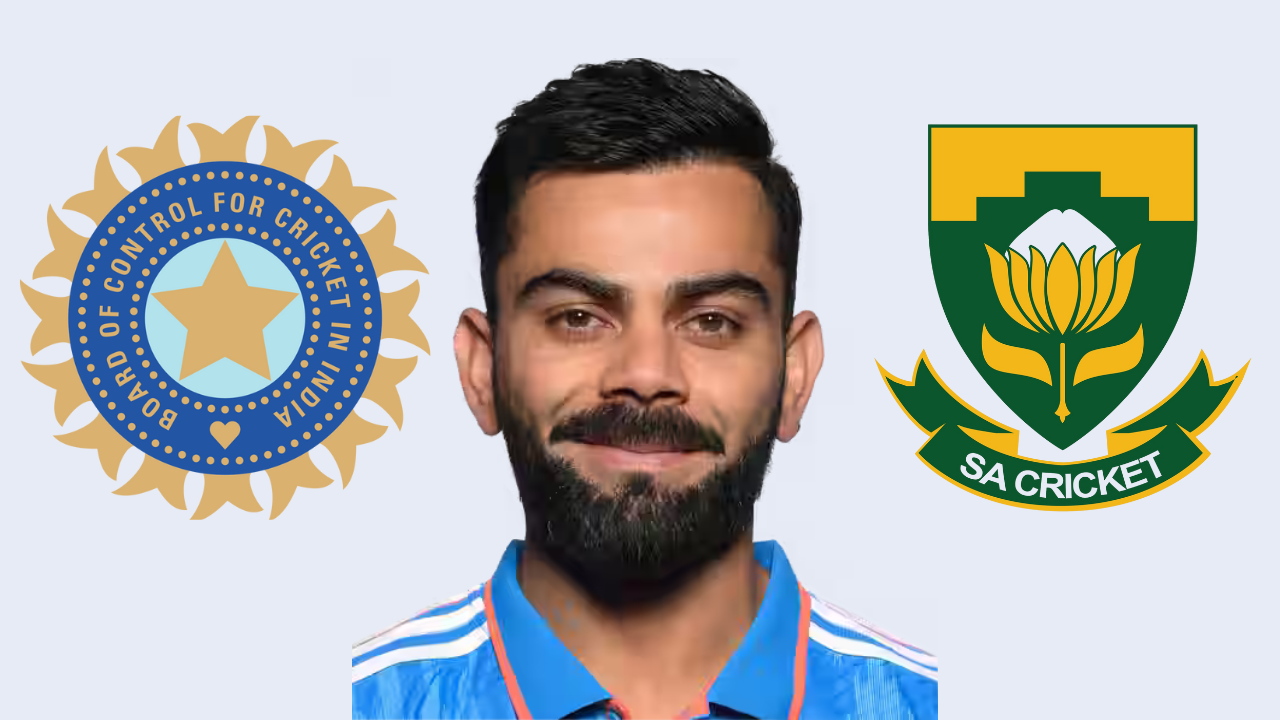
The handshake that wasn’t: Kohli’s viral moment sparks debate
What was expected to be a straightforward ODI series opener between India and South Africa took an unexpected turn off the field. As players lined up for post-match handshakes after India’s 17-run victory in Ranchi, a moment involving Virat Kohli and South Africa head coach Shukri Conrad caught online attention.
Video footage circulating widely on social media appeared to show Kohli walking past Conrad without acknowledging him — no handshake, nod, or glance — before moving on to greet other members of the South African contingent. The footage’s brevity makes it unclear whether Kohli had already interacted with Conrad prior to the clip. Yet, the visual sparked a flurry of speculation, especially given the timing — just days after Conrad’s controversial “grovel” comment.
Virat didn’t shake hands with the SA coach 😲
how did this go unnoticed? pic.twitter.com/9UW5V0HGhs
— Kanishk (@jeene2yarr) December 2, 2025
Shukri Conrad’s “grovel” remark ignites backlash
Following day four of the Guwahati Test, with South Africa in a dominant position, Shukri Conrad had explained their strategy in no uncertain terms.
“We obviously looked at how best we were going to use the new ball, because in the morning we still wanted a newish, hardish ball. What we felt is that when the shadows come across the wicket in the evening, there’s something in it for the quick bowlers, so we didn’t want to declare too early and not be able to use that. And then, obviously, we wanted the Indians to spend as much time on their feet out in the field, we wanted them to really grovel, to steal a phrase, bat them completely out of the game, and then say to them, ‘Come and survive on the last day and an hour this evening.’ So, so far so good, but we also know that they’re not just going to roll over; we’re going to have to be at our very best in the morning,” Conrad said during the post-day press conference after the fourth day of the Guwahati Test.
The term “grovel” carries a heavy historical burden in cricket. It harks back to a racially insensitive quote by former England captain Tony Greig, who ahead of the 1976 series against West Indies famously said:
“I’m not really sure they’re as good as everyone thinks. These guys, if they get on top they are magnificent cricketers. But if they’re down, they grovel, and I intend, with the help of Closey [Brian Close] and a few others, to make them grovel,” Tony Greig said in an interview on BBC’s Sports Night program.
The echoes of that infamous quote have long haunted the sport’s past, and Conrad’s usage — even if casual — drew widespread criticism from former players and fans alike.
Bavuma stays composed, distances team from coach’s words
As outrage simmered, it was left to South Africa captain Temba Bavuma to address the situation. Speaking at the post-match press conference after the second Test, he took a pragmatic stance.
“Comments made by coach came to me this morning. I was focused on game and didn’t have a chance to speak to him. Shukri is close to 60 years old and he will have a look at his comments,” Bavuma said.
While maintaining that it wasn’t his role to defend or interpret Conrad’s words, he offered a nuanced perspective:
“But in this series certain guys have also crossed the line. Not saying coach crossed the line, but he will surely think about it,” he added at the same press conference.
At the pre-match press conference before the second ODI, Bavuma reiterated that the comment hadn’t unsettled the team.
“No, I don’t think it is distracting (and) no it’s not for me to clarify,” he said.
Experience returns: Bavuma reflects on Rohit and Kohli’s presence
Looking ahead to the second ODI, Bavuma also shared his thoughts on the impact of India’s veteran stars Virat Kohli and Rohit Sharma, who were instrumental in the first ODI.
“The inclusion of those two guys that does bolster the team. Like we said at the start of the series, these are two guys who have a lot of experience and a lot of skill and that can only benefit the team,” Bavuma said ahead of the South Africa’s training session in Raipur.
He fondly recalled an early memory of Rohit Sharma’s international debut:
“We played against, Rohit… I think it was in 2007, the T20 World Cup, I was still in school then. I mean, these guys have been around, so there is nothing new. These are world-class players,” he said.
And while acknowledging the challenges, Bavuma also emphasized that South Africa was no stranger to high-stakes showdowns.
“(Coming up against them is) nothing new, we have come across it. We have been on the bad end of it. But we have also had good times against them. It all just makes the series a lot more exciting,” he noted.
A call for more high-quality Test cricket
Bavuma used the moment to look beyond the white-ball contest, shifting attention to a larger concern echoed across the cricketing fraternity — the shrinking volume of red-ball cricket against elite opposition. Speaking candidly ahead of the second ODI, he underlined the importance of engaging with top-tier teams like India in longer Test series, not only for competitiveness but also for growth as a unit.
“All of us have been crying for more cricket especially against the top nations,” he said at the pre-match press conference.
He lamented the short length of the recent series and argued for a higher standard of competition:
“The Test series (against India) now, as much as there were two-match series, a lot of us would have wanted to see it going to three or four-match series. When it’s a side like India, they would have raised the standard, which would have forced us to raise our standards as well,” Bavuma noted.
While passionate about the need for more games, he acknowledged the limitations of his role in shaping schedules.
“As players, we don’t get involved when it comes to the scheduling, the negotiation, and all of that. Those are for, I guess, the people in suits, the Cricket South Africa,” he stated.
With a hint of humor, Bavuma concluded with a smile: “Some of us are getting a little bit old, so we’re not going to go too long to make another four match Test series against India.”
Bavuma’s remarks underscore a broader sentiment within the cricketing world — that marquee Test series deserve room to breathe and evolve. As international schedules tighten and franchise leagues expand, his call serves as a timely reminder of the enduring value of traditional formats, especially when contested between elite rivals like India and South Africa.