
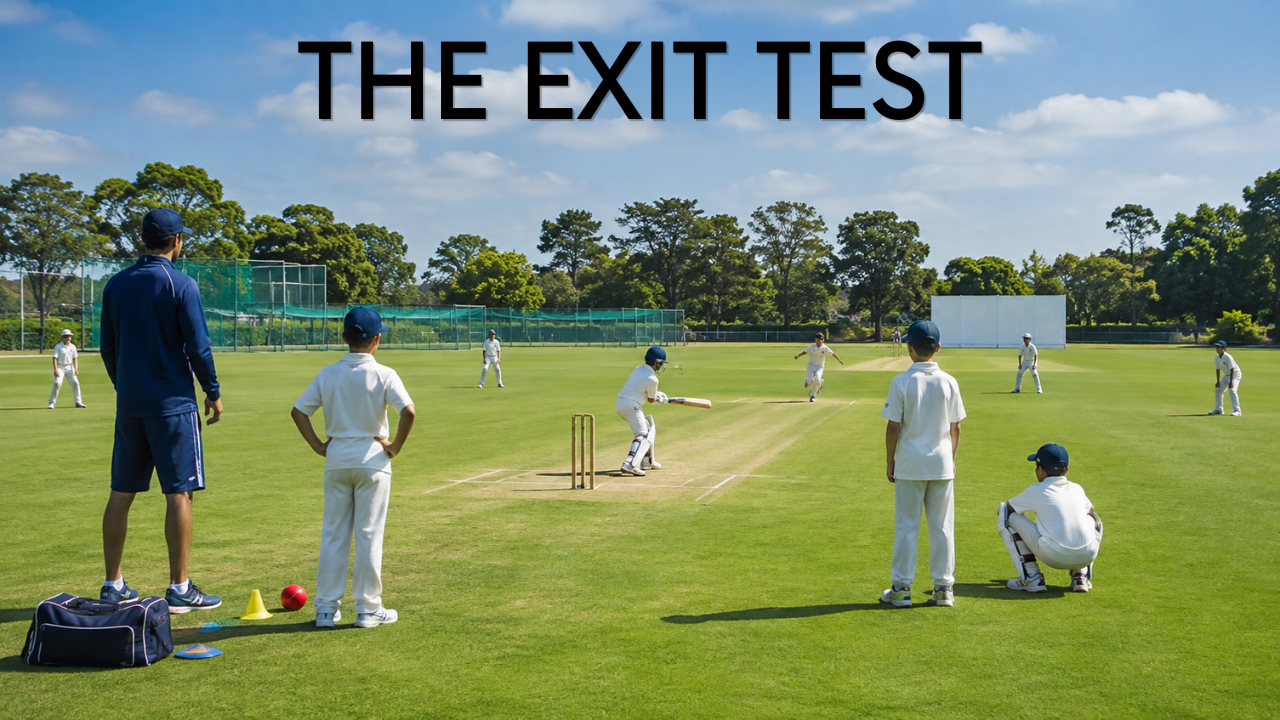
Go back to a place where you once ran cricket and you learn something quickly.
Sometimes the game is still there. A strip of matting rolled out on the same patch of ground, a taped tennis ball, different children, someone running the session whose name you do not know. Nobody remembers you were involved, which turns out to be the point.
More often there is nothing. The kit bag has gone. The funding cycle ended. The coach who ran it took a job somewhere else. What you left behind was a good season and a set of photographs.
I have been on both sides of that outcome, in Afghanistan, Sierra Leone, Sri Lanka, Jamaica, Panama, and closer to home in London. Different languages, different levels of resource, entirely different reasons the young people were in the room. The variable that predicted survival was never funding size, equipment quality, or the standard of the coaching.
It was whether the program had been designed to stop needing us.
The test
One question, and I have found it uncomfortable to answer honestly about my own work.
If we stopped funding this tomorrow, would it still be running in eighteen months?
If the answer is yes, what you have built is infrastructure. If the answer is no, what you have funded is a season of activity. Both can be worth doing. But only the first compounds, and it took me years to learn to tell them apart in my own programs.
The test cannot be passed with money. A larger budget makes a dependent program bigger and more dependent. The only route through it is structural. The delivery has to sit with people who were already there and are not going anywhere.
Cricket already has the best proof of this that any sport can offer. The Afghanistan story did not begin with a federation or a facility. It began with young people learning the game in refugee camps, taught by people who stayed, and it produced a Test nation inside a generation. Nobody planned that as a development program. It survived because the people delivering it were never going to leave.
Where I have got this wrong
The useful information in this work sits in the corrections rather than the wins, so I will be specific about mine.
I have designed programs around a visiting coach, which meant the coach was the program, and it ended when they did. I have run standalone cricket festivals that were excellent days and left nothing behind for the remaining fifty one weeks. I have delivered kit into schools with no trained adult able to use it, which is not a program, it is storage.
Every one of those was well intentioned and well delivered. Each failed to ask, at the design stage, what would still exist once the initial energy ran out.
Why cricket in America is at exactly this point
Two things have changed that make the school question live in a way it was not fifteen years ago.
The first is format. Cricket’s shortest formats have made the game teachable inside the constraints American schools actually have. A version of cricket that fits a forty five minute physical education period, indoors, with a soft ball and no specialist surface, is a fundamentally different proposition to a teacher than anything the sport could offer previously. Cricket spent two decades shortening itself for broadcast. The unintended consequence is that it became deliverable in a gymnasium.
The second is that the sport now has professional structure in this country and a fixed date in front of it. Los Angeles 2028 will bring cricket its largest American audience ever, and its first Olympic appearance since 1900. Whatever exists on the ground by then is what that audience walks into.
There is also a precedent in another sport worth noting without judgment. After 1994, soccer in the United States built its professional layer quickly while much of its participation pathway developed through paid club structures, which connected youth access to what families could spend. That industry has been open about it and invested seriously in addressing it, but changing an established pathway has proven long and expensive. The lesson is about sequence rather than intent. Cricket’s professional layer here is young enough that both things can still be built together.
What passes the test
Three things I have learned building schools cricket in the United States, all of them the international lesson arriving in an American accent.
Train teachers, not coaches. Coaches are excellent, and coaches move on when a funding cycle ends. The teacher is in that building every day and will be there next year regardless of what cricket does. In England, schools cricket has endured for two decades precisely because it went through the education system rather than around it. Train a coach and you have bought a season. Train a teacher and you have permanently changed what that school can offer.
Attach to curriculum, not enthusiasm. Enthusiasm gets a meeting. What moved districts for us was building the training to recognized physical education standards and making it count toward professional development credit teachers already need. American schools are not looking for another sport. They are looking for something that solves a problem they already have, on paperwork they already file. A program embedded in a district’s own requirements survives a change of principal, a budget cut, and your departure.
Fund the unit before you promise the unit. This is the correction that cost me most. In a room full of goodwill it is very easy to attach a number to a commitment. Every child gets this. Every school receives that. Any promise that scales linearly with children reached becomes unaffordable at exactly the moment the program starts working. Success becomes the thing that breaks you.
The commercial argument is the same argument
None of this competes with the professional game. It is the demand engine for it.
A child who learns cricket in a school gym at eight is a ticket buyer at eighteen, a season ticket conversation at thirty, and a parent bringing two more children at forty. Youth participation is the lowest cost customer acquisition available to any sport and the only kind that compounds. But it compounds only if it persists. A program that ends when the funding moves produces a good number in a report and no audience later.
That is why I have come to treat the exit test as a commercial instrument rather than an ethical one. It is the difference between an expense and an asset.
The wider game is already moving this way. Grassroots investment now appears in the same sponsorship roundups as shirt fronts and title rights, and the ECB has attracted seven figure commercial funding into its Cricket Cities work. Participation in cricket is becoming something that can be valued and sold, which means it is worth building to last.
The takeaway
Judge every cricket program you fund on one question: would it survive without us?
Apply it this week to something already running, not to a strategy document. If it would not survive your withdrawal, that is not a reason to stop funding it. It is a reason to redesign it, so the delivery sits with someone who was already in the building.
There are practical versions. A named school district relationship reported alongside the attendance figures. Persistence written into sponsorship agreements rather than activity alone. Teachers trained and schools equipped published next to children reached, because those are what remain after the funding moves.
The programs I am proudest of are ones I have nothing to do with anymore. Somebody else runs them, on ground that was always there, with children who have no idea anyone ever flew in. That is not modesty. It is the only version that was ever going to last.
Adam Hall is Founder and CEO of AMHC Global Holdings which is the parent company of Cricket Impact Group & Level 7 where he acts as CEO for both properties. He has spent two decades delivering cricket programs for young people across Afghanistan, Sierra Leone, Sri Lanka, Jamaica, Panama, and many more.


