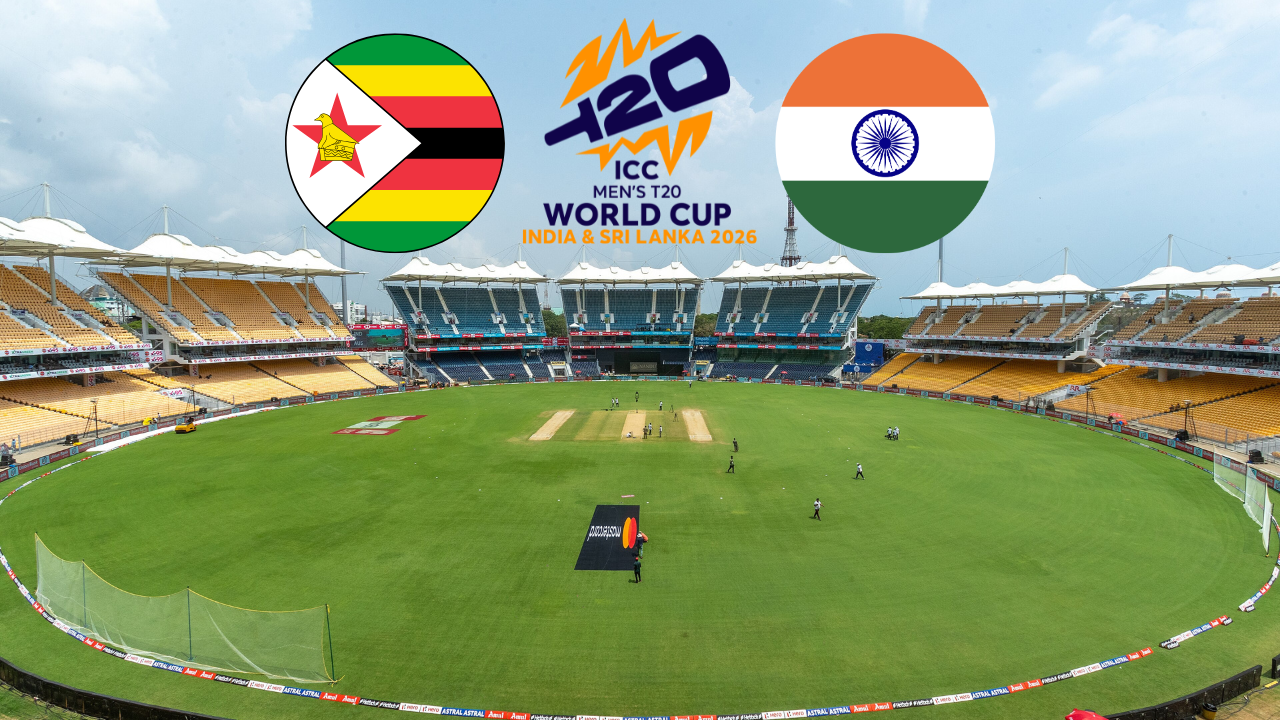
Dew has long tilted the balance in night matches in Chennai. This time, Chepauk had a countermeasure ready.
A US-imported chemical known as “Dew Cure” had been applied at the MA Chidambaram Stadium ahead of India’s T20 World Cup 2026 Super 8 clash against Zimbabwe, according to a report by The Indian Express, in an effort to neutralise moisture that often shapes evening contests.
How Dew Cure was used at Chepauk
With temperatures hovering around 30 degrees Celsius and humidity levels rising through the week, dew was expected to influence the match. To mitigate that risk, the Tamil Nadu Cricket Association (TNCA) treated the outfield with the imported solution, which is also used at Major League Baseball venues in North America.
The chemical was mixed with water and sprayed across the outfield on Tuesday and Wednesday, with another round applied on match day afternoon to ensure maximum impact under lights.
Explaining its function, sources told The Indian Express: “Once Dew Cure is sprayed, it ensures that there is no moisture on the grass leaves. As soon as it gets wet, it will be absorbed and the grass leaves will turn dry,” highlighting its role in preventing water droplets from settling on the surface.
India vs Zimbabwe: match context and result
The fixture itself carried significant weight after India’s 76-run defeat to South Africa in their Super 8 opener. India responded emphatically, posting 256 for 4 before restricting Zimbabwe to 184 for 6 to seal a 72-run victory.
Abhishek Sharma led the scoring with 55, while Hardik Pandya remained unbeaten on 50 and Tilak Varma finished 44 not out. Ishan Kishan contributed 38, Suryakumar Yadav added 33, and Sanju Samson made 24.
In reply, Brian Bennett struck an unbeaten 97 at the top of the order, with Marumani scoring 20 and skipper Sikandar Raza adding 31, but Zimbabwe fell short.
During preparations, India’s players had reportedly stayed back after training to assess the outfield conditions under lights and were satisfied with how the surface behaved.
Could Dew Cure feature in knockouts and IPL?
As per the report, there is an expectation that the same chemical could be used for the semi-finals and final if required, although there has been no official confirmation from organisers.
The development also has wider implications for domestic cricket. The Board of Control for Cricket in India (BCCI) is understood to be considering whether the product should become mandatory across Indian Premier League venues next month, given how frequently dew influences toss decisions and match outcomes in night games.
For now, Chepauk’s experiment represents a notable intersection of sports science and tournament logistics — an operational tweak that could reshape how venues manage evening conditions in major ICC events.