
The IPL has spent years constructing one of franchise cricket’s most elaborate integrity frameworks — a layered system of anti-corruption officers, device restrictions, and secured zones designed to ensure that what happens on the field is determined only by what happens on the field. On Friday night in Guwahati, that framework was tested not in a back room or a quiet corridor, but in full view of broadcast cameras, with millions watching. Debate over the incident over the weekend, including new developments on Monday.
The incident and its immediate fallout
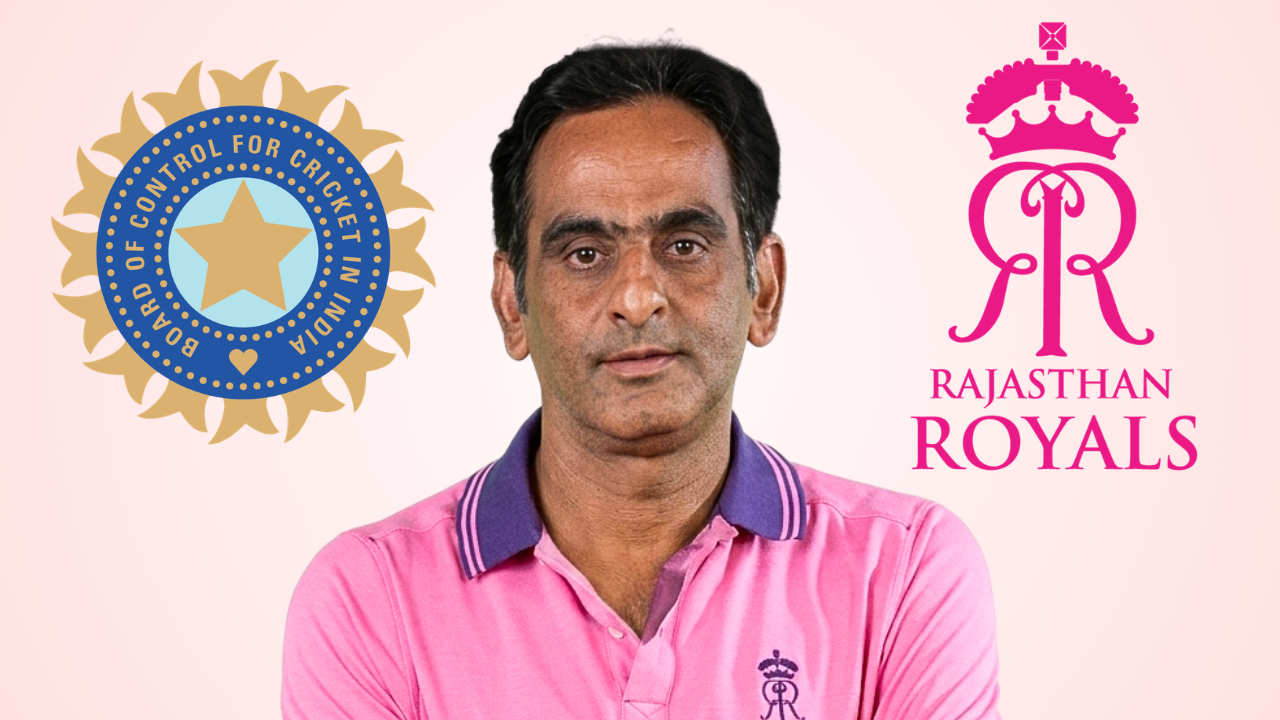
Rajasthan Royals manager Romi Bhinder was captured on live television using a mobile phone inside the team dugout during the franchise’s six-wicket victory over Royal Challengers Bengaluru at the Barsapara Stadium in Guwahati on Friday. The moment occurred during the 11th over of Rajasthan’s chase of 202, shortly after Vaibhav Sooryavanshi’s dismissal, with Sooryavanshi visible alongside Bhinder as the device was in use, and also peering at it. The footage was picked up and circulated widely across social media within hours, triggering a response that quickly moved beyond fan debate into institutional territory.
Having a MOBILE PHONE IN THE DUGOUT – is a COMPLETELY A NO NO. did this really happen. I hope not. If it did. Then @IPL governing council needs to take IMMEDIATE ACTION https://t.co/AaZpz4KAoL
— Lalit Kumar Modi (@LalitKModi) April 11, 2026
Lalit Modi, the IPL’s founding chairman, reacted publicly on X upon learning of the incident. “Having a MOBILE PHONE IN THE DUGOUT – is a COMPLETELY A NO NO. did this really happen. I hope not. If it did. Then @IPL governing council needs to take IMMEDIATE ACTION,” he wrote. Having subsequently viewed the footage directly, his second post dispensed with any qualifier. “This is COMPLETELY A NO NO. WHERE WAS ANTI CORRUPTION,” he added — a question directed not at Bhinder but at the officials whose sole function during a live match is to prevent precisely this from occurring.
This is COMPLETELY A NO NO. WHERE WAS ANTI CORRUPTION 😳 https://t.co/6za4cvc6gm
— Lalit Kumar Modi (@LalitKModi) April 11, 2026
The rule, and why its location matters
The IPL’s Players and Match Officials Area protocol is not a broad conduct guideline — it is a document of surgical precision, built around the principle that any unmonitored external communication during a match represents a potential vector for influence. The dugout is treated as the most sensitive point within that framework, precisely because it sits at the intersection of the playing arena and the team environment.
The IPL 2026 PMOA protocol document draws the relevant boundary explicitly: “Mobile phones and other electronic communications equipment are not allowed to be used in the PMOA other than for a few members of the team. The Team Manager may use a phone in the Dressing Room area but NOT in the Dugout.” All players and support staff are required to surrender devices to the Team Security Liaison Officer upon arrival at the stadium, with only the team analyst permitted to use a device at a designated table for data purposes.
Confirmation, consequences, and the weight of due process
The BCCI‘s initial public response confirmed what the footage had already suggested. A senior board official told PTI that “Bhinder has indeed breached the protocol of the Players and Match Officials Area (PMOA), as cell phones are banned in the dugout during a match.” With the breach established, the focus shifted to what follows — and on that question, the same official struck a tone that acknowledged seriousness without foreclosing on process. “It could be inadvertent, but there has to be some action since it amounts to a breach. Whether it will be a warning or a match ban will depend on the match referee and the ACU report. Based on that, the IPL GC can take a call,” the official told PTI.
BCCI secretary Devajit Saikia, speaking to Times of India, approached the matter from a position of procedural caution — one that prioritised the integrity of the investigation over the speed of the response. “Certain individuals are allowed to carry phones in the dugout and Romi Bhinder, as a manager, can carry it. But we need to thoroughly examine where exactly the event happened and whether the phone was used. We will conduct an internal examination before reaching a logical conclusion,” Saikia said. When the specifics of the PMOA document were put to him directly, he did not contest the rule’s clarity but maintained that evidence must precede action. “As I said, we will examine it. We can’t act on what is being said. We will see the pictures, video and whatever we can get before reaching to the conclusion,” he told Times of India.
The investigation and compressed timeline
The formal process now rests with the match referee and the BCCI’s Anti-Corruption Unit. Match referee Vengalil Narayanan Kutty, who officiated the Guwahati fixture, is expected to submit a detailed end-of-match report, with two anti-corruption officers having been present at the ground throughout the evening. Their observations, alongside any available broadcast footage, will form the evidentiary foundation of the ACU’s assessment.
A source tracking the matter told Times of India that the scope of any thorough investigation should extend beyond Bhinder himself — encompassing seizure and examination of the device, questioning of players who were in proximity at the time, and a sanctions framework that ranges from a financial penalty to a match ban or beyond, depending on what the investigation determines.
The timeline is tight. Rajasthan Royals, unbeaten through four matches and sitting at the top of the IPL 2026 standings, face SunRisers Hyderabad in Hyderabad on Monday. Whether Bhinder is cleared to occupy his position in the dugout for that fixture — or is stood down pending the outcome of the investigation — will itself serve as an early indicator of how the BCCI and IPL Governing Council are calibrating their response.
BCCI steps in as investigation adds new dimension
As of Monday, the BCCI issued a notice to Romi Bhinder as part of an Anti-Corruption and Security Unit investigation, as reported by The New Indian Express, marking a significant escalation in the episode. IPL Governing Council Chairman Arun Dhumal confirmed the process. “We have asked the ACSU to investigate and file a report on the incident,” he told the outlet.
At the same time, according to the report, sources familiar with the situation indicated that Bhinder’s use of the phone may have been linked to a medical emergency, including past health issues that have required hospitalisation. That detail complicates what had appeared to be a clear-cut breach of protocol, introducing questions around intent, necessity, and the extent to which exceptional circumstances are accounted for within the IPL’s anti-corruption framework — a balance the league will now have to navigate carefully as it moves towards a final decision.


