The debate over the Big Bash League’s future has become one of the most consequential conversations in world cricket.
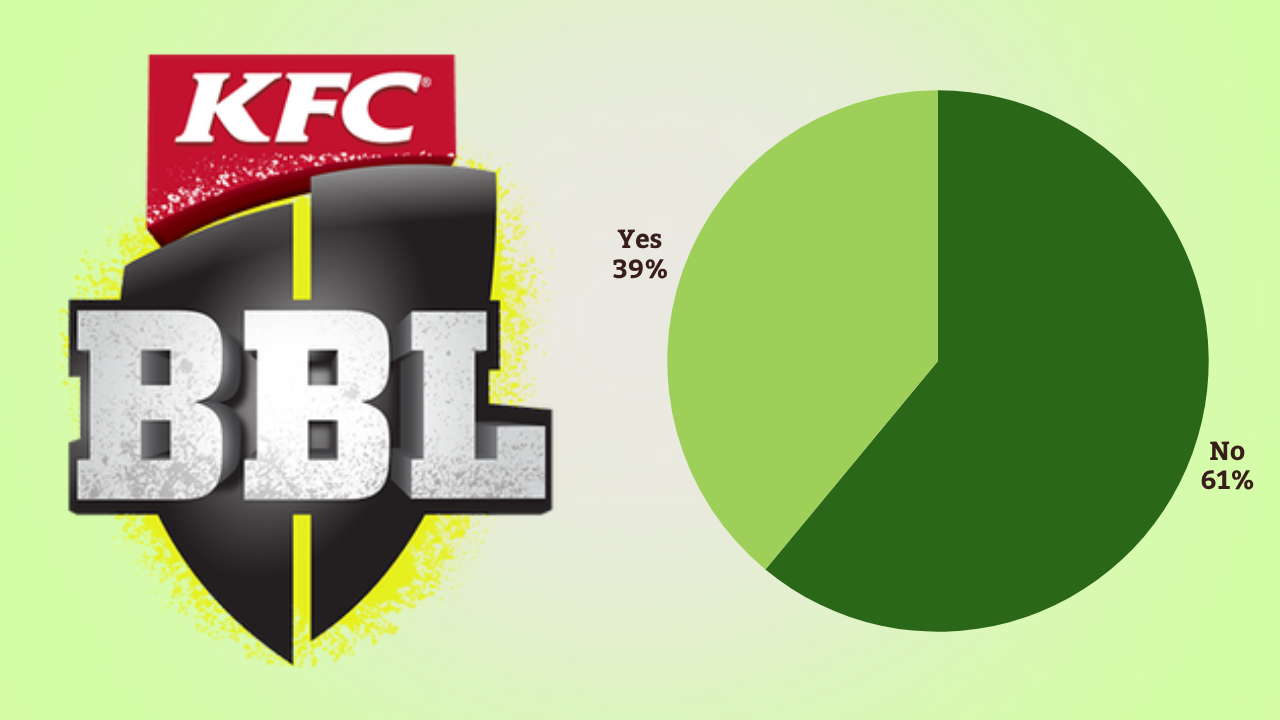
A cricexec poll of global cricket industry executives found that 61% believe the BBL cannot remain globally competitive without private investment, while 39% said it can, highlighting a growing divide over how Australia’s premier T20 competition should navigate an increasingly crowded and commercialised franchise landscape.
The result comes as Cricket Australia continues to weigh the future ownership structure of the BBL amid a prolonged debate involving state associations, players, investors and administrators. At stake is not simply who owns the teams, but whether the league can maintain its position among cricket’s leading franchise competitions without access to the capital that has transformed rival tournaments around the world.
The case for investment
For the majority of executives surveyed, the issue is fundamentally about competitiveness.
Cricket Australia Chief Executive Officer Todd Greenberg has been among the strongest advocates for exploring private investment, arguing that the global T20 market is evolving rapidly and that standing still carries its own risks.
Speaking to SEN Cricket, Greenberg outlined an ambitious vision for the league.
“The way I have described it… I think there will be effectively the Grand Slams in T20 franchise cricket. We have already seen one in the IPL, let us call that Wimbledon. I think The Hundred (in England) will make their mark there. I want to make sure that in Australia, we form part of that Grand Slam series of T20 events.”
That ambition sits at the heart of the debate.
The BBL remains one of the world’s most established T20 competitions and continues to generate profits, but it now operates in a market where privately funded leagues are attracting investment, expanding internationally and competing aggressively for talent.
Greenberg was explicit about what he believes is required to compete in that environment.
“And to do that, you need capital, you need investment, you need the best players, and you need the right window. I am conscious that if we just sit around and hope that we can compete as opposed to genuinely trying to find ways to compete, we might lose our place on that stage.”
As Cricket Australia’s privatisation discussions intensified, Greenberg continued to frame the issue as part of a broader global shift.
Speaking on the ABC Cricket Podcast, he said:
“This might feel new in our country, bringing private capital into sports, but it’s certainly not new globally. The concept of bringing private capital to cricket is inevitable at some point.”
He added:
“The question will remain about when that actually happens. My view is it will happen. What we have to make sure is the levels of control are in place and you’re not just taking the biggest cheque, you’re looking for the right partner.”
The concern among supporters of investment is not simply about raising money. It is about maintaining relevance in a market where leagues across India, England, South Africa, the UAE and the United States are all competing for players, audiences and commercial partners.
Greenberg acknowledged that reality directly.
“Can all of these leagues survive and can they all thrive?”
He then outlined where he believes the BBL should sit.
“I think what the future looks like is global T20 leagues will have, and I use this term loosely, a concept of a grand slam where there’ll be three or four major T20 global leagues participating around the world.”
Adding:
“Clearly the IPL’s already found its niche, I think The Hundred’s anchored itself into a slot, and unashamedly we want to ensure the BBL sits in that apex.”
Competition is intensifying
The case for investment has also been reinforced by developments beyond Australia.
New Zealand Cricket’s exploration of a privately backed NZ20 competition illustrated how quickly the southern hemisphere landscape could change.
While New Zealand ultimately chose to focus on revitalising its domestic structure, the proposal itself highlighted the growing attraction of investor-backed models.
The pressure created by that environment was acknowledged by Cricket Victoria Chief Executive Nick Cummins when Cricket Australia responded to New Zealand’s decision.
“There’s no doubt, coming just then with the announcement of New Zealand, that the landscape is much more competitive than when I started at Sydney Thunder at BBL 3 when we had the window to ourselves,” Cummins told reporters at the briefing.
Cummins also pointed to how player economics have changed.
“There was no pressure. Someone like Kevin Pietersen would gladly come and play in the Big Bash.”
Before adding:
“(But) if Kevin Pietersen was playing now, he would have a range of decisions. One of them would be not to play at all, because he could earn enough money elsewhere, so we really need to be cognisant of that.”
For many executives, these realities help explain why 61% believe private investment may ultimately be necessary.
The argument against privatisation
Yet the poll result also reveals substantial resistance.
Nearly four in ten executives believe the BBL can remain globally competitive without outside ownership, reflecting concerns that introducing investors could create problems as significant as those it seeks to solve.
The strongest opposition has come from within Australian cricket itself.
Cricket New South Wales CEO Lee Germon has consistently argued that growth and privatisation should not be treated as synonymous.
“Our position is that we still do not believe that the sale of the BBL clubs is the right approach here,” Germon told reporters
Importantly, Germon’s objection is not to the league becoming stronger.
“What I would like to reiterate is that we are in fierce agreement with Cricket Australia that we need to invest in the BBL, that we need to grow the BBL, we need to have our best players play in the BBL and in a window that allows that.”
Instead, his concerns centre on governance and control.
“So we see some risks here, which Cricket Australia share, by the way, I think we all understand this, that one of the risks in bringing that is that you suddenly open up the involvement of external investors who will not have aligned goals with the states or Cricket Australia in terms of how they want the game to be run.”
He continued:
“Our biggest fear is external investment coming into a cricket ecosystem, which is working very effectively and very well now, in terms of adding more voices to how our cricket is run and how our players are produced.”
Queensland Cricket has adopted a similar position.
In a statement announcing it would not proceed to the next phase of the sales process involving the Brisbane Heat, the organisation said:
“Instead, we want to continue to find ways to work with Cricket Australia to grow the Big Bash Leagues in Australia and make it one of the best T20 competitions throughout the world without selling a minority share in the Brisbane Heat.”
That statement is perhaps the clearest articulation of the argument underpinning the 39% view: that competitiveness and private ownership are not necessarily inseparable.
A decision that will shape the next decade
What makes the debate particularly significant is that both sides broadly agree on the destination.
Few dispute that the BBL must continue evolving, attract leading players and strengthen its commercial position.
The disagreement is over the mechanism.
Supporters of private investment view capital as the fuel needed to keep pace with a rapidly changing global marketplace. Opponents fear that introducing outside investors could dilute cricket’s long-term priorities in pursuit of commercial returns.
Cummins perhaps captured the scale of the decision best.
“I think us and the IPL are the only T20 comps that actually make money, and we want to make sure that we stay at the front of the pack. When we make this decision, we’ve got to make sure that we’re thinking about the next 50 years, not just the next five.”
That long-term perspective may explain why the debate has become so intense.
The cricexec poll suggests most industry leaders believe private investment will eventually be required if the BBL is to remain among the world’s elite T20 competitions. But the sizeable minority view also demonstrates that concerns around governance, identity and control remain far from resolved.