
A litigator’s first principle
Ask Cecelia Joyce why cricket has been so slow to recognise the people who actually play it, and she answers not as a former international or an advocate, but as a lawyer.
“As a litigator, I’d say leverage equals action,” she says. “If you don’t have the leverage, you’re just going to struggle to get anywhere.”
It is a deceptively simple line, and it runs through everything she does. Joyce spent seventeen years opening the batting for Ireland — 57 one-day internationals and 43 T20 internationals between 2001 and 2018 — while building a parallel career as a commercial disputes lawyer. Today she is a senior associate in the Disputes and Investigations group at A&L Goodbody in Dublin, a founding member and now president of the Irish Cricketers’ Association (ICA), and a long-serving board member of the global players’ body, the World Cricketers’ Association. Her professional life is spent identifying pressure points, weighing risk, advising clients on strategy and moving opponents toward settlement. Her volunteer life is spent applying exactly that mind to a sport that, for most of its history, treated the player’s claim on the game as a matter of sentiment rather than entitlement.
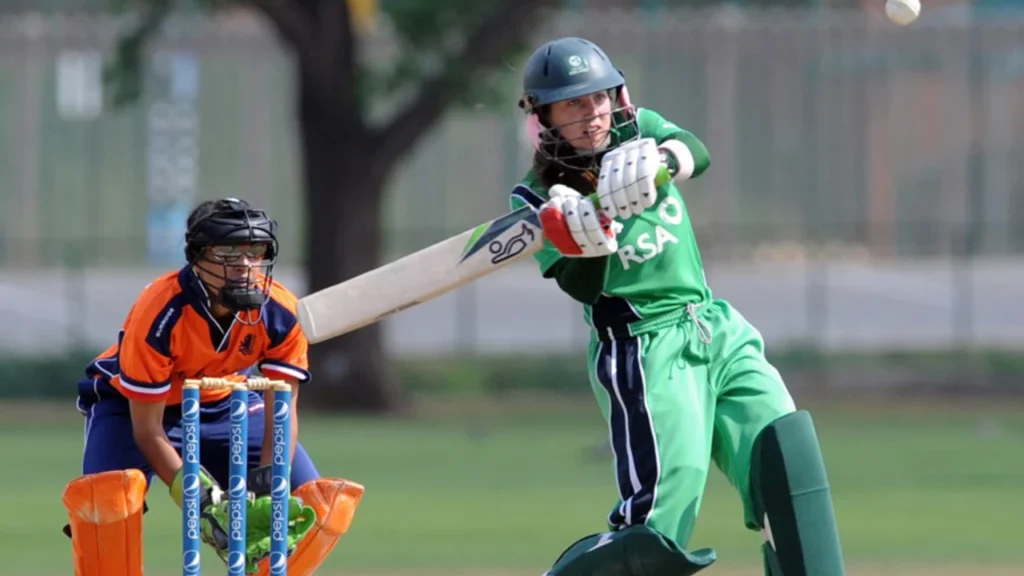
That duality is rare in cricket administration, and it makes Joyce an unusually clear-eyed witness to one of the sport’s defining tensions: a game awash with new money that still, in large parts of the world, asks its players to perform for almost nothing.
“My brother’s time was valued more than mine”
To understand why this matters so much to Joyce, it helps to understand where she comes from.
She is one of nine children in what is arguably world cricket’s most prolific family. Five Joyce siblings have represented Ireland: Cecelia, her twin sister Isobel — who captained the national side — and brothers Dominick, Gus, and Ed, the last of whom also played for England. Their father introduced the game; their mother kept score in internationals. The family helped drag cricket in Ireland from a niche, sometimes faintly stigmatised pastime toward something closer to the mainstream.
It was also, in microcosm, a lesson in how unevenly the sport rewards its own.
“I grew up with eight brothers and sisters, and we all have different careers,” Joyce says. “In cricket, my brother’s time was valued more than mine. He played in a league, he played international cricket, he played for England, he played for Ireland.”
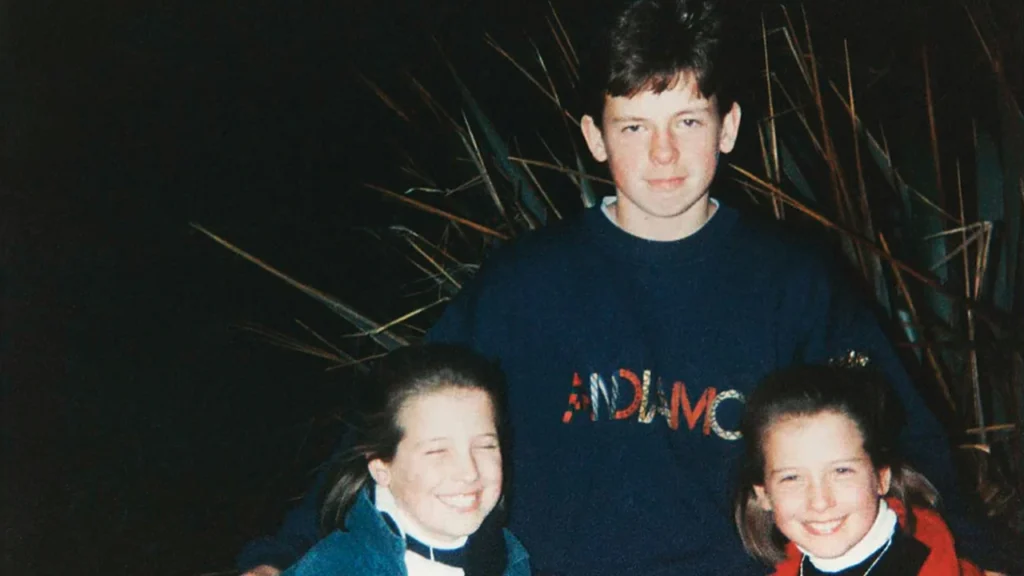
Joyce was obviously not remunerated at anywhere near the same level. She is not bitter about it — the affection in the Joyce household is well documented, and she is careful to note how supportive Ireland’s past players have been of the current generation. That said, as she remarks about the gender disparity: “You can justify it all you like. Doesn’t feel good.”
The asymmetry lodged itself early, and it never left. A history graduate of Trinity College Dublin, where she captained both the cricket and hockey teams, Joyce frames her motivation in the language of the discipline she studied.
“I’m a history graduate, so I’m consigned to never forgetting how far we’ve come,” she says. “And I feel that if I can try to make a difference in the labour movement, and in the position of women in society, I will.”
Why cricket came late to the fight
Joyce’s central diagnosis is structural, and it explains a great deal about why cricket lagged behind other sports in giving its players a voice.
“The culture of the leading countries is going to drive the culture of the sport,” she says. “Cricket is very much an international sport first, and a domestic sport second, historically. So you don’t have the leagues driving that. In other sports — football, American football, basketball — you’ve got domestic tournaments that become very valuable, and therefore you have more bargaining chips. In international cricket, that just isn’t there in the same sense, because you don’t have the same leverage.”
The consequence is that cricket’s labour gains have been lumpy and geographically concentrated. Strong players’ associations in Australia and England made real strides decades ago, drawing on national histories of workers’ rights. Elsewhere, the idea that paying someone makes them, in law, a worker has been slow to take hold — partly, Joyce notes, because of a doctrine that sport likes to invoke for itself.
“There’s still that theory of what they call in EU law the specificity of sport,” she explains. “In other words, that there’s a derogation from the ordinary rules of commerce when it comes to sport, because of its specific position in society and its importance.”
She extends the point to an institution most people are reluctant to criticise. “Essentially the Olympics benefits from the work of athletes who are not paid — and are not only not paid, but also can’t even commercialise their performances during the Games.”

That model, she warns, carries a hidden cost: it quietly narrows who can afford to compete at all. “I don’t want cricket to become a sport for elitism — and it hasn’t historically been,” she says. “But it’s going to get there if it doesn’t start paying people properly for their time. Because who can afford, in this country, to be paid less than minimum wage for a year, and then expect to be kept in it? Ireland, and Dublin in particular, is one of the most expensive places in the world to live.”
The Netherlands player on unpaid leave
If there is a single image that captures Joyce’s argument, it is two players facing each other at a World Cup.
“You’ve got somebody playing for the Netherlands against somebody from Australia,” she says, “and we’re talking about both women and men. The person from Australia is earning life-changing money. And the person from the Netherlands is taking unpaid leave from work.”
This is the constituency Joyce speaks for: not the stars of the wealthiest boards, but the players for whom representing their country is a financial sacrifice rather than a windfall. It is also what distinguishes the WCA’s mission from the better-resourced unions that dominate the conversation. The leverage that Australian and English cricketers can bring to bear simply does not exist in the same form for Ireland, the Netherlands, Scotland, or the Associate nations — which is precisely why the structure around them matters so much.
She points out some real gains that have been made for all players via the WCA’s collective agreement with the ICC relating to prize money and commercial rights payments for ICC events. The model is a gender equity deal based on equal prize money for equal finishing place across men’s and women’s events. Joyce is particularly proud of the impact this has had for the players from countries like Ireland and Scotland, but also for players from countries who do not have players’ associations and whose own bargaining power is thereby reduced.
The case for incremental progress
For all her sharpness about the scale of the problem, Joyce is no firebrand. Her method is patience, and her evidence is Ireland itself.
“I’m a big believer in incremental progress,” she says. “I don’t believe we have to solve all problems at once, nor do I think it’s helpful to try. So I try not to go on religious crusades too much. Something very basic — like people have to be paid for the work that they do, especially if there’s a contract that says they’re going to be paid — is an obvious one.”
The Irish women’s pathway, which she helped drive, is her proof of concept. It began modestly and built logically. “The first step was expenses and mileage. The second step was a payment in lieu — so when our schedule got busier and we were being asked to be available more often and had to take more and more time off work, we’d get a payment from Cricket Ireland in lieu of the time we had to take off,” she says. “In other words, to continue to pay your rent or your mortgage if you had one. That got us to a place where there was a stream of money being paid towards women. And it wasn’t such a big leap from there to getting part-time contracts, and then from part-time contracts to full-time contracts.”
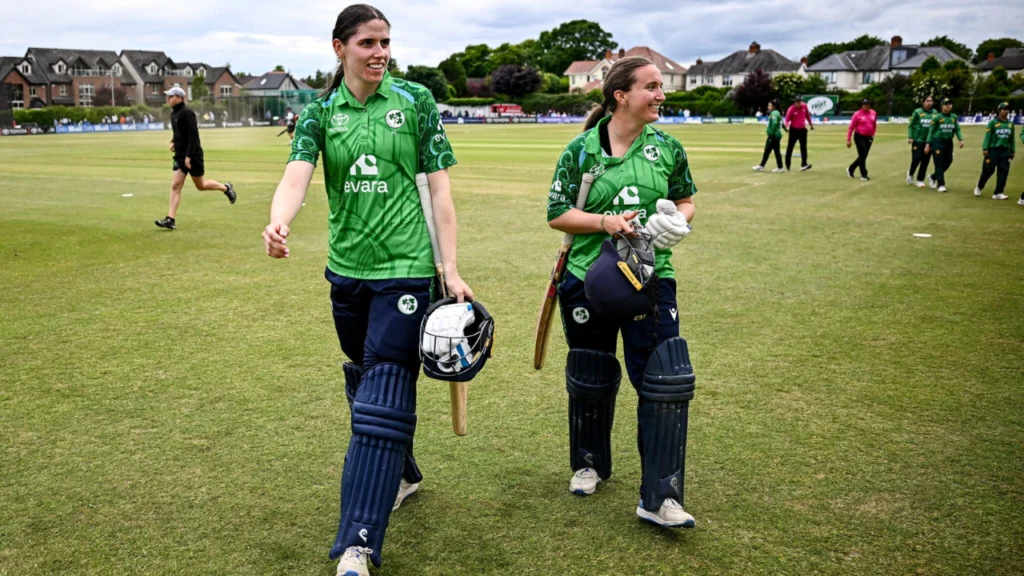
That progression has been faster than almost anyone expected. The payments in lieu arrived around 2017 and the line from there to professional contracts is, as she puts it, “a very, very clear incline.” The current generation of Irish women are now paid in a way that Joyce’s never was, and she insists that is a source of pride rather than resentment among those who came before.
“Past players are only delighted for the current players,” she says. “Sometimes people can look back and say, well, it’s not fair, we never got that. But actually, the support from past players in Ireland has been immense.”
The women who don’t reach the top
It is at the intersection of two of her commitments — players’ rights and the position of women — that Joyce is most candid, and most willing to challenge an organisation she serves.
Asked why cricket’s off-field leadership remains so heavily male, even within bodies designed to represent players, she does not flinch. The World Cricketers’ Association board, she points out, is largely composed of the CEOs and presidents of national associations — so its gender balance is a downstream symptom, not the disease.
“Your problem isn’t with the World Cricketers’ Association necessarily,” she says. “It’s really more to do with the promotion of women within the governing bodies and the associations themselves.” She is, by her own description, one of the few women among those association leaders at the table, and one of the only ones doing the job entirely as a volunteer.
The deeper cause, she argues, is one that economics has now formally recognised. The 2023 Nobel laureate Claudia Goldin won her prize for demonstrating how childbearing drives the gender earnings gap — a finding Joyce greets with affectionate exasperation.
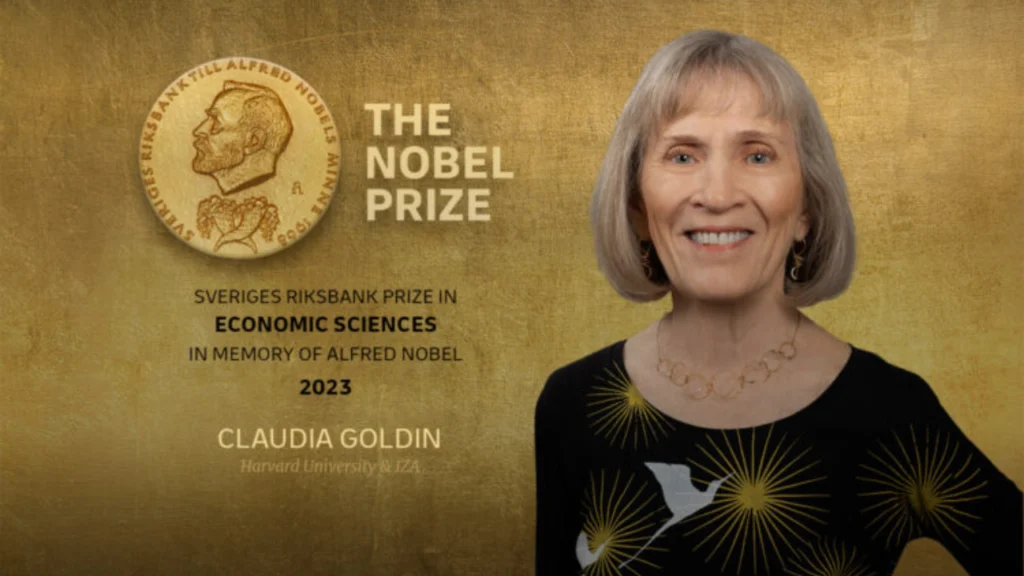
“A recent Nobel Prize winner demonstrated what my mum said was the most obvious thing she’d ever heard in her life,” Joyce says. “The gender pay gap and the executive gap are both caused by the fact that women are the people who have children. It’s incontrovertible. From law firms to executive positions — if you have to take, as I have, two maternity leaves, you are just at a disadvantage.”
She refuses to speak for all women, a caveat she returns to more than once. But she is unsparing about her own situation. “I really think the impact of maternity leave is about three years — one year pregnant, one year on leave, one year coming back,” she says. With twin daughters aged five and a son nearing two, she is clear about her limits: “I’m not willing to be away from them any more than I already am. If I had to do much more travel in this role, honestly, I wouldn’t do it.”
The fix, in her view, is partly cultural and partly a failure of imagination. Organisations reward the wrong thing. “We probably overvalue the recent and undervalue the potential,” she says. “Women tend to be assessed on recent output, and men tend to be assessed on potential. A woman has to demonstrate achievements, literally be able to show output, which is a challenge when you have interruptions caused by childbearing.”
The remedy is to plan deliberately for the long term: to identify talented women, support them through the years when children dominate, and accept that a leadership timeline can be different without being lesser. Joyce concedes this is harder for small players’ associations than it might be for a law firm or large corporate — “tapping someone to be a CEO in five years’ time just isn’t happening” — but she sees a role for sponsorship and mentorship, and for boards willing to choose someone who doesn’t resemble the person who held the job before.
The context sharpens the point. From March 2026, Cricket Ireland has been led by Sarah Keane, who becomes the first female CEO of an ICC Full Member nation — and who, like Joyce, is a qualified solicitor. Joyce is careful not to put words in Keane’s mouth, but she describes the kind of leadership she hopes the moment represents: a living wage for players, greater equity across regions, and sustainable investment in the parts of the game that have always had to go without.
The bravest players have the most to lose
The most counterintuitive idea Joyce offers concerns who actually carries the burden of collective action — and it inverts the usual assumption that the biggest stars take the biggest risks.
“The players with the most leverage are going to have to be the bravest, which is always very hard,” she says. “Those who have the most to lose have to stand up with the rest of the players.” Collective action needs all players to have the greater good in mind, and for the highest-paid cricketers to stand shoulder to shoulder with the rest. “I ask my players to think of their teammates in the same shirt, and to think of themselves in a few years’ time and to fight for better conditions not only for themselves now, but for their past and future selves.”
And yet, she points out, it is often the lower-paid players who sacrifice the most in proportional terms. Recent flashpoints — including a Caribbean T10-format franchise tournament where players went unpaid and some refused to take the field — make the dynamic vivid. “If the Irish players were to take collective action, they’d be losing less money, but they’d be losing more personally, because they have less to lose,” she says. “When we ask them not to sign squad terms — the Australians are millionaires with so many opportunities, but our guys are thinking, what does this mean for me? I really have to go to this World Cup. It is so important that both groups are involved.”
Her answer to that bind is twofold: remind the biggest players of the responsibility their leverage confers, and remind everyone else of the players who sacrificed before them. The strongest associations, she says, already do this instinctively. “West Indies, New Zealand, Australia, England, South Africa — they are absolutely outstanding at educating their players on the benefits of collective negotiation, and the fact that other players made sacrifices so that they can be where they are.”
A global citizen of the players’ movement
The franchise era complicates all of this, and Joyce knows it. As more players choose lucrative club contracts over international cricket, the old lines of allegiance blur — and so does the sense of shared responsibility that collective action depends on.
“With the franchisation of cricket, there may be less allegiance,” she says. “I’m not saying people aren’t loyal to their countries. But if you become a team of one, responsible only for yourself, your decisions are a bit different. We’re going to have to get players to think of themselves as global citizens — to feel affiliated to the world players’ movement.”
This is the thinking behind the WCA’s Leagues Hub, and behind its close collaboration with the incoming European T20 Premier League. Part of the aim is to bring best practice into new competitions and establish a presence in them early. But part of it is more basic: making sure that players moving through these ecosystems, and the retired internationals who fall between national structures, have someone looking out for them.
“For your retired international players — where do they sit, and who’s helping them?” she asks. “We need to be thinking about that, supporting them as global players, rather than as national or terrestrial players.”
The next lever: Europe and the courts
If leverage equals action, then Joyce is watching closely for where the next leverage might come from. Her answer, characteristically, is the law — and specifically, the courts of Europe.
“The stronger European countries become in sport — any sport — the better the regulation tends to become,” she says. “If you look at football, the European Court of Justice hasn’t allowed UEFA to run things its own way. It has put constraints on them. That’s where a lot of the principles in European sports law come from.”
She points to the precedents that reshaped football and, more recently, cases in ice skating, all turning on the principle that bodies engaged in commercial activity must respect free movement and competition law. She notes that the Court of Arbitration for Sport has just established a presence in Dublin, and that the rise of European cricketing nations — Ireland, the Netherlands, Italy — could change the legal weather around the player movement in ways the sport has not yet reckoned with.
“It’ll be very interesting to see how that has an impact on the player movement and the sport overall,” she says. “An international governing body or not, the Court of Justice of the European Union requires entities engaged in commercial arrangements to comply with the principles of free movement and competition law. I see some real opportunity there.”

It is a lawyer’s optimism — patient, precedent-minded, alert to the slow accumulation of small advantages into structural change. After more than two decades inside the game, first as a player who was paid almost nothing and now as one of its most persistent advocates, Joyce has learned not to expect unprompted concessions.
“I don’t think anyone’s going to give up more than they have to, by their analysis of the commercial drivers,” she says. So the players will have to keep finding leverage, and keep being brave with it. That, in the end, is the whole of Joyce’s case.