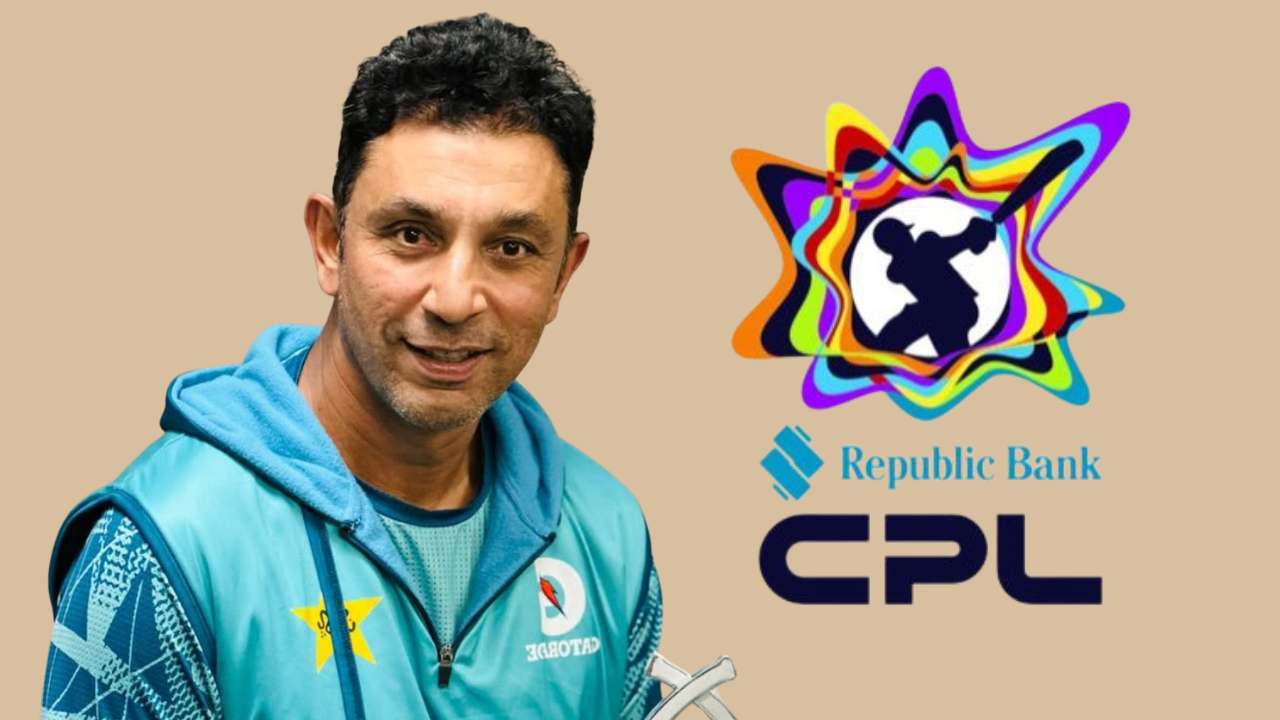
Azhar Mahmood has alleged that his Pakistani heritage cost him a coaching role in the Caribbean Premier League, using the experience to warn that similar dynamics could affect Pakistani players in The Hundred. Speaking on the Wisden Cricket Weekly podcast, the former Pakistan all-rounder directly connected his personal setback to what he believes is a broader, IPL-linked franchise ecosystem shaping opportunities across global T20 leagues.
Mahmood first outlined when the incident occurred. “It happened four years ago straight away after Covid when the CPL was happening,” he said on the Wisden Cricket Weekly podcast.
He then detailed how the opportunity unfolded and why it fell through. “I was asked to coach in one of the franchises and later on I found out because my background as a Pakistani they said we can’t have any Pakistani coach or player in our side,” he added.
The allegation places nationality at the centre of a professional decision and frames his concerns about the direction of franchise cricket as rooted in lived experience rather than speculation.
From personal setback to structural concern
Mahmood argued that the issue is not limited to a single tournament. He suggested that the expanding footprint of IPL-linked ownership groups across competitions has made pathways narrower for Pakistan-origin professionals.
“I’m an English qualified coach and I was coaching Surrey county cricket and then I went back to Pakistan for the last two years, and now because I was part of the Pakistan set-up for the last two years, finding roles now is quite difficult. Everything is connected to the ecosystem of the IPL. They have four or five franchise leagues, SA20, MLC – as a coach I find it tough to get into those teams which are owned by IPL and Indian owners. It’s difficult. The same thing goes for the players as well,” he continued.
The former all-rounder’s career spans 164 international appearances for Pakistan between 1996 and 2007, alongside extensive county stints with Surrey and Kent. After becoming a British citizen in 2011, he transitioned into coaching, serving as Pakistan’s Bowling Coach from 2016 to 2019 and later returning as acting Head Coach in 2025 following Jason Gillespie’s departure. He has also held multiple coaching roles in the Pakistan Super League.
Despite those credentials in both English and Pakistan cricket structures, Mahmood indicated that affiliation with the Pakistan setup has complicated his access to certain franchise environments.
“It’s not the ideal situation for me,” Azhar Mahmood said on the Wisden Cricket Weekly podcast.
Hundred ownership model in focus
Mahmood’s remarks come amid heightened scrutiny of The Hundred, where Southern Brave, MI London, Manchester Super Giants and Sunrisers Leeds are under partial IPL-linked ownership. Reports have suggested concerns over whether Pakistani players may be overlooked within that framework.
Rather than framing the debate purely as an auction issue, Mahmood positioned it as a governance matter for English cricket administrators.
“There are a lot of Pakistani communities in England,” he stated.
He continued, “There is a great relationship between the England Cricket Board and Pakistan Cricket Board, and you can see the people of England are crazy about cricket, coming from Pakistan. Hopefully the ECB will act on those things.”
By highlighting both the strength of the Pakistani diaspora in England and the longstanding relationship between the two boards, Mahmood underscored why he believes the ECB has both responsibility and incentive to address any perceived imbalance.
Franchise expansion and reputational risk
The IPL’s commercial expansion into leagues such as SA20, Major League Cricket and The Hundred has reshaped global franchise cricket. Pakistani players have not participated in the IPL since 2009, and representation within IPL-owned teams in overseas competitions has remained limited.
Mahmood’s account of losing a CPL role, combined with his broader critique of interconnected ownership structures, adds a personal dimension to an increasingly structural debate.
For the ECB, the discussion now extends beyond player registrations or draft mechanics. It concerns how The Hundred maintains credibility as an inclusive, merit-based tournament while operating within a rapidly consolidating franchise ecosystem.
Mahmood’s message is clear: what happened to him in the Caribbean should not become a pattern elsewhere.