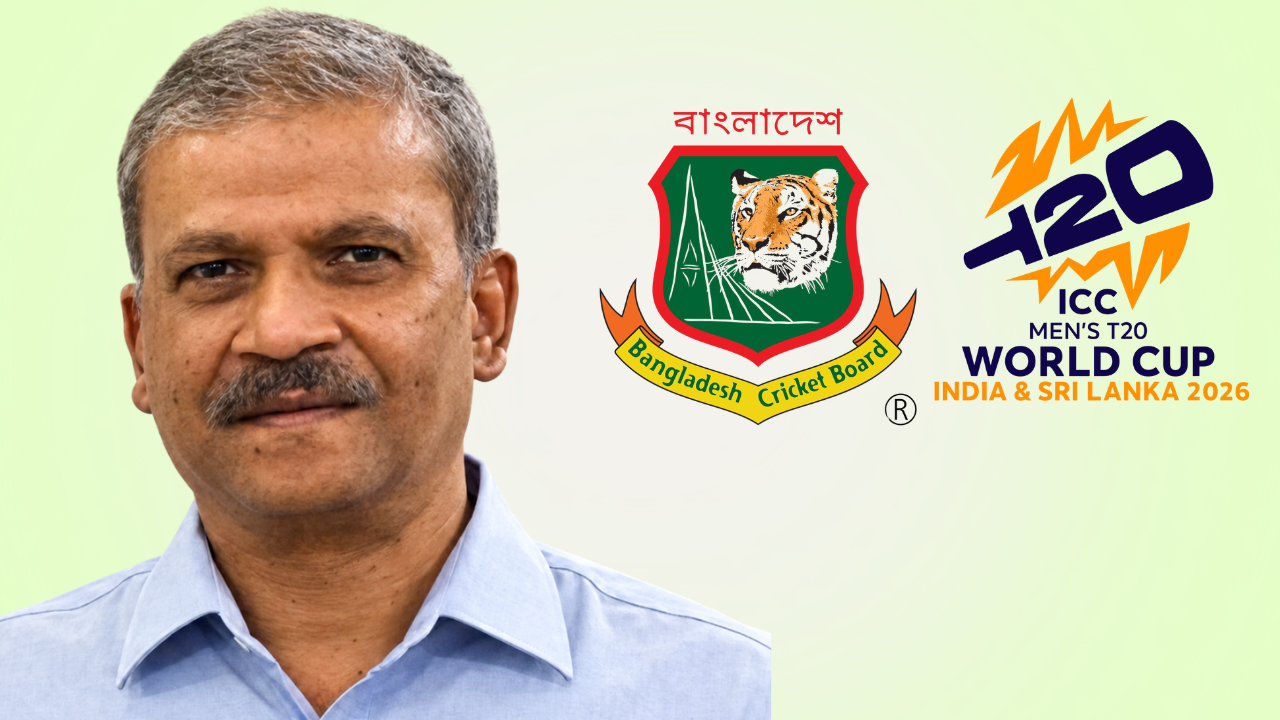
A Bangladesh government inquiry has identified former Youth and Sports Adviser Asif Nazrul and the then interim government as responsible for the national team missing the 2026 ICC Men’s T20 World Cup, concluding that Bangladesh should have participated in the tournament, according to a report by Cricbuzz journalist Atif Azam.
The three-member committee was established by the Ministry of Youth and Sports to examine how Bangladesh came to miss the tournament and assess the roles of the authorities involved. It was headed by Ministry of Youth and Sports Additional Secretary Dr A.K.M. Oli Ullah and also included former Bangladesh Captain and current Chief Selector Habibul Bashar and Barrister Faisal Dastgir.
Inquiry puts decision-making under scrutiny
The committee found that the BCB supported the position taken by the sports ministry under Nazrul rather than independently changing the course of the decision.
Dastgir, speaking at a press conference at the National Sports Council, said: “Based on what emerged from the investigation, our discussions with the relevant people, media reports and everything else, it can be said that the person responsible for not going to the World Cup was then youth and sports adviser Asif Nazrul. The government at the time and he were responsible.”
The committee also examined the BCB’s response during the dispute. In its assessment, the panel identified deficiencies in “independent strategic leadership, crisis diplomacy capability and long-term planning” within the board’s handling of the situation.
Dastgir added: “Bangladesh definitely should have gone to play in the World Cup.”
Players were positive about competing in India
The dispute developed after Kolkata Knight Riders released Bangladesh fast bowler Mustafizur Rahman from their IPL squad following a BCCI directive. The BCB subsequently sought to have Bangladesh’s World Cup fixtures shifted from India to co-host Sri Lanka.
The ICC rejected that request after reviewing the security situation, and its Board confirmed on January 21 that Bangladesh’s matches would remain in India. Bangladesh declined to participate under the existing schedule and Scotland replaced them on January 24.
According to Cricinfo, the inquiry interviewed Bangladesh T20I Captain Litton Das, Test Captain Najmul Hossain Shanto, Assistant Coach Mohammad Salahuddin, BCB President Tamim Iqbal, Chief Executive Nizamuddin Chowdhury and former General Secretary Syed Ashraful Huq. Litton and Shanto had attended a meeting with Nazrul and then BCB President Aminul Islam after the ICC Board’s decision, with both players indicating during the inquiry that they had been positive about playing the World Cup matches in India.
The committee interviewed 12 people overall but did not obtain statements from Nazrul or former BCB President Aminul Islam. It also did not contact the ICC during its investigation.
Tamim questions political influence on decision
The inquiry assessed political tensions between Bangladesh and India, the ICC’s refusal to relocate the fixtures and government intervention as having a very high impact on the eventual outcome. It classified the BCB’s failure in negotiations as having a high impact and communication failures as having a medium impact.
BCB President Tamim Iqbal said in testimony to the inquiry committee: “Personal grudges powered by another country’s opinion should not be the factor in destroying the dreams of players and people of Bangladesh.”
Tamim also told the committee that 14 teams opposed Bangladesh’s attempt to relocate its matches, while the Pakistan Cricket Board supported the proposed change.
Nazrul accepts primary responsibility
Nazrul responded after the inquiry’s findings were released, addressing his own role in the decision and questioning the need for the subsequent investigation.
The former Youth and Sports Adviser said on Facebook: “As the then Sports Minister, the decision not to travel to India for the T20 World Cup was primarily mine. I have stated this publicly on multiple occasions. Therefore, I fail to understand what prompted the Ministry of Sports to conduct a high-profile investigation into the matter and release the findings after all this time.”
Nazrul maintained that the interim government had made extensive efforts to secure a change of venue and defended the decision on the grounds of national dignity, safety concerns involving players, journalists and supporters, and stability ahead of Bangladesh’s national election.
Committee calls for stronger cricket governance
The inquiry concluded that players and supporters bore the greatest consequences of Bangladesh’s absence from the tournament, which was staged in India and Sri Lanka from February 7 to March 8.
Its recommendations included strengthening the BCB’s independence, separating cricket from political disputes and improving coordination between the government, cricket board and other stakeholders during future crises.
The committee also called for greater emphasis on player welfare and security and proposed the creation of a national framework for sports diplomacy.