

Eighty-five, defended
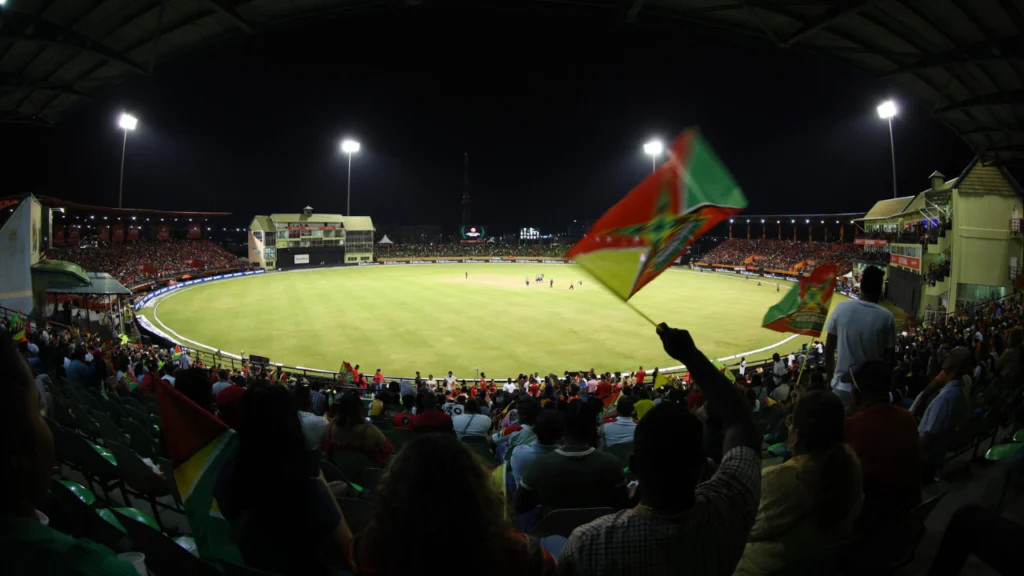
The Guyana Amazon Warriors won the toss at the Guyana National Stadium on Saturday evening, elected to bat, and quickly collapsed to 29 for eight behind the San Francisco Unicorns’ spin-heavy attack. The match’s outcome was effectively determined well under an hour after it started.
The Warriors’ Matthew Forde then made an invaluable 28 and Dwaine Pretorius finished 17 not out, the pair sharing a vital 41-run ninth-wicket stand that took the defending champions to 85 all out in 18.5 overs. It was still, by any conventional reading, over.
But somehow it was not. Pretorius struck with his first ball, removing the in-form Tim Robinson; Gudakesh Motie bowled Connor Esterhuizen with the first delivery of the second over. Mohammad Nabi and Pretorius finished with 3-12 and 3-24 respectively, Imran Tahir was on a hat-trick at one point, and the San Francisco Unicorns were dismissed for 79 when a direct hit from Shimron Hetmyer found Callum Stow short of his crease with seven balls remaining. No total lower has ever been successfully defended in a franchise T20 final anywhere in the world.
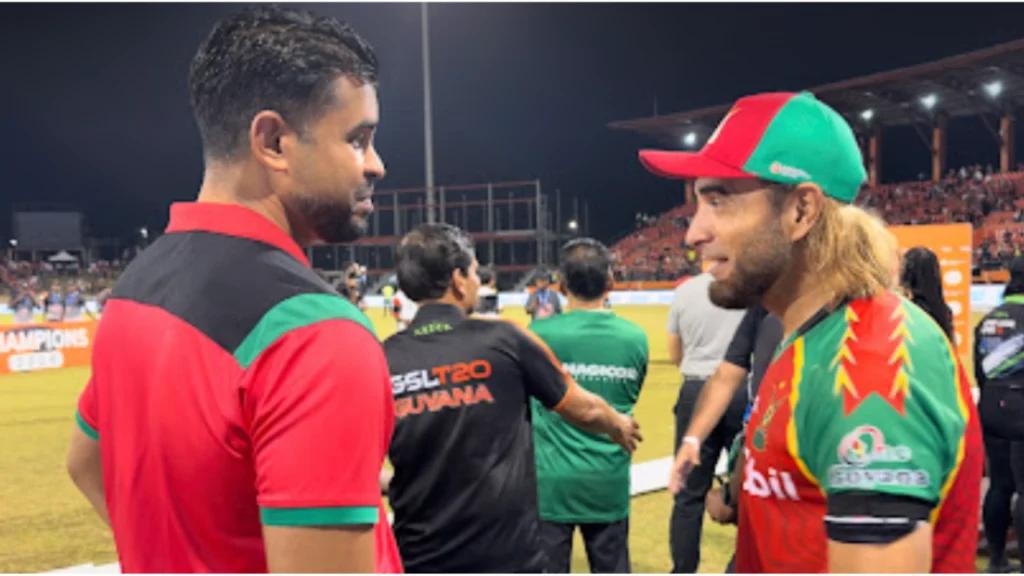
Charles Ramson Jr, Guyana’s Minister of Culture, Youth and Sport, was still processing it an hour later. “I don’t think anybody could have asked for a better game in terms of sheer excitement,” he told cricexec. “When we scored only 80-something, the stands remained full. Nobody left, even though victory was unlikely.”
He was more precise about the arithmetic of his faith: “I started to believe when the Unicorns were three down. But once they were six down, that’s when everybody kind of felt like we really had a shot at this. Even in the last over, I don’t think anybody would say for sure we would win. That’s what makes a great game.”
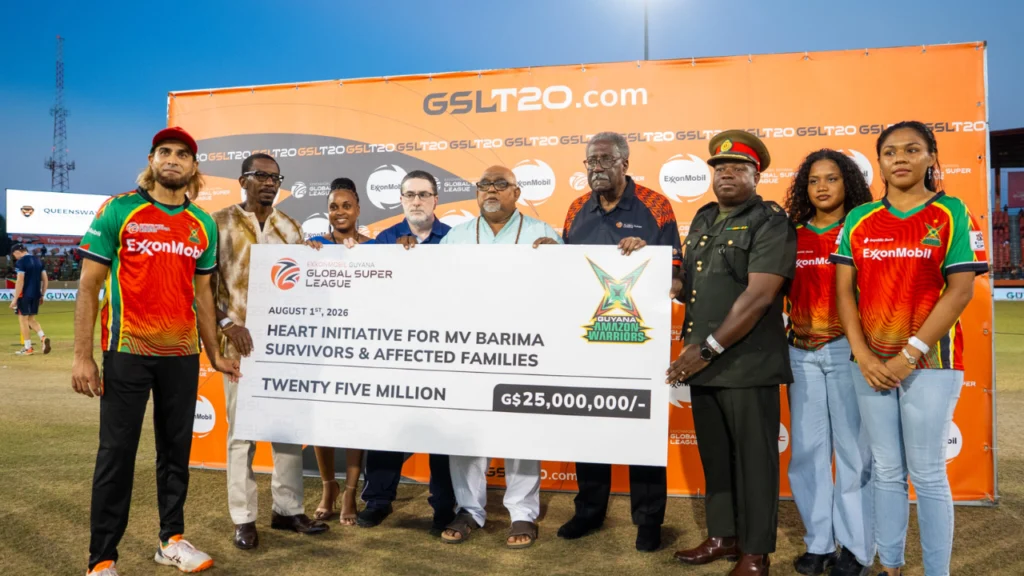
It was also a meaningful game. In a touching ceremony at the toss, proceeds from the final were presented by GSL Chairman Clive Lloyd to families of the victims of the MV Barima, the passenger ferry that capsized off the Essequibo coast on 18 July in Guyana’s worst maritime tragedy in decades.
The match, and this year’s 10-day tournament overall, was a fair advertisement for the standard of cricket the Global Super League has reached in three years. The cricket product is not, however, the main reason the tournament is significant. That has to do with what sits behind it.
A cricket country that came into money
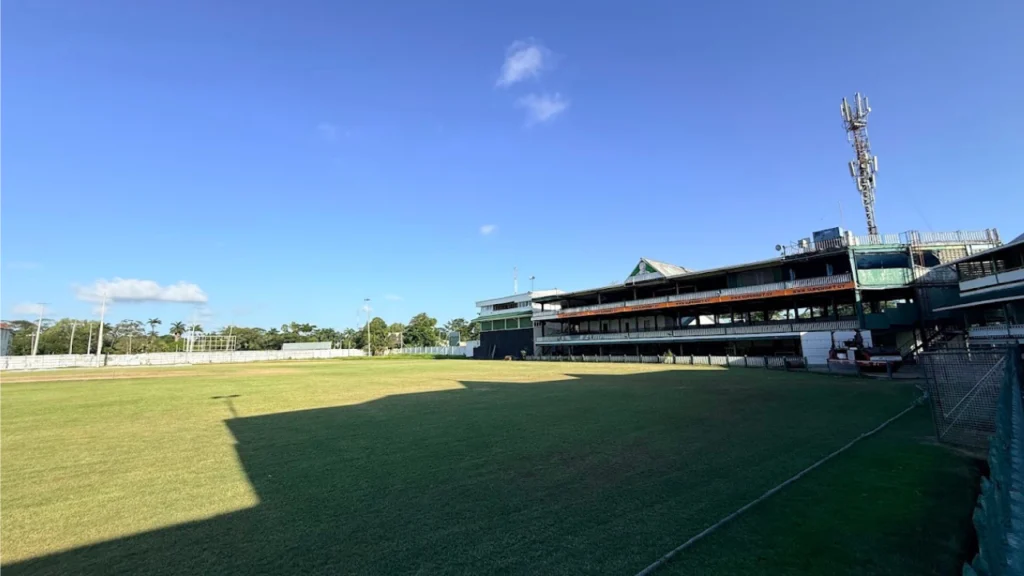
Guyana’s claim on the sport is not open to debate. Bourda — officially the Georgetown Cricket Club Ground, opened in 1884, the oldest major ground in the Caribbean, the first Test venue on the South American mainland, and the only one in the world below sea level, ringed by a moat to keep the water out — staged thirty Tests between 1930 and 2005. The country produced Rohan Kanhai, Lance Gibbs, Basil Butcher, Roy Fredericks, Alvin Kallicharran, Carl Hooper, Ramnaresh Sarwan and Shivnarine Chanderpaul, and, above all of them, Sir Clive Lloyd, the two-time World Cup winning captain who turned the West Indies into the most watched and most commercially valuable team the sport had known at that time.
That lineage means something special here, because for most of its modern history Guyana had little else to put on the world stage. It had a population under a million and, for decades, one of the weakest economies in South America.
Cricket was the thing that held all of it together. Guyana’s society is highly ethnically diverse — with Indo-Guyanese, Afro-Guyanese, Indigenous, Chinese, Portuguese populations. It is also pluralistic in its multiple religions – Hindus, Catholics, Protestants, Muslims, and others all celebrating one another’s festivals.
Against this backdrop, cricket has served as a source of unity, of pride, and of proof — the demonstration that a small, poor, divided country could produce stars the world wanted to watch, and come together to back them.
Then, in 2015 oil was discovered off Guyana’s shores, and in 2019 it started flowing.

The ExxonMobil-operated Stabroek Block offshore oil field has since taken Guyana from net energy importer to South America’s second-largest producer, lifting roughly 900,000 barrels a day against recoverable resources estimated at around 11 billion barrels, if not much higher. In 2022 the country recorded the highest real GDP growth in the world. A nation that spent generations with more heritage than resources now has both.
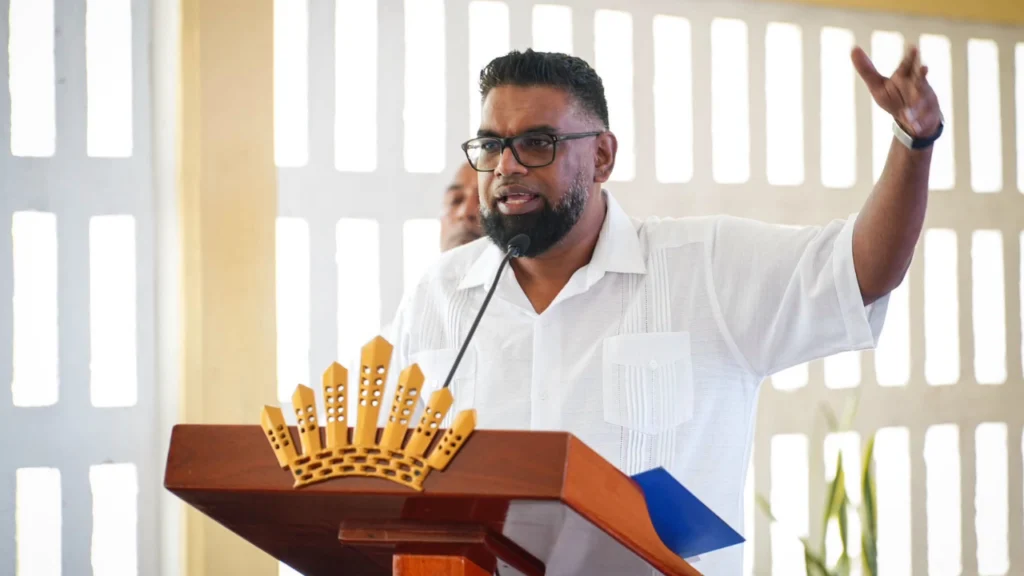
President Irfaan Ali has been explicit about where cricket sits in what follows. “GSL is not just about cricket,” he told cricexec. “It is part of our national strategy of repositioning sports as a major pillar of our economic transformation.” The ambition he attaches to it is regional and global: Guyana as the centre of cricket development across the West Indies, South America and North America, and a tournament built to serve the sport rather than the host.
The authenticity of the claim rests on the heritage rather than the balance sheet. Guyana is not buying its way into a sport it has no relationship with. It is funding one it has been giving to, without much return, for a hundred years.
The President’s tournament
The Global Super League was borne of Ali’s vision, and it consistent with the government’s One Guyana programme. The president took it to the leadership of the Guyana Amazon Warriors, the country’s CPL franchise, under Chairman Dr Ranjisinghi “Bobby” Ramroop. Guyanese hero Sir Clive Lloyd was recruited to be Chairman. The country’s strategic energy partner ExxonMobil were approached to support the ambitious undertaking, and they signed on as title sponsor.
The GSL also answers a practical problem. When the 2007 World Cup came to the Caribbean, a new national stadium was built at Providence — roughly 15,000 seats plus a grass mound — and Bourda’s era as an international venue ended. What Guyana gained in capacity it did not gain in content. The CPL brings roughly five home fixtures a year. Bilateral cricket is not Guyana’s to schedule; the country, like the other Caribbean cricketing islands, is dependent on Cricket West Indies to bring games. Meanwhile the building has continued: the new multi-purpose Bayroc National Stadium in Linden was commissioned this past February; the Anna Regina National Stadium in Essequibo was opened by the President just this past July 3; the 10,000-seat multipurpose Palmyra International Stadium in Berbice will be opened this year; with another a facility mooted for Georgetown – all conceived as regional sports hubs rather than cricket grounds alone.
An annual global tournament, owned locally and staged permanently in Guyana, helps to fill that gap. But filling it was never the point of the exercise – it was just a useful benefit.
Five leagues, one window
The competitive proposition is simple to state and hard to execute: bring the champions of the world’s major T20 leagues to one place, once a year, always in Guyana.
The 2026 edition, sanctioned by Cricket West Indies, ran twelve matches at Providence between 23 July and 1 August. Desert Vipers came as reigning ILT20 champions, a Perth Scorchers XI as reigning BBL champions, Lahore Qalandars as the PSL’s most recent title-holders from the previous season, and the San Francisco Unicorns from Major League Cricket, with the Warriors as hosts and defending champions. Hampshire, three-time T20 Blast winners, took part in the inaugural edition in 2024, which Rangpur Riders won. The absence, as ever, is the IPL.
The mechanics are more complicated than the concept. Squad composition rules travel with each franchise from its home competition rather than being harmonised across the tournament, so an Australian-domiciled side plays to different local-versus-overseas requirements than an ILT20 side does. Because cricketers belong to several franchises across a year rather than to one club, a player can belong to two participating teams at once — Brody Couch is contracted to both Perth and the Unicorns, and had to choose. And because the GSL window sits inside an unforgiving calendar, most visiting sides arrived without the full complement that won them their titles.
Michael Hall, the tournament operations director — a role he also holds at the CPL, and one he performed at the 2007 World Cup hosted by Cricket West Indies across nine countries and 51 matches — describes a competition that begins and ends with the schedule, because nothing else can be resolved until the dates are. The financial model is deliberately clean: participating teams arrange their own travel to Guyana – covered by participation fees from the tournament – and from the moment they land the tournament absorbs the cost and the logistics. The prize pool this year was US$1 million.
Hall also emphasises where this year’s edition sits in the tournament’s life cycle: “In many ways, a competition that is three years old is still very embryonic,” he says, noting that expansion is the natural ambition of any enterprise.
Lloyd wants one specific addition. “We would love to have the winners of the CPL playing in our competition,” he says. “That would give it a little bit more flavour. But you never know what’s in store in the future.”
The year the tournament looked inward
The first two editions were an exercise in external credibility: getting the cricket world to notice, ensuring the event was well run, that teams had a good experience, that everyone was paid on time. It worked.
The third edition added an additional focus on Guyana. Jamie Stewart, CPL co-founder and Commercial Director has spearheaded the GSL’s delivery – along with Warriors owner Ramroop, Sir Clive Lloyd, CPL co-founder and CEO Pete Russell, and former ICC General Manager of Commercial Campbell Jamieson. Stewart says the recent focus has been empowering and enabling the Guyanese ecosystem to take more ownership of the event’s production: “We wanted to look a bit more inward and say — how are we ensuring that this event leaves a legacy, is creating value for the country?” Stewart says. “Not just in terms of how it projects itself externally, but in terms of building capacity internally.”
The campaign that carried it, Super We, was developed by the Georgetown agency Ogle & Stone, and drawn from the way Guyanese speak about themselves.
Guyana internet provider ENet conducted a Talent Search that addressed a long-standing fan complaint: that there had never been a Guyanese face and voice on cricket television in the region: GSL, CPL, or otherwise. Melissa King was chosen as ‘Face of GSL’ and Delwin Neblett as ‘Voice of GSL’, each receiving G$500,000, and both worked the tournament alongside the production team that covers the CPL. A separate ExxonMobil Guyana Super Host search produced two new in-stadium announcers, Rhonda Maxius and Shemar Grey. A Laparkan/Canon photography scholarship placed Afsaana Azimullah alongside the tournament’s official photographer, Ash Allen — an initiative that began with the discovery that the reason Guyana had no local cricket photographers was that nobody in the country owned the long lenses the job requires.
Another substantial initiative ran in parallel with the cricket. On 30 and 31 July, the Government of Guyana, the Ministry of Culture, Youth and Sport and the National Sports Commission staged a two-day sports seminar with Australia’s Deakin University and the GSL, under the title Strengthening Sport in Guyana through Education. It was led by Professor Pamm Phillips of Deakin, a sport management scholar with more than twenty-five years of academic and professional experience across Australia, the United States and Asia, and opened by Guyana’s Director of Sport, Steve Ninvalle, with remarks from Ramson and from Steven Jacobs MP, Minister within the Ministry. It was also facilitated by Jamieson, who currently has a strong association with Deakin University, his alma mater.
The agenda went well beyond cricket. Sessions covered building an ecosystem for sport participation and development through to elite performance, governance, and the sport workforce, followed by a facilitated discussion applying global sport ecosystem case studies to Guyana. The second day turned to sport tourism and leveraging events, and closed on building Guyana’s future sport system.
Lloyd, in his capacity as chairman, framed the seminar as the point of the whole exercise. “I am very proud to call myself Guyanese, and equally proud for GSL to be playing a role in the upliftment of our sporting knowledge base and opportunities for growth in our great country,” he said. “GSL is a proudly Guyanese event that seeks to engage the world and celebrate our wonderful country, both its heritage and its bright future. The latest GSL campaign celebrates the Super We: our greatest strength, which is our people.”
The deepest transfer is happening inside the operation itself. For the first time, Hall worked the tournament with an understudy seconded from the Guyana Cricket Board, shadowing him across the full scope of the role — not only the cricket, but the interface with broadcasters, sponsors and every other external stakeholder. With the exception of Hall and a couple of people shooting content, the entire event delivery staff in 2026 was Guyanese.
What the visitors took home
For the participating franchises, the calculation is part cricket, part market discovery. Avram Glazer – owner of the Desert Vipers as well as Manchester United and the NFL’s Tampa Bay Buccaneers – flew down Guyana during the tournament to meet with the organisers as well as government officials, including President Ali.
Phil Oliver, CEO of Desert Vipers, brought a side that had just won the fourth season of the DP World ILT20 and treated the fortnight as preparation as much as competition. “We’ve learned a lot about our playing group for season five of our own tournament,” he says. “But we’ve done so much off the field, which has been a real positive in lots of ways.” The conditions were unfamiliar, which was the point. So was almost everything else. “We’ve got guys from Dubai who have never been in South America.”
What Oliver keeps returning to is the tournament’s composition. “I think that diversity is attractive to them,” he says of his players. “They appreciate the opportunity to play against different players from different places.” Five squads shared a hotel for a fortnight — an arrangement unworkable in most competitions, and one he describes as great fun. The Vipers went into the interior and saw parts of the country most visitors never reach. “It’s a fantastic place to play cricket,” Oliver says.
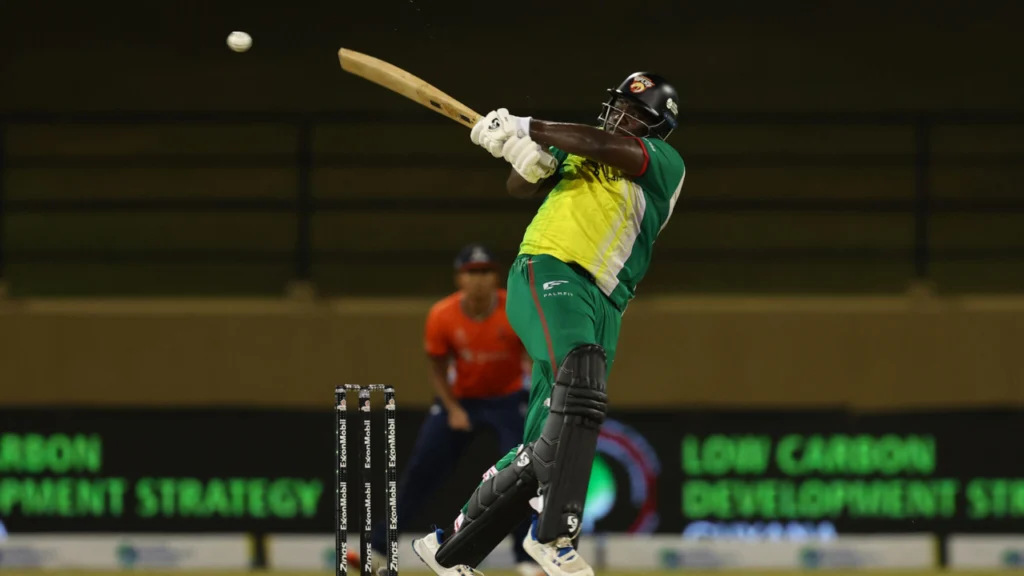
For players, the tournament also functioned as a shop window. Nabi took the Player-of-the-Tournament award with ten wickets and 53 runs, including a crucial unbeaten 40 in the preliminary stage; Pretorius took Player-of-the-Match for his all-round performance in the final. Among the visiting sides, the young leg-spinner Anirudh Immanuel — 3-7 in the final — and Fabian Allen, both of the Unicorns, left Georgetown with considerably raised profiles.
Lloyd sees the exchange running the other way too. Guyanese players and Guyanese crowds are being put in front of a class of cricketer they would otherwise only watch on television — from England, from Australia, from Pakistan and Bangladesh, several with IPL pedigree. “They’re thrilled,” he says. “The people they saw on television, they now can witness. I think it’s a very good innovation. I’m glad I’m involved with it.”
A wider strategy
Cricket is the anchor sport for the government, but it is not the whole programme. In July, Guyana staged Round 3 of the GT Challenge de las Américas at the South Dakota Circuit at Timehri — branded locally as the Guyana Grand Prix, launched at State House by the president in May, and the first time an English-speaking nation has hosted the series, with a full GT3 grid and several thousand international visitors. The Guyana Cup returns to the National Park Raceway in August. In October, the National Stadium hosts the inaugural Caribbean Archery Championship alongside the eighth Caribbean Development Championships. The CPL follows the GSL into Providence.
This is a deliberate sports tourism strategy, and the operational capability being assembled around the Global Super League is intended to serve all of it. “You’ll have this core team of young professionals who can move across all these events, providing event services and marketing and support,” Stewart says. “We’d like GSL to be the leading light of that.”
The competitive logic runs through all of it. Sport, as Ramson puts it, is an entertainment industry now, and a live event is competing not just with other cricket but with everything else claiming the same attention. What Guyana is selling is the thing that cannot be replicated on a replay. “Guyana gives a different kind of experience, just because of the atmosphere and the mixture of culture,” he says. “Guyana has a unique product.” Three editions in, the GSL is well run, well funded, growing in stature and increasingly Guyanese in its execution.
Fifty years ago Clive Lloyd led a West Indies side that made cricket money everywhere it went and came home to a country that had none. He is now chairman of a tournament in that same country, funded by that country, built to bring the world’s best teams to Providence every year. “I’m very impressed with what I’ve seen over the years,” he says, “and we seem to be getting better.” Guyana has waited a long time to be the one doing the inviting.


