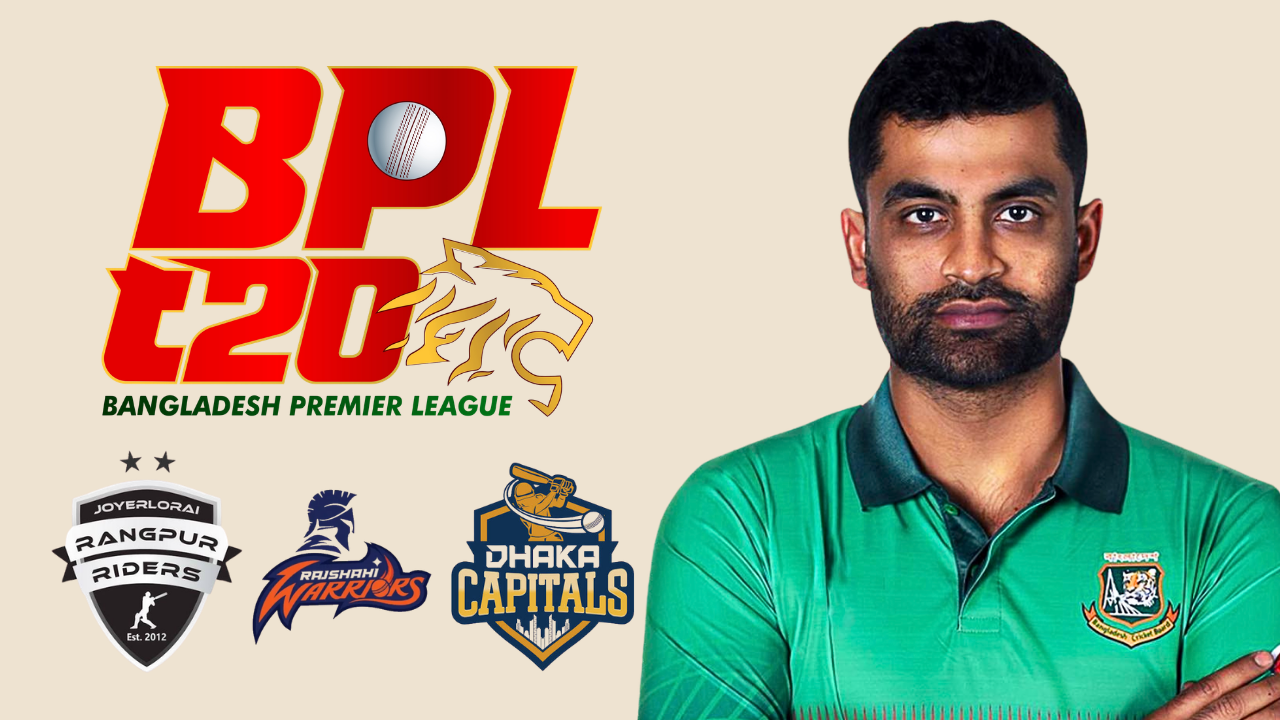
Bangladesh Premier League franchises are prepared to accept a break in the competition if it gives the Bangladesh Cricket Board time to build a more sustainable tournament, with three existing teams backing the reform agenda being pursued by BCB President Tamim Iqbal.
Representatives of Rangpur Riders, Rajshahi Warriors and Dhaka Capitals met Iqbal at BCB headquarters on Saturday to discuss the league’s future. The talks covered the structure of the competition, longer-term scheduling, franchise finances and the need for a model that provides greater stability for teams and players.
Franchises back BPL reform push
The discussions signal significant support from franchise operators for the BCB to prioritise structural changes rather than rush another edition under the existing framework. Rangpur Riders Managing Director and CEO Ishtiaque Sadeque told reporters after the meeting: “As for the BCB’s point of view, right now the BCB has taken a short break and is looking at how the entire tournament can be organised in a better way, with a more sustainable model. Our discussion was very fruitful, and among the three franchises that were here, there was a word from Rajshahi that I really liked: ‘reform.’”
The franchises are seeking a model developed jointly with the BCB and capable of providing greater long-term certainty. Their discussions also addressed when future editions should be staged and how the league can move away from the short-term planning that has characterised its previous operations.
As previously reported by cricexec, Iqbal has made restructuring the BPL a priority rather than staging another tournament simply to preserve its annual place on the calendar. The BCB President previously identified franchise compliance, contractual issues and financial sustainability among the problems requiring attention, while indicating that he was prepared to give the process as much time as necessary.
The BCB has also incurred losses of around Tk40 crore (approx. US$3.3 million) from the BPL over the past two years. Iqbal has said the Board wants franchise arrangements completed much earlier in the tournament cycle, with April-May identified as the preferred period, giving it more time to deal with operators that fail to meet their commitments.
Five-year calendar becomes central demand
One of the clearest proposals emerging from Saturday’s meeting was a five-year BPL calendar. Franchises believe knowing the tournament window well in advance would strengthen their ability to recruit players and plan their operations in an increasingly congested global franchise market.
Sadeque told reporters: “We also discussed what the model would be like, starting from this time slot, which dates it would be held on, and for five years. From whenever the next BPL takes place, we have asked for a five-year calendar. Because when we go to contract players, in the international T20 market, there are a minimum of 20 franchise cricket competitions taking place. So our BPL gets the lowest priority. When we want to bring top-class players, we have said that we need to be given the calendar for five years.”
The push goes beyond securing overseas talent. A fixed multi-year schedule would give franchises a longer planning horizon for building teams, securing commercial partnerships and preparing for future editions rather than operating around a tournament window established on a shorter-term basis.
Player payments expose financial pressure
Financial sustainability is another major part of the proposed reset. Rangpur Riders, which has been involved in the BPL for a decade, still has outstanding payments to some local and international players months after the most recent edition.
Sadeque told reporters: “Actually, you know better than us that, as far as the players’ bread and butter is concerned, this is how it is here. At the same time, when the BPL ends, these very players then chase the franchises. I have no shame in saying that Rangpur Riders have been here for 10 years; this has never happened to us. But even now, after January, today it has probably been running for seven or eight months, and we still have payments remaining for some local and international players.”
The financial strain also extends to commercial agreements underpinning franchise operations. Sadeque added: “Because the sponsors who had agreements with us do not make the payments according to their commitments. And the market situation is getting so bad day by day that it will get even worse. So, rather than holding a nominal BPL, committing to paying Tk 30 lakh but then not paying the player the last Tk 15 lakh, not answering the phone and disappearing—it is better to take some time and do it under a good model.”
That financial backdrop has strengthened the case among franchises for resolving structural problems before the competition returns, rather than maintaining an annual tournament at the expense of longer-term stability.
Rajshahi accepts disruption for longer-term reset
A season without the BPL would nevertheless have consequences for franchises whose operations extend well beyond the playing window. Team building, sponsorship activity and other preparations take place throughout the year, making continuity commercially and operationally valuable.
Rajshahi Warriors CEO Moksadul Kamal Babu told reporters: “So, from that perspective, having this continuity broken is somewhat of a disruption. But we are perhaps accepting that disruption for the greater good.”
Rajshahi’s position reflects the trade-off now facing the league: maintaining continuity under a model franchises believe needs significant improvement, or absorbing a temporary interruption while the BCB and team operators attempt to establish stronger foundations.
Dhaka Capitals draws line under existing model
Dhaka Capitals has taken an even firmer position on the need for change. CEO Atik Fahad indicated that continuing under the framework of the previous two seasons would affect his willingness to remain involved.
Fahad told reporters: “If it continues the way it has been for the last two years, I will not stay. For the last two years we have invested money, but at the end of the day I am the one who has received the abuse from people.”
During Saturday’s discussions, Iqbal presented franchises with the broader choice between continuing with the previous approach and allowing time for a reformed competition. While the timing of the next edition remains the immediate issue, franchise representatives were told that the BPL itself would continue.
Dhaka is prepared to support that process rather than push for an immediate return. Fahad told reporters: “BCB president said the BPL will surely take place but he wants some time. Tamim bhai wants to increase the quality of the BPL and wants a good model. We agree to give him time.”
Players to have their say on BPL future
The franchise position represents only one side of the BCB’s discussions over the competition. Players are also set to formulate their collective position, with the Cricketers Welfare Association of Bangladesh preparing to consult its members before engaging with the Board.
CWAB President Mohammad Mithun told The Daily Star: “I can’t give the decision solely. The national players have just returned from Australia. So all the players are coming tomorrow [Sunday] and we will hold a meeting within us first and then after we will sit with the BCB and come to a decision.”
With the franchises broadly prepared to give the BCB time, attention now turns to how the Board incorporates the players’ position and converts its reform agenda into a workable long-term structure. The emerging franchise demands are clear: greater financial sustainability, stronger operating standards and a five-year calendar capable of giving the BPL more certainty in the increasingly competitive global T20 landscape.