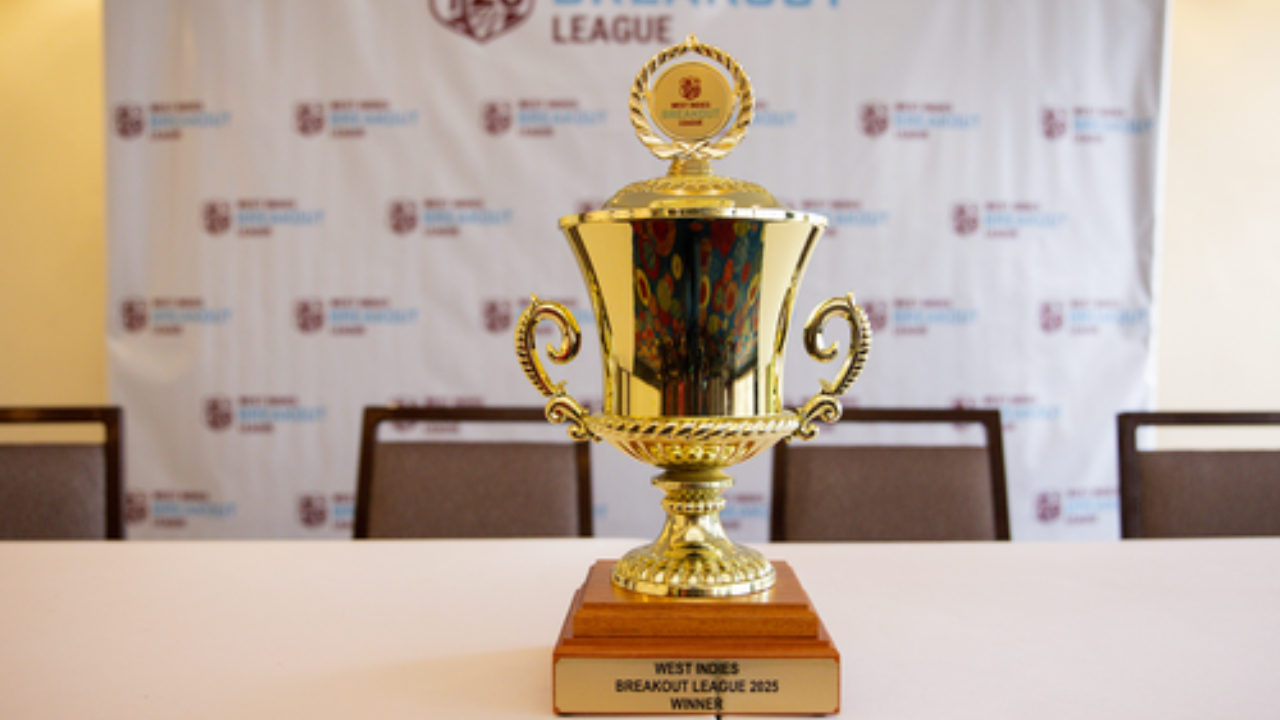
For development-focused leagues, sustainability often becomes the first real test after early promise.
That reality is now confronting the Breakout League, with its immediate future uncertain as Cricket West Indies (CWI) weighs whether it can proceed without external financial backing. Speaking at a recent CWI press conference, President Kishore Shallow outlined a situation where intent remains strong, but viability depends on factors beyond the board’s direct control.
Uncertainty grows around staging plans
The tournament’s return this year is far from guaranteed, with CWI acknowledging that without additional support, staging the competition will be difficult.
“So we’re still exploring those opportunities. Hopefully we find a partner, but in the absence of that it will be difficult to have it this year. What we have also explored and discussed is that it may be a case of tactically hosting the Breakout League every other year or so,” Kishore Shallow said at a Cricket West Indies press conference.
That admission reflects a shift from earlier optimism to a more cautious, conditional outlook — one where even the frequency of the league is now under review.
Sponsorship emerges as the deciding factor
At the centre of those discussions is the search for commercial backing, with CWI actively exploring partnerships that could share the financial responsibility of hosting the tournament.
“Of course, we are open to exploring partnerships. If we find someone in the corporate space, whether in the region or internationally, who would be willing to meet us halfway to host that tournament, because we understand how critical it is to host the Breakout League to expose our young talent,” he said.
The emphasis on collaboration highlights the league’s strategic purpose — not just as a standalone competition, but as a pipeline for emerging players who might otherwise lack exposure at higher levels.
From postponement to reconsideration
The current uncertainty follows earlier decisions to delay the tournament due to scheduling pressures. A congested calendar, including preparations for major ICC events, initially pushed the league off track before financial realities began to reshape the conversation further.
“Earlier in the year we were forced to reschedule it…and we thought of cancelling it altogether for this year, but we decided to explore that decision and explore the option of having it,” he continued.
What began as a scheduling adjustment has now evolved into a broader reassessment of whether the league can be sustained annually under current conditions.
Exploring alternative pathways
Alongside commercial avenues, CWI has also turned to regional stakeholders in an effort to keep the initiative alive, even if timelines shift.
“But we are really exploring the possibility, talking to key partners like governments to see how possible it is to host this Breakout League later this year, but if not, then next year,” he added.
A defining test for a development initiative
The Breakout League was designed to bridge a gap in Caribbean cricket by offering competitive opportunities to players outside the established system. Its early promise suggested it could become a consistent pathway for talent identification.
Now, however, its trajectory depends less on concept and more on execution. Without timely financial support, the league risks becoming an intermittent project rather than a stable fixture.