
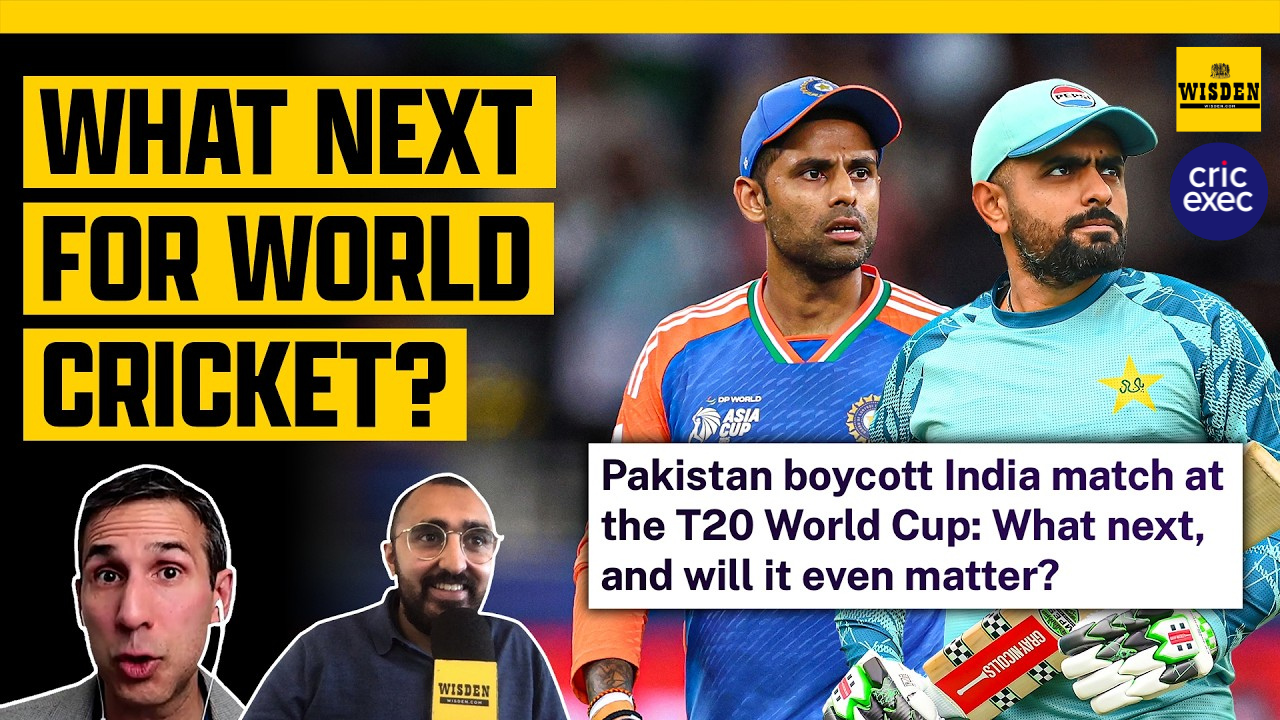
cricexec Founder Zee Zaidi was the featured guest on the latest episode of the Wisden Cricket Weekly Podcast, hosted by Yas Rana.
Watch the episode:
How the India-Pakistan fallout impacts world cricket, new law changes & Nepal’s cricket obsession
What began as a discussion about the possibility of an India–Pakistan match not taking place quickly evolved into something far broader — a deep dive into the economic architecture of global cricket, the fragility of its revenue model, and the uncomfortable truth that one fixture underpins an extraordinary share of the sport’s financial ecosystem. Across a wide-ranging conversation, Zaidi broke down — in unusually granular terms — why the absence of India–Pakistan is not a $25 million problem, nor even a $50 million one, but potentially a hundreds of millions of dollars shock to the system, with consequences that could be felt for years across boards, broadcasters, sponsors, and emerging cricket markets worldwide.
“This is seismic”: why India–Pakistan is unlike any other match
Zaidi did not mince words when asked to describe the magnitude of the situation. “Seismic is probably the best word I can use to describe it,” he said, emphasizing that while the threat has always existed in the background as tensions have flared on and off for years, “now it seems like it might actually be happening.”
At the core of his analysis is a simple sports-business truth. “In sports, ultimately you can monetize because there are fans who care,” Zaidi explained. “That’s the basic core of it.”
Few sporting events on earth concentrate attention like India–Pakistan. Depending on format and context, Zaidi noted, the global television audience runs easily into the hundreds of millions. During the 2024 T20 World Cup in the United States, comparisons to the Super Bowl missed the scale entirely. “There were comparisons to the Super Bowl — and it many times the size of the Super Bowl,” Zaidi said, underlining that no other match comes close.
Why the $25–50m figure is both right — and deeply misleading
One of the most persistent points of confusion, Zaidi explained, is that people are talking about different layers of economic impact. “You hear a few different numbers thrown around, and that’s partly why there’s some confusion,” he said. “How much is this match worth? There are different ways of defining that.”
At the narrowest level is direct advertising loss to broadcasters who have already acquired rights — primarily JioStar in India. “People say $25 to $50 million is what Jio is looking at,” Zaidi explained. “You gross that up, maybe $50 to $60, $70 million in advertising revenue lost globally from this one match.”
That number, he stressed, is real — but it is only the first layer. “The larger numbers and the larger implications come from the bigger nature of this match and other ways to define the economic damage,” Zaidi said.
The rights cycle problem: where $250–300m suddenly makes sense
Cricket’s broadcast economy is built on cycles, not individual matches. We are currently in the ICC’s 2024–27 rights period — and, crucially, on the verge of negotiating the next one. “Part of what makes this very, very painful for the ecosystem is we’re on the verge of the next cycle being sold and negotiated,” Zaidi explained.
Broadcasters don’t just buy inventory; they buy certainty. “These rights are bought with the expectation that they can sell rights to advertisers,” Zaidi said. “If broadcasters are going to say, ‘We can’t even count on this match,’ that’s where you get the estimates that this match not happening is worth a few hundred million dollars — $250, $300 million.”
Compounding the issue is structural consolidation in the Indian broadcast market. “JioStar used to have a competitor,” Zaidi said. “Now they’re really the only game in town.” That has already raised concerns about a downward reset in rights pricing, even before India–Pakistan uncertainty is factored in. “Without the certainty of an India–Pakistan match,” he added, “broadcasters are going to say, ‘We can’t pay for something that might not happen.’”
The hidden half-billion: second- and third-order ripple effects
Beyond rights valuations lies an even murkier zone of indirect economic fallout. “There’s a bigger number you see floating around — three, four, five hundred million dollars,” Zaidi said. “That factors in all the other consequences to the broader ecosystem of this match not happening.”
He pointed to the hospitality and ticketing sector as one example. “I have a friend who runs a hospitality ticketing company that partners with the ICC,” Zaidi explained. “When Bangladesh was out of the tournament, he got a lot of cancellations. When it seemed like this match is not happening, there were a lot more cancellations.”
That effect, he said, extends across concessions, digital platforms, and subscription-based broadcasters. “This one match sells subscriptions,” Zaidi said. “They’re sticky, and people stay on. If there’s no India–Pakistan in a World Cup, people are less likely to subscribe.”
When all of that activity is stripped out of the ecosystem, Zaidi argued, the half-billion-dollar figure no longer feels exaggerated.
Why this hits smaller boards hardest — and fastest
The financial danger is not evenly distributed. “About 80% is the number you hear floated around of the ICC’s revenue comes from the India broadcast rights deal,” Zaidi said. That money is then distributed back to member boards.
While England, Australia, and India have strong domestic cricket economies, Zaidi emphasized that most boards do not. “For smaller boards, like the U.S. where I’m based or Canada, the ICC distributions account for the vast majority, in some cases close to all, of their revenue,” he said. Even among full members outside the big three, reliance is heavy. “For Pakistan, it’s about half.”
Alarmingly, boards were already being warned to expect a downturn. “At the last ICC annual general meeting in Singapore, the ICC was already warning its members to expect a downward reset,” Zaidi said — even before the India–Pakistan situation escalated. “There were boards doing scenario planning: what happens if we get 30% less, what happens if we get 50% less?”
Regulation, consolidation — and a perfect storm
The timing could hardly be worse. Zaidi pointed to India’s recent restrictions on gambling and gaming advertising — a category that had become a major sponsor of cricket worldwide. “India’s parliament passed an anti-gambling, anti-gaming bill,” he said. “That was funding so much of the sponsorships worldwide.”
Layer that onto broadcast consolidation and geopolitical uncertainty, and the economic model looks increasingly fragile. “If JioStar factors in that we’re never going to have an India–Pakistan match, or that it might not happen,” Zaidi said, “those rights are going to come down.”
The fan reality no spreadsheet can fix
Switching briefly from analyst to fan, Zaidi acknowledged the emotional pull of the rivalry. “There have been enough phenomenal ones,” he said, noting that classic matches still anchor public interest despite more recent one-sided results.
But nostalgia does not change demographics. “There are close to two billion fans in three countries — India, Pakistan, and Bangladesh,” Zaidi said. “In these countries, especially India and Pakistan, you can call them one-sport countries.”
“That reality,” he added, “is just going to make India–Pakistan numerically and financially the centerpiece. Nothing we can do about that.”
The real solution: diversification, not denial
Zaidi’s argument was not to minimize the rivalry, but to rely on it less. “The imperative is to diversify away from that,” he said. “Not to make it smaller — but to make it gravy.”
Some boards have begun that work. “Pakistan is starting to do this with the PSL,” Zaidi said. “They know they’re up against the IPL, they know they’ll lose players, but they’re trying to carve an existence that’s not as dependent.”
Even so, he cautioned that for many countries, true self-sufficiency remains far off. “For many, if not most countries, they’re decades away.”
A structural challenge at the heart of the ICC
Ultimately, Zaidi returned to governance. “The ICC is a members organization,” he said, “and its primary mandate has not been to grow cricket everywhere.”
If that were the primary goal, Zaidi argued, money would flow very differently. “If cricket were to be big in the U.S. or Canada from a fan perspective, that would help the whole global economy diversify away from this dependence,” he said.
While development work does undoubtedly exist, he concluded, “that’s not the overarching priority — and that’s part of the challenge.”
Franchise cricket, formats — and an overloaded calendar
The conversation also explored how franchise cricket and multiple formats have reshaped the sport. “We went from one format to three,” Zaidi said, “and now pretty much everyone has franchise leagues.”
While T20 cricket has expanded the sport and transformed player earnings, it has also diluted attention. On top of that, the fact that there are three different formats with their own ICC World Cups or World Championships leaves bilateral tours lower on the pecking order, with only some exceptions.
“There’s only so much attention to go around,” Zaidi noted. “When people don’t care, there’s no money there.”
An uncomfortable truth for cricket’s future
Zaidi offered no easy answers. “These aren’t soundbite questions,” he said.
What the India–Pakistan uncertainty exposes, however, is a deeper vulnerability. The rivalry is not just a marquee event; it is a structural pillar of cricket’s global economy. Removing it, even temporarily, reveals how concentrated and fragile that system has become — and how urgently the sport needs to build resilience beyond a single match.


