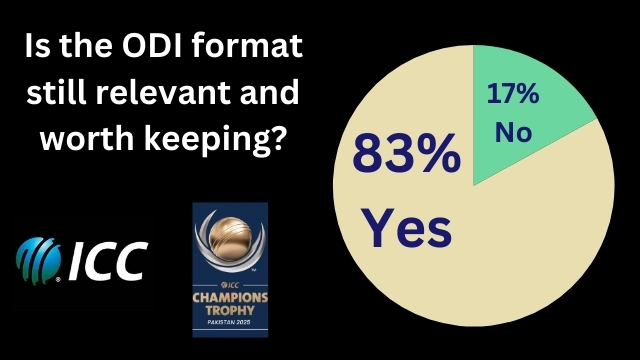
The One Day International (ODI) format remains a hot topic in global cricket circles, with poor attendance at the Champions Trophy reigniting concerns about its relevance. However, a new cricexec poll of global cricket industry executives found that an overwhelming 83% believe ODIs are still relevant and worth keeping, while only 17% feel the format should be abandoned.
Despite this strong support, the debate is far from settled. Cricketing legends, governing bodies, and broadcasters have all weighed in with differing opinions—some advocating for preservation, others suggesting drastic changes.
ODIs: Losing Their Spark?
While the most recent ODI World Cup in India in 2023 was the most attended in history, featuring thrilling encounters and record-breaking viewership, concerns persist about the format’s sustainability outside of that tournament.
Sachin Tendulkar, one of the format’s greatest exponents, has been vocal about ODIs becoming too predictable. He has previously noted:
“It’s getting monotonous, without a doubt. The current format, which has been there for a while now, is two new balls (per innings). When you have two new balls, you have kind of eliminated reverse swing. Even though we are in the 40th over of the game, it’s just the 20th over of that ball. And the ball only starts reversing around the 30th over.”
He warned that the lack of reverse swing, which was once a key factor in the latter stages of ODI matches, has diminished excitement:
“That element (reverse swing) is missing today because of two new balls. The current format, I feel, is heavy on bowlers. Right now, the game is becoming too predictable. From the 15th to the 40th over, it’s losing its momentum. It’s getting boring.”
To address this issue, Tendulkar proposed a radical change—splitting ODIs into four innings of 25 overs each to keep the game dynamic:
“So, both teams bowl in the first and the second half. Commercially too, it is more viable as there will be three innings breaks instead of two.”
Calls for Shorter ODIs and Scheduling Adjustments
While Tendulkar proposes an overhaul, others suggest shortening the format rather than reconfiguring its structure.
Wasim Akram, one of cricket’s greatest fast bowlers, believes reducing ODIs to 40 overs per side would increase engagement and help address modern audience behavior:
“I have a problem with ODI cricket right now. Very rarely do you see nowadays in One-day cricket something interesting happen in those (middle) 30 overs. Just go to 40 overs, you’ll have more action during that period.”
Acknowledging the shift in how people consume sports, Akram added:
“I don’t know if it’s going to happen, but I think 40 overs would be more interesting, especially for bilateral series. Nowadays the audience, we do know their (attention) span is lesser than the nineties, because of T20 format and because of social media. We have to adapt.”
His former teammate, Waqar Younis, has also weighed in, calling for an adjustment to the ball regulations to make the format more bowler-friendly:
“ODI cricket is too friendly for batters. Suggestion @ICC: Two new balls to start, take away one ball after 30 overs, continue with the other. At the end, that ball will only be 35 overs old. We’ll see some reverse at the end. Save the art of #ReverseSwing.”
Drastically reducing the number of ODIs
In 2023 the MCC‘s World Cricket Committee recommended a ‘significant reduction’ of ODI cricket after the 2027 World Cup, scheduled to be hosted by South Africa, Namibia and Zimbabwe.
Specifically, the 13-member committee advocated “removing bilateral ODIs, other than in the one year preceding each World Cup.”
Former England captain Mike Gatting, who led the committee, believed a reduction in fixtures would make ODIs more special and free up space in an overcrowded cricket calendar:
“A scarcity of ODI cricket would increase the quality, achieved by removing bilateral ODIs, other than in the one year preceding each World Cup. This would, as a consequence, also create much-needed space in the global cricketing calendar.”
As former MCC Mark Nicholas said at the time, this was in many ways an acknowledgement of the dominance and attractiveness of the T20 format:
We believe strongly that ODIs should be World Cups only. We think it’s difficult bilaterally now to justify them. They’re not filling grounds in a lot of countries. And there is a power at the moment to T20 cricket that is almost supernatural.
It’s more than just ticket sales. It’s the amount of people that want to own franchises, the amount of countries that want to run tournaments, it’s the amount of players that want to be in a market all around the world.
In a free market, the most money wins. And that’s just the end-game. The players can see that bubbling away and they want to be a part of it. So, it is an extraordinary power that T20 has, and I think scheduling 50-over cricket alongside it just continues the story of the death knell of the ODI game.
ODIs Still Have Their Moments
While some advocate reform, others see ODIs as indispensable. The 2023 World Cup’s success demonstrated that when stakes are high, the format still delivers drama and spectacle.
Australian captain Pat Cummins, after leading his team to victory, confessed he rediscovered his love for ODIs during the tournament:
“I must say, maybe because we won, I did fall in love with ODI again this World Cup. I think the scenario where every game really matters, it does mean a bit different to just a bilateral.”
He also dismissed concerns that ODIs are fading into irrelevance:
“I mean, the World Cup’s got such rich history, I’m sure it’s going to be around for a long time. Yeah, there’s so many wonderful games, so many wonderful stories within this last couple of months. So, I think there’s definitely a place.”
Balancing Tradition and Innovation
ODI cricket isn’t dead, but it is at a crossroads. Especially with the performance of this year’s Champions Trophy, the format must adapt to modern viewership habits while preserving its core appeal. The cricexec poll confirms that industry leaders want ODIs to continue—but whether they remain unchanged or undergo a transformation remains the bigger question.
As the cricketing world looks ahead to future ICC events and domestic leagues continue to rise in prominence, administrators must find a way to strike the right balance between tradition and innovation.
_______________________________________________________________________________________
Stay ahead of the latest cricket industry trends by subscribing to our free cricexec “daily briefing” newsletter.