
Cricket as national strategy
Guyana is a country of 800,000 people in the middle of an extraordinary decade. Oil found off its coast has turned one of South America’s weakest economies into one of the fastest-expanding on earth, and its head of state devotes a striking share of his attention to cricket.
The relationship between those two facts runs in the opposite direction to the one cricket’s institutions might assume. The sport is not decorating the boom. The boom has given a cricket country the means to act on a century of investment in the game, and Dr Mohamed Irfaan Ali, President of the Co-operative Republic of Guyana, has spent three years turning that into a tournament, an academy, a development argument and a standing proposition to the sport’s governing bodies.
“GSL is not just about cricket,” Ali says. “It is part of our national strategy of repositioning sports as a major pillar of our economic transformation.”
Sports tourism, sports development, community development, and the physical infrastructure to support disciplines beyond cricket are all, in his account, elements of the same programme. The tournament is the most visible instrument, not the objective.
The rest of the programme is already visible. In July, Guyana staged Round 3 of the GT Challenge de las Américas at the South Dakota Circuit at Timehri — branded locally as the Guyana Grand Prix, launched at State House by Ali in May, and the first time an English-speaking nation has hosted the series. The Guyana Cup returns to the National Park Raceway this month. In October, the National Stadium hosts the inaugural Caribbean Archery Championship alongside the eighth Caribbean Development Championships. Horse racing, boxing and further motorsport events are in the pipeline. Cricket is the anchor, but the strategy is a calendar of international events and the domestic capability to run them.

The objective is geographic. “We want to position Guyana as the centre of cricket development in the West Indies, South America and North America,” he says. It is a claim with more history behind it than most of the sport realises, and one worth taking on its own terms.
That argument is now backed by something Guyana has never previously had: leverage. Since first oil in 2019, the ExxonMobil-operated Stabroek Block has taken the country from net energy importer to South America’s second-largest producer. Recoverable resources are estimated at around 11 billion barrels; output reached roughly 900,000 barrels per day during 2026 and is projected to approach 1.7 million by 2030. In 2022, Guyana posted the highest real GDP growth in the world. The population, meanwhile, remains under a million.
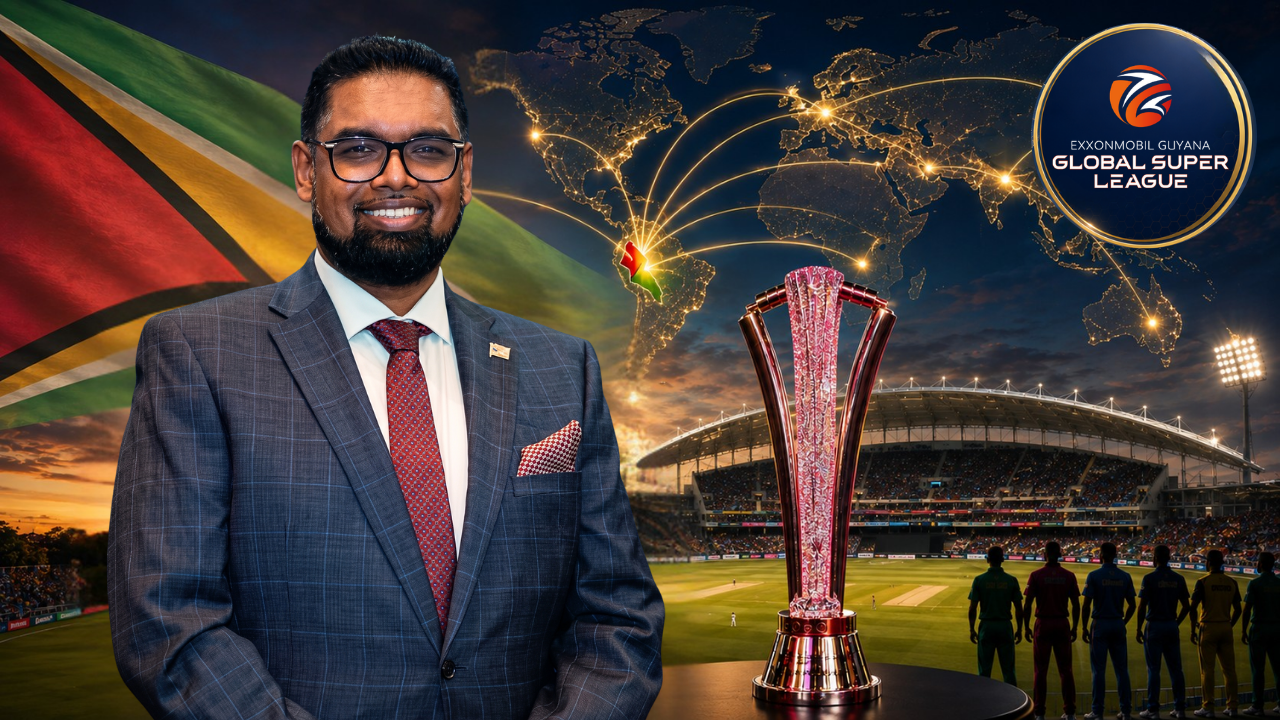
The convergence is not lost on anyone in Georgetown. The tournament’s title sponsor is ExxonMobil Guyana. The trophy is modelled on Kaieteur Falls. Ali, re-elected in September 2025, presides over an administration whose stated project is to convert a finite resource windfall into permanent national capacity — and cricket, in a country where it is the only sport that reliably delivers Guyanese to a global stage, has been written into that project rather than left outside it.
The president’s own investment in the sport predates the office. An off-spinner in his playing days and a competitive junior cricketer at St Stanislaus College, he still holds some Guyanese youth records. His instinct for what the sport does in Guyana surfaces in the examples he reaches for. At the opening of Guyana Festival earlier this year, he described a day on which the whole country was talking about the same thing — not politics, but the CPL draft, and how early the Guyanese spinner Gudakesh Motie had gone. It was, he said, the kind of shared national feeling that briefly erases every other division.
The tournament as an instrument
The idea began with a decision that Guyana should host something of consequence, permanently, and that cricket was the obvious vehicle. Surveying the landscape confirmed the space was there. “When we looked at the landscape, the Champions League was discontinued,” Ali says, “and we believed that there needed to be a global product that brought together the best T20 teams from around the world.” Guyana, he adds, “has a long, outstanding history in cricket, part of the West Indies, and we are willing to make the investment to be that venue.”
The Champions League Twenty20 ran for six editions from 2009 before its governing council — the BCCI, Cricket Australia and Cricket South Africa — scrapped it in 2015, citing the tournament’s limited public following. The commercial evidence was blunt: a title sponsor exercised an exit clause when ratings came in at less than half the contracted threshold, and the broadcaster was carrying heavy losses against a billion-dollar rights deal.
The structural problems it hit have not gone away. Unlike European club football, where domestic leagues run on broadly aligned calendars, T20 competitions are scattered across the year, and players belong to several franchises at once rather than to one club. Any attempt to assemble champions from different leagues in a single window inherits all of it. But 2015 was a different market. The IPL had not reached its present scale, the CPL was two years old, and the PSL, SA20, ILT20, MLC and the Hundred did not exist.
The GSL’s answer has been to accept the constraint and build inside it. Five teams, one venue, a short window, and an invitation list drawn from league champions — this year the reigning ILT20 winners Desert Vipers, BBL champions Perth Scorchers, PSL title-holders Lahore Qalandars from the previous season, MLC’s San Francisco Unicorns, and the host Guyana Amazon Warriors, who retained the trophy in a final so improbable that the Warriors defended a total of 85. Squad composition rules travel with each franchise from its home competition, which is one of several complications the organisers absorb rather than resolve.
Ali is emphatic that the product is not a Guyanese vanity project. “GSL is not about Guyana,” he says. “GSL is about developing a global product. What that will do is help cricket around the world.”
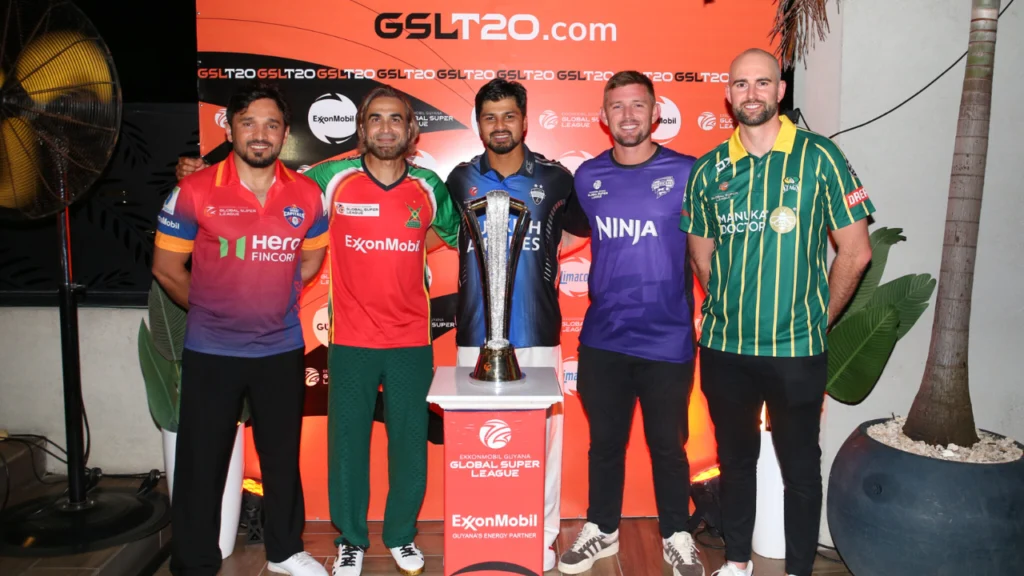
He defines the project broadly, and returns to that breadth whenever the conversation narrows to cricket alone. “The Global Super League is not only about cricket,” he says. “It’s about culture. It’s about economic expansion. It’s about the positioning of cricket within the geographic space that we are in. It’s about people. It’s about the development of young cricketers.”
Whatever else it is, it is not a breakaway. The GSL takes champion teams from existing leagues by invitation, is sanctioned by Cricket West Indies, and pays participation fees to the franchises rather than contracting players away from them. Every side that travels does so with its home competition’s blessing.
The domestic dividend is being pursued in parallel, through capacity-building initiatives grouped under the tournament’s Super We campaign — a talent search that put two Guyanese broadcasters into the television and radio coverage, a photography scholarship, a junior clinic with Georgetown Cricket Association clubs, and a Deakin University sports management workshop delivered with the Government of Guyana. Charles Ramson Jr, Minister of Culture, Youth and Sport, frames the whole enterprise as a proof of method. “The fact that the president had this big vision for the tournament, and really backed it, and we had a lot of private sector support — this shows that when we have a big vision and we put our arms together, we can achieve something pretty spectacular,” he told cricexec at the National Stadium after the final.
The gateway to a continent
The part of the ambition that gets least attention is the one Ali rates most highly. Guyana sits on the South American mainland, which makes the Global Super League the first major international franchise tournament staged on the continent — a fact that tends to surprise people, including within cricket.
“We know that the trajectory of cricket will take it into North America,” Ali says. “There’s a lot of emphasis on that, and we believe that there is opportunity that is unexplored in South America.”
Guyana’s claim to serve as both gateway and anchor rests on sitting in three places at once. “Culturally, in the CARICOM region — fully part of the CARICOM group of countries, but also in South America,” he says, “and with a deep connection with North America in terms of our diaspora. That positions us from a geographic standpoint, a cultural standpoint, a people standpoint, an infrastructure standpoint, as an international hub for cricket within North America, the West Indies and South America.”
What makes the proposition more than an accident of borders is that the South American continent has a cricket past, not merely a cricket future. That heritage is the subject of the landmark 2021 book Evita Burned Down Our Pavilion: A Cricket Odyssey through Latin America, by the cricket journalists Timothy Abraham and James Coyne, which remains the definitive history. Their central finding is one most of the sport has forgotten: cricket was the first sport played in almost every country of the Americas, arriving before football, before rugby, before baseball. When England and Australia played the inaugural Test at the MCG in 1877, Uruguay and Argentina were already a decade into a cricket derby contested across the River Plate.
That is the inheritance Ali is arguing cricket has left unclaimed. A continent of more than 400 million people, where the sport arrived first and then lost, sits immediately south of a market cricket is now spending heavily to enter. Guyana’s case is that the way in runs through a country that never stopped playing.
The window problem
If the first half of Ali’s argument is about what Guyana is building, the second is about the structural conditions he says make it harder than it needs to be. He starts with the calendar, because everything else follows from it.
“The IPL can announce their window for five years,” he says, “because the ICC has given them a permanent window.” A competition that must curtail its length to fit whatever space is left over, he argues, begins at a disadvantage no amount of ambition or capital corrects. “You have to fight for a window, and you have to curtail your tournament to meet the specifications of that window. So that is where the problems start.”
He traces that back to how the game’s governing body sets its priorities. “The ICC sets its global agenda to safeguard the IPL. And then you have the Hundred, and the BBL. So the ICC decision-making is stymied by its interests of safeguarding certain global tournaments. Everything else that happens around cricket has to happen outside of those windows. And that is a reality. That is the truth. There is no hiding.”
His broader diagnosis is that this is protection mistaken for strategy. “What we have seen is a lot of isolated action that is keen on protecting markets rather than expansion of the sport,” he says, “rather than integration of the sport in the rest of the world, and that’s a danger for cricket in the long term. The economics around cricket must go beyond India.”
What he says Guyana had hoped for was the opposite: that the ICC would treat the GSL as an asset. A tournament with government backing, stakeholder commitment and an international field, staged in a part of the world the ICC says it wants to grow, could extend the governing body’s own footprint and open a route into South America. He also offers a pointed reading of the ICC’s revived interest in a cross-league championship, which he says was dormant until the GSL launched. “It suddenly became alive again.”
The debt owed to West Indies cricket
The historical claim underneath all of this is one Ali makes directly, and in the plainest terms available to him.
“West Indies cricket is the cricket that propelled global attention to cricket,” he says. “West Indies cricket is the cricket that generated the most revenue, and we did not benefit proportionately when West Indies was the one that was driving cricketing revenue around the world. Today we are at a disadvantage, when we need help in the West Indies to develop West Indies cricket.”
The consequence, as he sees it, is that the sport’s politics have stopped serving the sport. “It’s unfortunate that the politics around cricket and the power around cricket is not putting cricket first, or putting the expansion of cricket first,” he says. “It’s more market-oriented and more market protection.”
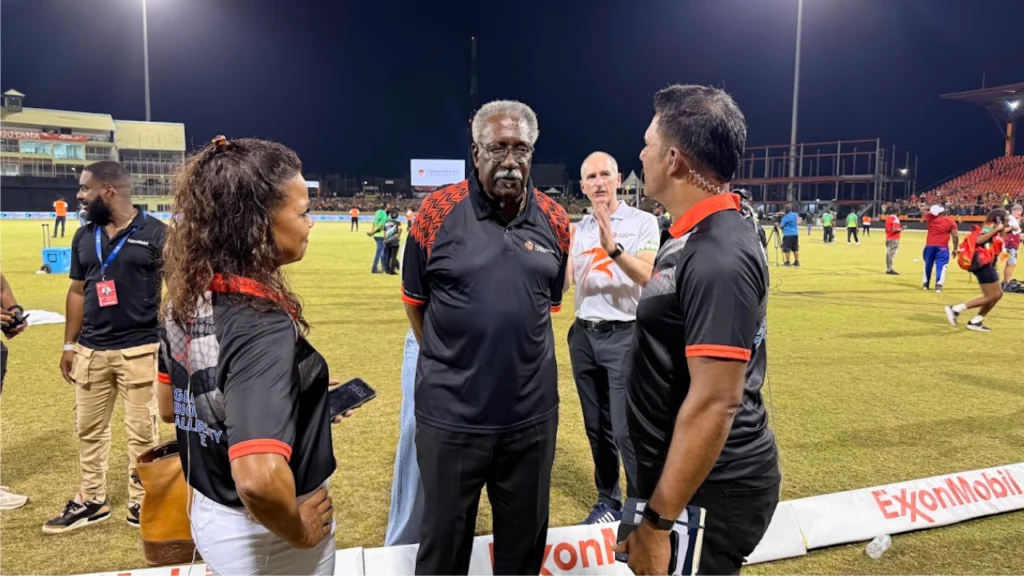
Sir Clive Lloyd — Guyanese, the GSL’s chairman, and the captain who made the West Indies the most commercially valuable team in the sport — puts the same history in the first person. “Everybody wanted us to play,” he told cricexec in Georgetown. “Whenever we played, they made money. Sponsors were happy. And now here we are.”
Ali chairs CARICOM’s Prime Ministerial Sub-Committee on Cricket, a role he took over from Trinidad and Tobago’s Keith Rowley in February 2025 and one that turned urgent that July, days after West Indies were bowled out for 27 by Australia at Sabina Park — their lowest Test total ever, and the second-lowest in the history of the format.
Ali says his fellow CARICOM heads of government are united on this imperative. “They’re all locked into this. We know the potential of cricket, not only as a sport, but as sports tourism, as part of the tourism sector, as part of our culture. From a social perspective, the impact of cricket is enormous. We cannot afford to have cricket dying. Every government knows that we have a duty to cricket and to the young people, to ensure it is kept alive.”
What he wants in return is unusually specific, and unusually modest. “We are not asking for financial support,” he says. “We are asking for support in terms of participation, and allowing a stronger global reach.”
The second ask concerns an academy Guyana is building, alongside the facility Cricket West Indies is developing in Antigua. Again, the request is not for money. “We are investing in an academy here in Guyana, and again we’re not asking for financial support,” he says. “What the ICC needs to do is to embrace this academy, and to work on taking cricket back to the grassroots — helping in a new development programme, helping in a way that enables cricketers to focus on cricket on a full-time basis.”
What he wants from the governing body is technical expertise and standing. “How can we get the ICC to provide technical expertise? How can we get the ICC to recognise this venue?” he says. “Academies that we can have integrated in a global cricketing system. It can’t be isolated. It has to be the integration of the global cricketing infrastructure to support the redevelopment here.”
And he is explicit that the point is not to shore up the Caribbean alone. “The expansion is not only about Cricket West Indies,” he says. “We have to leverage Cricket West Indies to expand into South America, to expand into North America. You’re not just thinking about pumping a lot of money into American cricket at the disadvantage of West Indies cricket.”
Underneath both asks sits a resourcing problem he states bluntly. Because of the shortage of money and opportunity in the regional game, he says, West Indies cricketers “are not full-time cricketers — they’re part-time cricketers.” Facilities built by governments across the region sit idle: “We have governments that have invested tremendously in infrastructure, and the infrastructure is completely underutilised,” because the fixtures do not come. And the consequence, if it is not arrested, is a market that disappears. “You can’t imagine losing the West Indies market,” he says. Survey young people in the region, he argues, and cricket will not remain the preferred sport.
What development actually looks like
Running alongside the argument about windows and market protection is a separate one, and Ali rates it as the more serious of the two. Cricket, he says, has largely stopped investing in the countries it claims to want.
The contrast he reaches for is football. “Look at the last World Cup — how many new teams were added, and you saw how those teams performed, because there was a genuine investment programme for the development of those teams,” he says. Countries such as Cabo Verde with populations under a million became stars of the tournament, because somebody had spent years making that possible.
Cricket’s record, he argues, is the opposite. “Kenya came on board. There was no long-term investment for development. And where is Kenya today?” Afghanistan he cites as a rare case of sustained investment producing a genuine competitor. And the West Indies, he notes, are now allocated on terms comparable to associate nations — a full member of long standing funded like a project that has yet to start.
“Because of this focus on just protecting certain markets,” he says, “the global impact of cricket is falling away.”
What he wants instead is a strategy rather than a distribution formula: an ICC that engages beyond Cricket West Indies, including with the prime ministerial sub-committee, to understand the whole ecosystem around the game and then invest across it — school systems, communities, talent identification — over a horizon long enough to matter. Several governments in the region, he points out, are willing to put money behind exactly that.
Two boards, two asks
Ali’s requests are addressed to specific institutions, and he does not soften them.
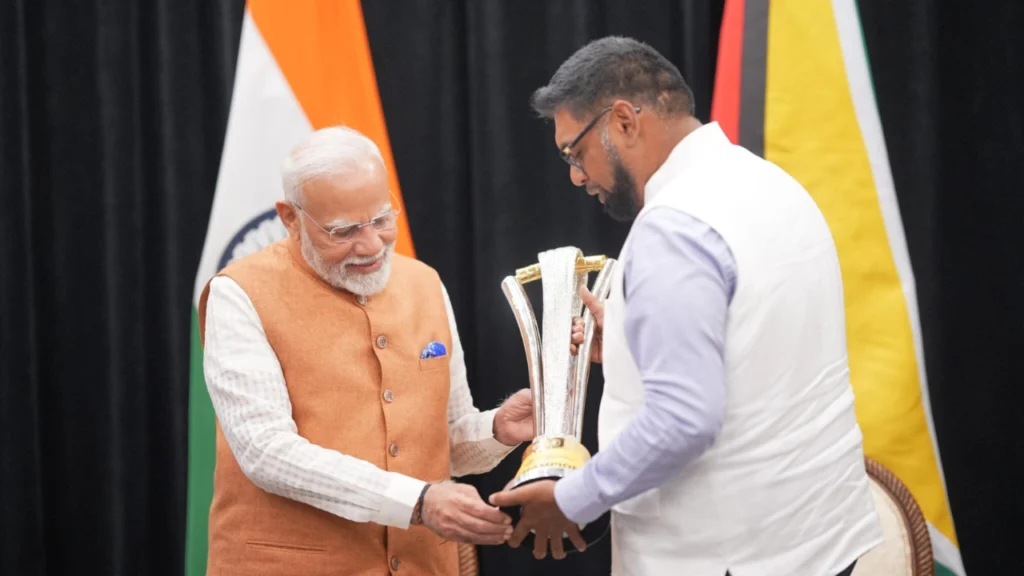
To the BCCI, the ask is participation, in whatever form India finds tolerable. “I even said to the Indian cricket board, if it is difficult for you to put the winner of your local tournament into this Super League, then why not have a diaspora XI?” It is an idea he has floated for at least a year, including, he has said previously, directly with Prime Minister Narendra Modi as an extension of India’s diaspora engagement. He says he has now written to the ICC, to the BCCI, to everyone. The response, as he reads it, has been an insistence on control: “They are so bent on protecting the market that they believe they must have ultimate control. And that can’t work in the long term.”
The appeal is not an abstract one for him. Ali is himself of Indian descent, part of the Indo-Guyanese population that arrived under indenture in the nineteenth century and now forms the country’s largest ethnic group; he is also the only sitting Muslim head of state in the Americas, and only the second in the region’s history. He frames the refusal as a misreading of India’s own position. “We believe that India has a global responsibility, being a country that went through a colonial past, to understand that cricket is much more than market, is much more than a game,” he says. “It has a deep cultural connection, a political connection, a connection that is linked to the freedom of people.”
To the ECB, the ask is historical. A T20 Blast side took part in the tournament’s first edition, but Ali wants a great deal more than an appearance. “The English cricket board needs to take a stronger role,” he says. “The English cricket board owes it to West Indies cricket. Take a stronger supporting role for West Indies cricket. If there is one cricket board that owes the West Indies cricket board, it is the English cricket board.”
He is blunt about why he thinks that has not happened. “India has held the English cricket board on its arm,” he says, “and the two of them now are working in a collaborative way in this protectionism kind of affair.”
Australia, on his account, has behaved differently, and the reigning BBL champions have travelled to Guyana as a result. “They understand the global nature of cricket, and they understand what is needed for the expansion of the cricketing brand and cricketing product — and even their own footprint in different parts of the world, developing their own fan base, developing their own market potential,” he says. “And not being captured in this protectionism.” The other participating teams, he adds, are there for the same reason: “They are looking to expand their reach and looking to be more recognised.”
The capital question
There is a harder commercial question underneath all of this, and Ali engages it directly. Serious institutional capital is circling cricket — sovereign wealth funds, private equity, American sports investors — and almost all of it converges on a single asset class: an IPL franchise. A two-week tournament in Georgetown is not, on its face, a deployable product for a fund with billions to place.
His answer is not to dispute the premise but to redefine the objective. “What the IPL represents is people,” he says. “It reaches people, the television rights, the broadcasting rights. And companies are looking to reach people, because that’s what the brands want.”
The task, then, is to build a second property with comparable reach. “We have to develop a product with the power and potential to reach people,” he says — “expanding the market, reaching into markets. And that is what Indian cricket, the IPL and the ICC are afraid of. They believe that somehow that can dilute the power of the IPL. That will not dilute the power of the IPL. It will enhance the power of cricket and the reach of the ICC and the expansion of cricket that is critically needed.”
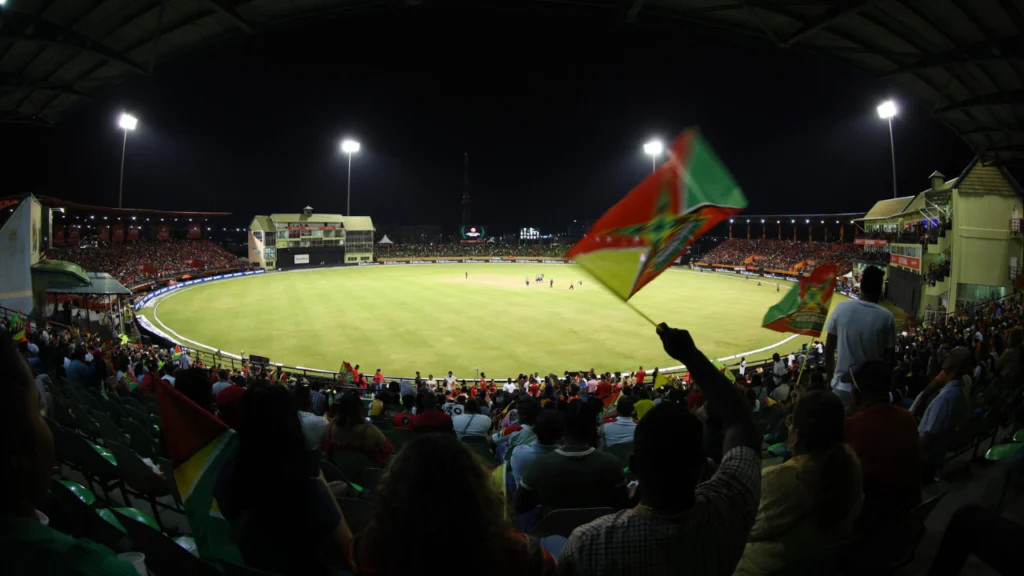
The picture he paints of a fully realised GSL is a short, dense tournament carrying the best franchise teams in the world into the Americas, with every major diaspora in North America championing a club side of its own — Indian, Pakistani, Bangladeshi, Australian, Caribbean — and each participating brand extending its network position in a market it cannot currently reach, and one that will strengthen the ICC and the IPL’s positions. Cricket, he argues, has barely begun to think about product innovation the way other sports have; he cites the viewership of a football half-time show as an illustration of how much value sits outside the field of play.
Disruption by collaboration
Asked what it would take to change the order he has described, Ali does not hesitate. “There has to be a disruption of the current order,” he says. “The current order, as I’ve described it, is protectionism. And protectionism will not serve cricket in the long term.”
Then he immediately qualifies the method. “In Guyana, we are trying to disrupt it by collaboration.”
That is the whole position, and it is a more interesting one than either half taken alone. He is not building a rival circuit or shopping for a governance fight. “You can’t ignore the ICC, because we fall under the umbrella of the ICC,” he says. “But the power of the ICC and the power of the Indian cricket board can easily displace what you’re trying to do. And what we are trying to do is to get collaboration with the ICC.”
He has made the approach formally and repeatedly. “I have written the ICC. We’ve written the Indian cricket board. We have written everyone,” he says. “There must be a balanced approach, and there is no balance in the approach right now.”
He is asking cricket’s powers for an approach Guyana has taken itself, in an arena where it finds itself holding the stronger hand. Guyana has roughly 86 per cent forest cover, straddling the Guiana Shield and the Amazon, and has built its Low Carbon Development Strategy around keeping that standing rather than clearing it — with 15 per cent of carbon revenues transferred directly to Indigenous communities. In 2024 Ali used his UN General Assembly address to launch the Global Biodiversity Alliance, whose founding Georgetown Declaration was signed the following year by the leaders of Barbados, the Dominican Republic, St Vincent and the Grenadines and Ecuador, with the World Bank joining in 2026. Both were showcased around this year’s tournament.
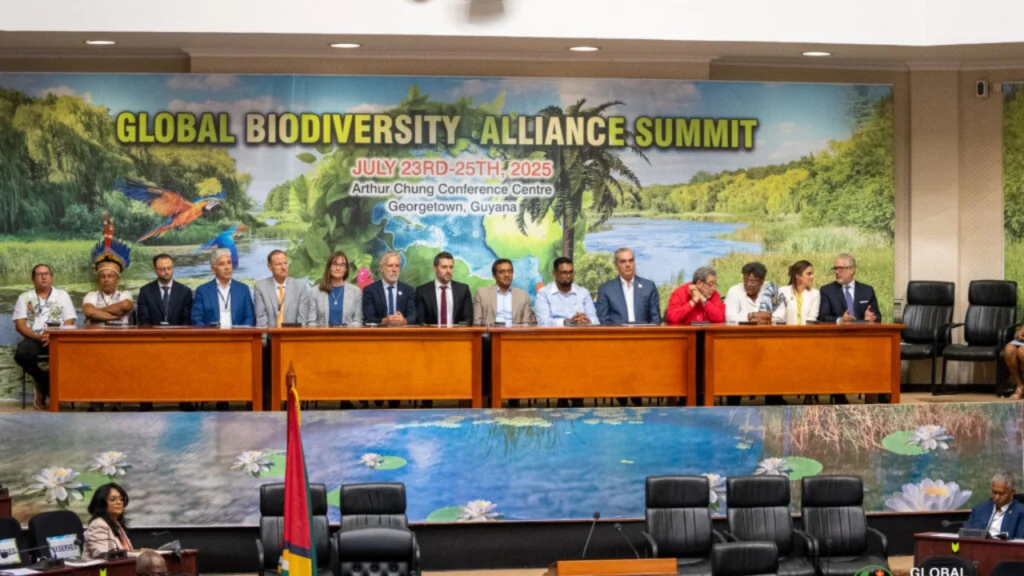
The logic is the one he wants applied to cricket. Guyana argues that protecting a shared asset and growing an economy are not opposing goals, and that the countries best placed to act have an obligation to. “Prosperity and forest protection are not mutually exclusive,” he told the Forest and Climate Leaders’ Partnership last year. The method he describes for the Alliance is the one he keeps asking cricket for: “We must be willing enough to involve everyone — have everyone around the table.”
In cricket, he is asking for the same reciprocity from institutions that he says have shown little appetite for it — and he also does not think Guyana can elicit it alone. “It will take a revolutionary approach from different cricket boards to get this done,” he says, “and we are willing to be part of that.”
He is also clear-eyed about what happens if the invitation keeps going unanswered. Cricket is not the first sport to discover that capital refused entry does not simply go away. “You see what happened with soccer with Saudi Arabia,” he says.
Guyana is not asking for money. It is asking for a window, for teams, and for integration into a system it believes it helped build — and it now has, for the first time in its history, the means to keep asking until somebody answers.


