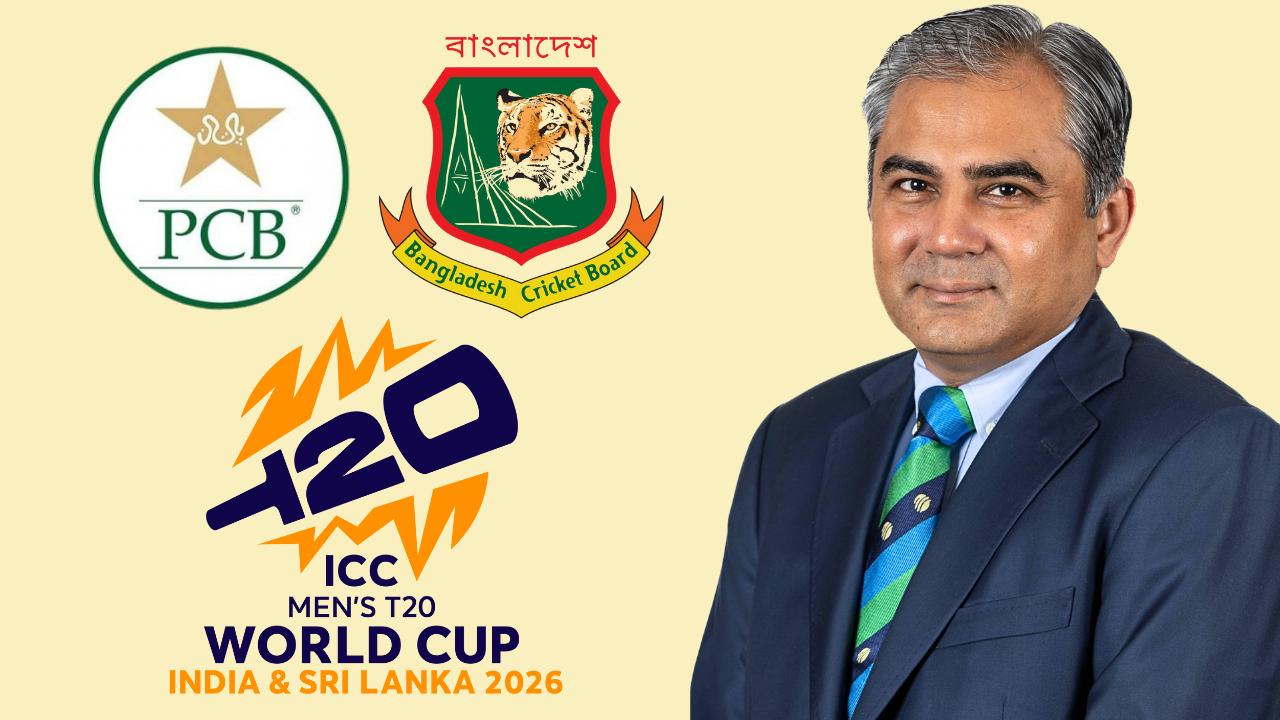
Bangladesh’s absence from the T20 World Cup continues to reverberate well beyond the tournament itself. What began as a security-based objection has now evolved into a deeper debate over influence, governance and long-term damage to the country’s standing in world cricket.
Former Bangladesh Cricket Board secretary and ex-Asian Cricket Council CEO Syed Ashraful Haque has alleged that the decision to pull out of the ICC event was shaped by persuasion from Pakistan Cricket Board chief Mohsin Naqvi, speaking in an interview with RevSportz.
Allegation of external influence in key decision
Bangladesh had declined to travel to India for their scheduled T20 World Cup matches, citing security concerns and requesting that their fixtures be staged in Sri Lanka. The ICC did not alter the tournament structure, and Bangladesh were subsequently replaced by Scotland.
Haque pointed directly to the role of Naqvi, who also serves as ACC president and Pakistan’s Interior Minister.
“Possibly, though I prefer not to discuss politics. As a cricket administrator, I focus on honesty and commitment. Aminul Islam, likely being naive, was influenced by Mr. Mohsin Naqvi, the current ACC president, who persuaded him to go along. At the end of the day, who won?” he said.
While Bangladesh’s withdrawal led to their exclusion, Pakistan — despite initially signalling solidarity — eventually played their fixture against India as scheduled.
Government call labelled ‘premature’
Haque argued that the withdrawal decision was taken too hastily and placed responsibility on the Bangladesh government, particularly then sports adviser Asif Nazrul.
“I always believed the decision taken by the Bangladesh government at the time, particularly by the then sports adviser (Asif Nazrul), was premature. There was no justification for such a drastic decision simply because Mustafizur Rahman was not allowed to play in the IPL in India,” he stated.
The controversy intensified after Mustafizur Rahman was released ahead of the IPL, a development that fed into the broader standoff. However, Haque maintained that administrative alternatives existed before resorting to a boycott.
“We had ample time to negotiate with the BCCI and, if necessary, the Indian government. The ICC organised the tournament and provided security, which they fulfilled. If we still had concerns, the government could have requested additional assurances regarding player safety.” he added.
According to Haque, dialogue rather than withdrawal would have preserved both participation and institutional relationships.
Cost to players and supporters
Beyond boardroom strategy, Haque emphasised the human impact of the decision, arguing that senior players were denied a major global platform.
“Players like Liton Das, Mustafizur Rahman, and Najmul Shanto are in their early 30s – missing this World Cup is an injustice to them and to Bangladesh’s cricket fans. After India, Bangladesh is probably the most cricket-obsessed nation, and depriving fans of their team in the World Cup is a shame and a let-down.” he said.
Bangladesh’s exit meant that experienced cricketers in their peak years missed what could have been a defining ICC campaign, while fans were left without representation at a marquee event.
Warning over Bangladesh’s international standing
Haque also cautioned that the episode risks weakening Bangladesh’s influence within global cricket structures.
“At the time, the government rode a wave of anti-Indian sentiment. Yet, there is no reason to oppose India except for the issue of harbouring a criminal, as claimed. Otherwise, Bangladesh needed the support of Indian cricket administrators. In Jagmohan Dalmiya’s era, we had respect and a strong position; now we risk becoming a laughing stock due to the actions of a few individuals and the government,”” he remarked.
India and Pakistan ultimately faced each other in Colombo during the tournament, a match that carried its own political undertones. Bangladesh, meanwhile, remained on the sidelines.
Haque’s remarks reopen questions about the balance between politics and cricket administration, and whether Bangladesh’s leadership misjudged both regional dynamics and the cost of withdrawal.