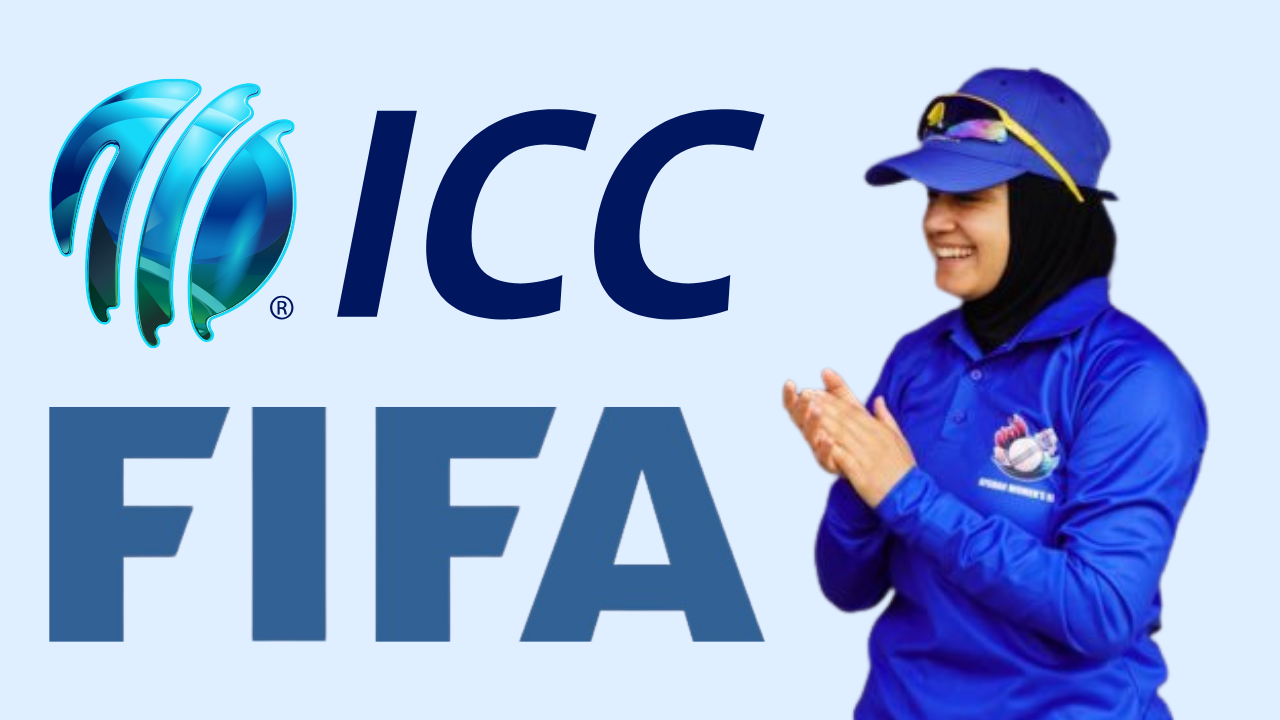
The ICC finds itself under mounting pressure over one of the most consequential governance failures in modern cricket — the complete disappearance of women’s cricket inside Afghanistan since the Taliban’s return to power in 2021, and the governing body’s continued recognition of Afghanistan as a Full Member nation through its men’s team despite that reality. The Olympic Charter establishes sport as a fundamental human right, affirming that access to it cannot be denied on discriminatory grounds — a principle the Taliban’s sweeping restrictions on women and girls directly violate, and one that cricket’s return to the Olympics in Los Angeles makes impossible for the ICC to sidestep indefinitely. Against that backdrop, the country’s exiled women cricketers are now demanding formal international recognition, emboldened by FIFA‘s decision in April to allow displaced Afghan women footballers to compete internationally without Taliban approval.
What the players are fighting for
Canberra-based exiled Afghan cricketer Shafiqa Khan, who has not played an official competitive international since before the Taliban takeover, spoke to ABC Sport’s Daniela Intili about the significance of FIFA’s intervention for Afghan women athletes across all sports. “FIFA has given significant hope to many Afghan women athletes and shown that no matter where they live, they can represent their country and follow their passion,” she said. Khan was equally direct about the players’ purpose beyond their own competitive ambitions, addressing the millions of women and girls inside Afghanistan who remain barred from education, employment and sport. “We can represent Afghan women who live back home and be a voice for a million girls who are denied their basic rights and follow their passion,” she added.
She spoke to what formal ICC recognition would deliver for that audience. “It [would] mean a lot and it would be an unforgettable moment for all Afghan women who live back home and are denied their basic rights,” Khan noted. The exiled players have continued to train and participate in exhibition matches abroad, but without ICC recognition they remain outside the structure of international competition entirely. “We can be a voice for Afghan women,” she said.
ICC governance under scrutiny
Dr Catherine Ordway, a Sports Integrity Expert and visiting scholar at UNSW’s School of Business Canberra who helped relocate several Afghan players to Australia after the Taliban takeover, has been among the most persistent critics of the ICC’s response. The governing body established a monetary fund and a task force — its second on this issue, the first having never convened at all — partnering with Cricket Australia, the England and Wales Cricket Board and the Board of Control for Cricket in India. The current task force has met only once. The players it was designed to support have formally requested representation within it and received none. When the ICC made its announcement, the playing group had welcomed it with genuine optimism — a reaction Ordway recalls, and one she contrasts sharply with what has followed in practice.
Ordway made clear where the ICC’s failure is most acutely felt. “They want to send a strong message to the women and girls stuck inside Afghanistan who are not allowed to get educated, can’t work, can’t move freely, much less play cricket. They want to send a strong message that women can do anything but the ICC just hasn’t stepped up to the plate yet,” Ordway told ABC’s Daniela Intili. She did not soften her assessment of the governing body’s handling of the issue. “It’s absolutely not a good look,” she added.
The broader stakes of the ICC’s inaction were not lost on her either. “It’s really important to send a strong message that the Taliban’s message on gender apartheid is completely unacceptable,” she noted. The task force’s structural shortcomings compound that failure. “At the moment it’s just made up of the Indian cricket, English cricket and Australian cricket representatives but none of the women are represented and they do not have a plan going forward after the funding ends in August,” Ordway stated. The funding deadline sits three months away with no confirmed successor strategy in place, leaving the playing group in a state of sustained uncertainty about their future support structure.
Ordway pointed to football’s governing body as the model the ICC has so far declined to follow. “There’s an example already out there with the international federation for football [FIFA], and I hope that other international federations will follow suit, including the cricketers,” she said. Human rights advocates and several national cricket boards have repeatedly called on the ICC to take a firmer stance on Afghanistan’s exclusion of women from sport, none of whom have succeeded in prompting a formal shift in the governing body’s position.
Edinburgh and the window ahead
The exiled players attended the opening fixture of the ICC Women’s T20 World Cup, which expands to twelve teams for its England and Wales edition running from June 12 to July 5. A planned visit to the United Kingdom timed around the ICC Annual Conference in Edinburgh from July 8 to 11 is now being viewed as a critical opportunity to force the issue onto the governing body’s agenda — the Afghan women’s team is not currently included in the conference programme, a fact that reflects the ICC’s broader pattern of treating the matter without urgency. Ordway described what the players’ presence in Edinburgh could mean at that moment. “The fact that they are going to be there at the same time, I am really hopeful [it] will help to put some pressure on the ICC to make some positive decisions, both for this group of displaced women but [also] for the ones inside Afghanistan as well,” she said.
The convergence of the Women’s T20 World Cup, cricket’s Olympic return and the Edinburgh conference gives the exiled players a rare window of visibility across multiple fronts simultaneously — and a moment the ICC will find increasingly difficult to meet with silence.
The ICC has yet to make any public statement addressing the players’ calls for recognition. With the Edinburgh conference weeks away and the funding window closing in August, the governing body’s silence is becoming increasingly difficult to justify — and increasingly costly for the women it has so far failed to act for.