
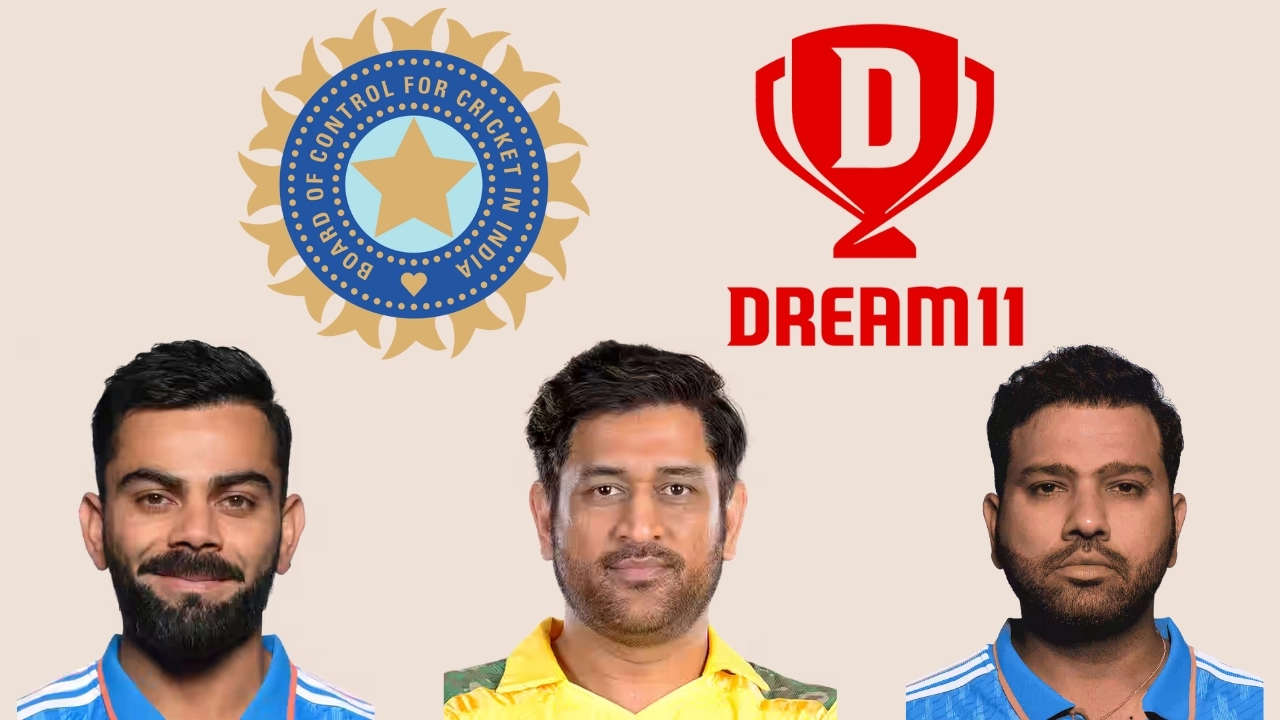
A financial shockwave hits Indian cricket
The Indian cricket economy has been dealt a massive blow following the government’s ban on real-money gaming under the Promotion and Regulation of Online Gaming Bill, 2025. This decision has sparked a dramatic shake-up in brand sponsorships, advertising budgets, and endorsement deals across the cricket ecosystem, from national stars to regional leagues.
Among the first major consequences: Dream11 pulled out of its ₹358 crore (approx. $40.87M) jersey sponsorship deal with the Indian national team. The company was the biggest real-money gaming brand tied to Indian cricket, and its exit marked a symbolic end to an era where gaming companies were the sport’s top commercial backers.
Kohli, Dhoni, Rohit lead list of players impacted
That said, beyond Team India, some of the hardest hit include players. According to a report by Cricbuzz, the total estimated annual endorsement losses for Indian cricketers are between ₹150–200 crore (approx. $17.13M–$22.83M).
Some of Indian cricket’s biggest stars had endorsement portfolios heavily tied to real-money gaming platforms. Virat Kohli earned ₹10–12 crore (approx. $1.14M–$1.37M) annually from his association with MPL. Rohit Sharma and MS Dhoni reportedly took home ₹6–7 crore (approx. $685,009.70–$799,177.99) each from Dream11 and Winzo, respectively.
Other prominent names affected include Jasprit Bumrah, KL Rahul, Rishabh Pant, and the Pandya brothers — all previously tied to Dream11. Meanwhile, Shubman Gill, Mohammed Siraj, Yashasvi Jaiswal, Ruturaj Gaikwad, Rinku Singh, and Sourav Ganguly were associated with My11Circle, with annual endorsement revenues in the ₹1–3 crore (approx. $114168.28–$342,504.85) range.
For younger players, the damage is deeper. In many cases, the gaming partnerships made up a significant portion — even a majority — of their endorsement income. For Mohammed Siraj and Washington Sundar, the loss of My11Circle and Dream11, respectively, could translate into a 33% drop in their endorsement earnings. Some players have reportedly lost their entire commercial portfolios, with gaming brands being the only sponsors on their rosters.
Ripple effects across leagues and franchises
Beyond players, the impact is being felt across the wider cricketing infrastructure. My11Circle had been contributing ₹125 crore (approx. $14.27M) annually as an associate sponsor of the IPL — a deal now under threat. Individual IPL franchises, including Kolkata Knight Riders, Lucknow Super Giants, and Sunrisers Hyderabad, are also set to lose ₹10–20 crore (approx. $1.14M–$2.28M) annually from gaming sponsors.
Smaller leagues and tournaments — such as the Legends League and regional/state competitions — face an even bleaker outlook. Some of these competitions relied almost entirely on funding from gaming companies, with no immediate alternatives on the horizon.
The European Cricket Network has already suspended operations, citing the collapse of Indian gaming-linked investment as the reason.
Advertising market to lose ₹8,000–10,000 crore (approx. $0.91B-$1.14B)
The consequences go far beyond cricket. The real-money gaming sector accounted for 7–8% of India’s total advertising market, and an even larger 15–20% share of digital ad spending. That revenue is now vanishing overnight.
“In terms of overall advertising spends, these gaming companies contribute around 7–8 percent of the market. Nearly 80 percent of that will vanish, since real money gaming accounts for 75–80 percent of the overall gaming market. So that is one big impact. Roughly 7–8 percent of total ad spends and about 15–20 percent of digital ad spends will also disappear, because their share in digital advertising is higher,” says Karan Taurani, executive vice-president, Elara Capital, speaking to Cricbuzz.
“This was the amount being spent on cricket and cricketers. Now, I think endorsements for cricketers will take a hit. Their brand value and income are bound to decline. While players endorse multiple products, the real money gaming segment contributed significantly to their endorsement revenue, which could drop by 20–25 percent. Broadly, that translates to about INR 8,000–10,000 crore,” Taurani added, as reported by Cricbuzz.
A reset in the cricket sponsorship economy
The Online Gaming Bill not only bans real-money games but also prohibits any form of advertising or promotion across media and social platforms. Payment channels for these games have been blocked, and a new national regulatory authority is expected to oversee the sector going forward.
While top-tier players like Kohli and Dhoni may be able to pivot to other categories, the industry at large faces uncertainty. Whether traditional sectors like FMCG, telecom, or fintech can step in to fill the commercial void left by gaming remains to be seen.
For now, Indian cricket is entering a new era — one without the oxygen supply that real-money gaming had provided for years.


