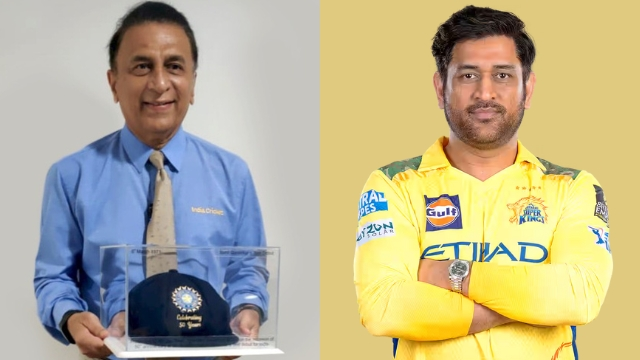
Sunil Gavaskar has delivered a sharp critique of the Indian Premier League’s (IPL) policy on uncapped players, warning that the trend of awarding massive contracts to untested domestic talent is harming Indian cricket. In his column for Sportstar, the former India captain questioned both the players’ motivations and the long-term impact of inflated valuations.
“A whole lot of the players bought for huge amounts simply fade away as their hunger and drive are satiated… but Indian cricket takes a bit of a beating,” Gavaskar wrote.
Rasikh Dar leads expensive uncapped picks — but underperforms
The 2025 IPL mega auction saw Rasikh Dar become the most expensive uncapped player, picked up by Royal Challengers Bangalore for ₹6 crore. Despite the hefty price tag, Dar has featured in only two matches this season, making little impact so far.
Gavaskar used this case to highlight a recurring issue: high-priced uncapped players rarely justify their valuation.
“In all these years, it is hard to recall an uncapped player bought for huge numbers who has justified his inclusion in the team,” he added.
Dhoni’s retention under ‘uncapped’ rule questioned
Gavaskar also took aim at a controversial rule change by the BCCI that allowed Chennai Super Kings (CSK) to retain MS Dhoni as an uncapped player for ₹4 crore. The rule, originally scrapped in 2021, was reinstated ahead of the 2025 auction, classifying any Indian player who hasn’t played international cricket in five years as “uncapped.”
“To accommodate Mahendra Singh Dhoni… the limit was raised to ₹4 crore,” Gavaskar revealed.
This move enabled CSK to bypass the higher salary brackets for retaining capped players, prompting Gavaskar to call for a stricter framework for auction rules going forward.
Lower prices, less pressure, better results?
While Gavaskar supports giving opportunities to young players, he argued that unrealistic expectations created by inflated auction prices can hinder a player’s development.
“If in the next auction his price comes down, then the pressure of expectations also comes down and the player plays a lot better,” he observed.
As IPL continues to grow financially, Gavaskar’s comments are a warning against turning the league into a high-stakes market for unproven talent. With younger players chasing big paydays, Indian cricket may risk prioritizing short-term gains over long-term stability.