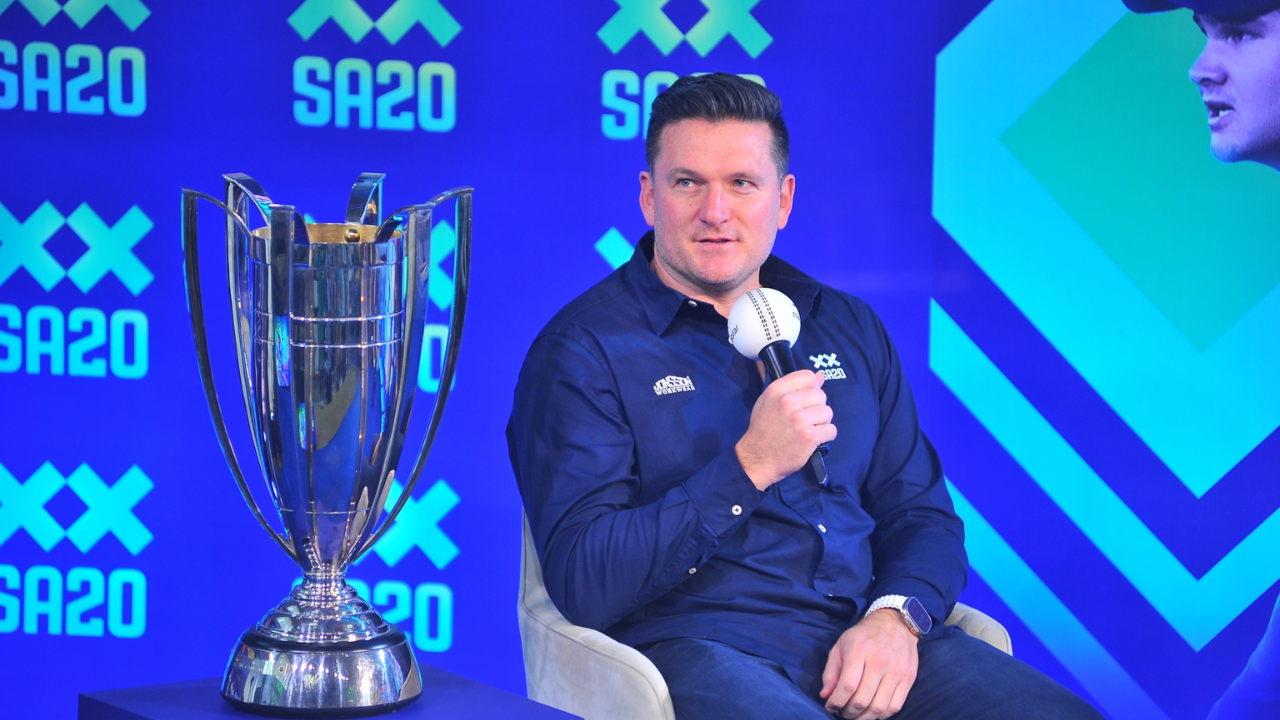
SA20 League Commissioner Graeme Smith believes South Africa’s franchise T20 competition has established itself as a preferred destination for players during the Southern Hemisphere summer, as the tournament prepares for its fifth season in 2027 amid competition from other major leagues.
The upcoming edition is scheduled from January 17 to February 19, overlapping with Australia’s Big Bash League (BBL), which runs from December 12, 2026, to January 26, 2027.
The former South Africa Captain also highlighted the league’s contribution to rebuilding domestic interest in cricket, creating opportunities for emerging players and strengthening the wider South African game.
SA20 establishes its position in crowded cricket calendar
Speaking during an interaction facilitated by SA20 following the Season 5 Auction, Smith reflected on the circumstances that enabled the tournament’s launch.
“I think it really has. I think in the beginning, credit to Cricket South Africa for one or two tough decisions that they had to make in cancelling, say, the initial ODI series in Australia, which allowed a window in an already busy FTP calendar to be filled.”
The competition now occupies a five-week period in South Africa’s summer, alongside international cricket commitments involving Australia, Bangladesh and England.
Smith added, “I really like to believe that we’ve become the league of choice, certainly in the Southern Hemisphere window. So, I think we have certainly established ourselves coming into Season 5.”
League’s development extends beyond franchise cricket
SA20’s emergence has also been closely connected to Cricket South Africa’s efforts to strengthen the domestic game following a difficult period for the sport.
Reflecting on those circumstances, Smith said, “I think just before SA20 started, South African cricket was in a challenging space. I think the national team was struggling. There were a lot of administrative issues. I think fans were getting disgruntled with the game.”
Beyond establishing another professional competition, SA20 has provided a prominent platform for players to develop their skills against competitive opposition.
Smith views the opportunities created by the tournament as beneficial to South Africa’s broader talent development system, with stronger individual performances contributing to the national team’s competitive prospects.
Fan engagement emerges as a key achievement
Smith also reflected on his experiences interacting with spectators during the league’s previous season.
He noted, “But we really wanted to bring fans back to the game in South Africa and introduce new fans. I think last year, walking around the stadium, the number of people I met who were watching cricket for the first time was remarkable. The growth of the fan base and the support for our game are certainly among the key goals that we have achieved over the first few years.”
Shaun Pollock highlights challenge of identifying young talent
The discussion around SA20’s player development has also brought attention to how franchises assess younger cricketers and determine when they are ready for opportunities at a higher level.
Former South Africa Pacer and Pretoria Capitals Assistant Coach Shaun Pollock addressed the subject during the same SA20-facilitated interaction.
Pollock said, “I think all the coaches would agree that we’re very conscious about trying to find some young talent. Vaibhav Sooryavanshi, I suppose, has brought a different dimension to the way people think about the younger guys and as to whether they can do it.”
Pollock added, “But I also think you’ve got to understand that batting in Indian conditions when you’re younger compared to batting in South African conditions when you’re younger is a bit of a contrast.”
For franchise coaching teams, identifying promising players involves weighing their potential against the demands of the competition and deciding how best to provide opportunities.
Smith targets sustained growth beyond fifth season
Smith outlined his longer-term ambition for SA20, saying, “Now, it’s about doubling down and making sure it goes from strength to strength, so that in the next five years, people still want to be a part of SA20 and see it continue to grow.”