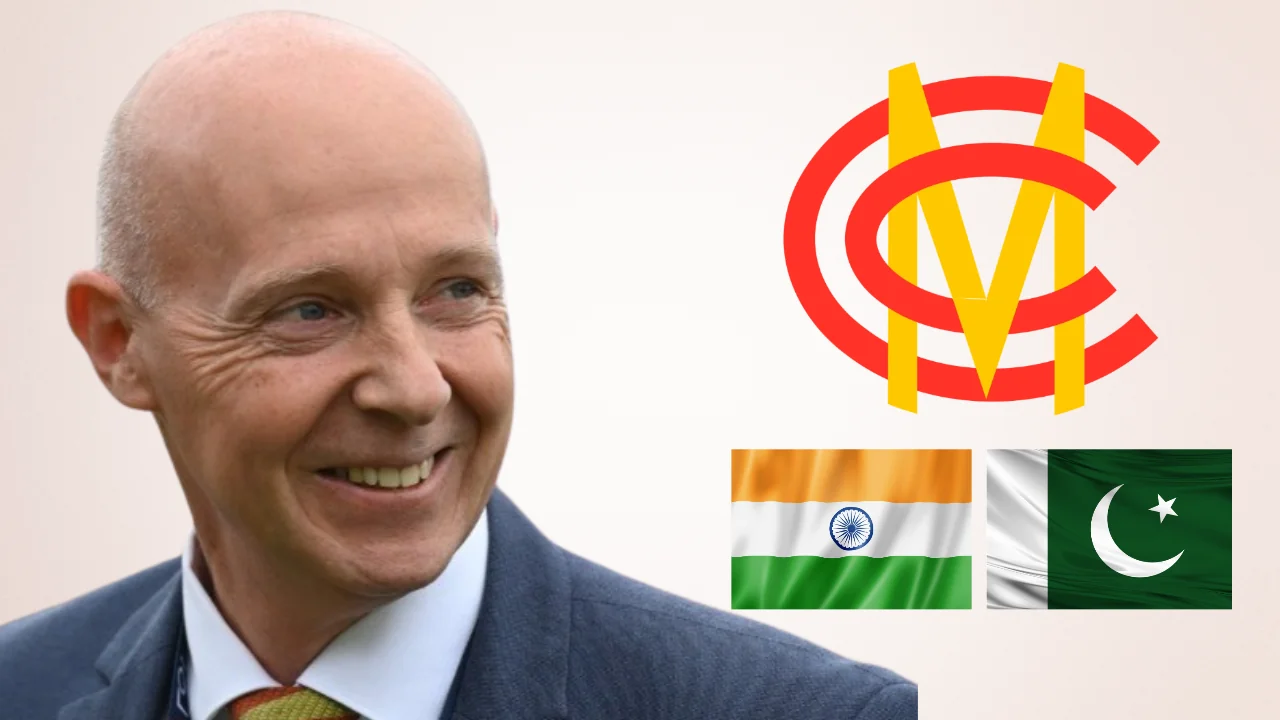
The Marylebone Cricket Club (MCC) has ruled out intervening in India’s ongoing refusal to exchange customary handshakes with Pakistan’s players, making clear that the politically sensitive dispute falls outside its authority as the custodian of cricket’s laws.
MCC Head of Cricket Fraser Stewart said the organisation could encourage respect between opposing teams but had no power to enforce a gesture that is not required under the Laws of Cricket.
His comments follow another instance of the handshake boycott during the India A-Pakistan A Rising Stars encounter in Doha on November 22, extending a practice that began during the 2025 men’s Asia Cup and has since appeared across different levels of international cricket.
MCC explains why it cannot enforce India-Pakistan handshakes
Speaking to PTI on the sidelines of the DP World ILT20, Stewart acknowledged that tensions between India and Pakistan extended beyond the sporting arena.
“There are certain instances that transcend cricket and come from a level that’s above my station to talk about geopolitical situations. What we can control is that, on the field, the players respect each other, they respect the umpires, the authority of the umpires and the game.”
The MCC is responsible for maintaining and interpreting cricket’s laws, but pre-match and post-match handshakes are sporting conventions rather than mandatory requirements.
Stewart indicated that although the organisation would prefer to see those exchanges resume, it could not challenge decisions shaped by wider political circumstances.
He added: “That’s what we can control. If there are edicts coming from above about handshakes, that’s not something that MCC is able to control. We would like to see it, but we realise that there are bigger issues at play and that’s something that’s beyond anything we can control.”
The boycott first emerged during the 2025 Asia Cup following heightened tensions between India and Pakistan after the Pahalgam terror attack. The absence of handshakes has subsequently become a recurring feature of cricket encounters between the two countries.
Stewart draws distinction between cricket’s laws and Sandpapergate investigation
Stewart also addressed the renewed controversy surrounding Australia’s 2018 ball-tampering scandal, following fresh allegations about how widely the use of sandpaper was known within the national team.
While the MCC has a clear position on the legality of altering the ball using an abrasive material, Stewart distinguished that responsibility from investigating the conduct of individual players and coaches.
“I think my line on that (Sandpapergate) would be that, as far as the laws of cricket are concerned, using sandpaper on the ball is a clear breach of the law.”
The scandal has returned to prominence after former Australia opener Usman Khawaja questioned the original investigation in his autobiography, with Cameron Bancroft subsequently publishing further allegations about the involvement and knowledge of members of the touring party.
Stewart said the existing sanctions were justified under cricket’s laws but declined to determine the credibility of competing accounts or speculate about who had known of the operation.
Responsibility for examining those claims, he maintained, belongs to Australia’s governing body.
Stewart explained: “It’s for Cricket Australia to investigate. There are fairly entrenched views on either side. I don’t know what the truth is. We have Australia coming to England for a hotly anticipated Ashes series next summer. Hopefully, by then, people will let the cricket do the talking.”
MCC considers expanding free-hit provisions to Test cricket
Beyond the controversies, Stewart outlined a potential development in cricket’s playing framework, revealing that the MCC has discussed whether free hits following no-balls should eventually become part of the formal Laws of Cricket.
Free hits currently operate through playing regulations in limited-overs formats rather than as a universal requirement across the sport.
The distinction means their use in Test cricket would require a change to the existing framework.
Stewart said: “Free hits, they’re not in the laws at the moment. It’s something we will consider. So they only exist as playing regulations. We’ve discussed it, but at the moment we’ve stopped short of bringing free hits into all cricket, but you never know. Eventually we’ll get there.”
No formal decision or implementation timetable was announced.
MCC expands access to cricket’s laws through new translations
The MCC is also working to make the Laws of Cricket easier to understand across different cricket-playing communities by expanding the number of languages in which they are available.
Stewart outlined work undertaken in India during October, including translations into Urdu, Hindi, Kannada, Marathi and Bangla alongside English. Further versions were being prepared for launch in Sri Lanka.
The initiative is intended to help players, officials and administrators engage with cricket’s regulations without relying exclusively on English-language material.
For the MCC, these projects represent areas where it can directly influence the sport’s development, in contrast to geopolitical disputes and disciplinary investigations that fall outside its remit.