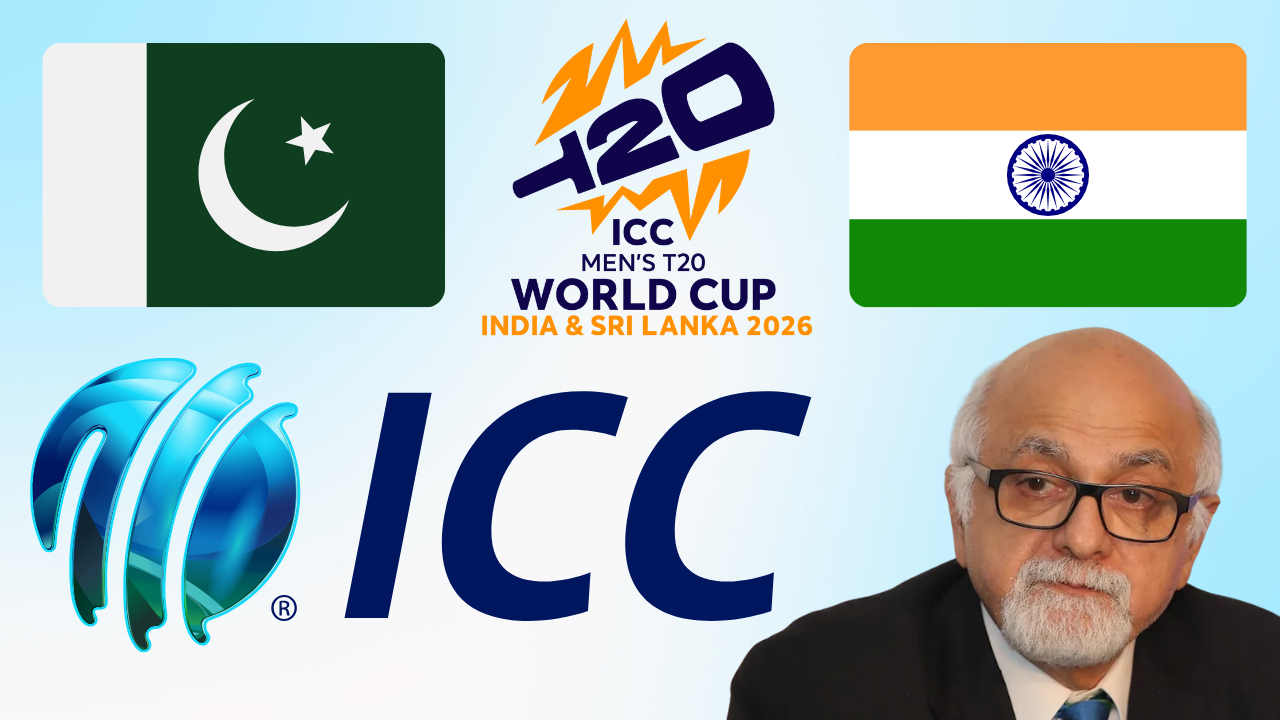
ICC launches informal diplomacy to avert high-profile no-show
In a high-stakes effort to prevent a major disruption to its marquee event, the International Cricket Council (ICC) has initiated quiet, behind-the-scenes diplomacy to persuade Pakistan to reverse its decision not to play India at the 2026 T20 World Cup.
According to a report by RevSportz and Dawn, the ICC has entrusted its Deputy Chairman, Imran Khwaja, with spearheading informal negotiations with the Pakistan Cricket Board (PCB). Khwaja, who represents the Singapore Cricket Association and is seen as a neutral figure, is tasked with “playing peacemaker” as tensions escalate over the group match scheduled for February 15 in Colombo.
The urgency follows a formal announcement by Pakistan’s government on X, stating: “The Government of the Islamic Republic of Pakistan grants approval to the Pakistan Cricket Team to participate in the ICC World T20 2026, however, the Pakistan Cricket Team shall not take the field in the match scheduled on 15th February against India.”
The Government of the Islamic Republic of Pakistan grants approval to the Pakistan Cricket Team to participate in the ICC World T20 2026, however, the Pakistan Cricket Team shall not take the field in the match scheduled on 15th February 2026 against India.
— Government of Pakistan (@GovtofPakistan) February 1, 2026
The decision has unsettled ICC officials, who see the India-Pakistan fixture as the commercial crown jewel of the tournament.
Revenue risks and tournament disruption loom
The group-stage clash between the arch-rivals is estimated to be worth approximately $500 million globally across a full rights cycle, factoring in broadcasting, sponsorships, advertising, ticketing and ancillary commerce. Advertising slots for the match command approximately US$ 44.2k per 10 seconds.
Such economic stakes have raised alarm across the cricketing world. Multiple cricket boards, unnamed in reports, have reportedly stepped in to assist the ICC in brokering a solution with the PCB.
While Pakistan has yet to formally communicate its boycott decision to the ICC, tournament regulations could make the consequences of a no-show severe. Pakistan would forfeit the points, damage its net run rate and face potential penalties under the Member Participation Agreement — a legally binding contract.
Political precedent and legal overhang
Pakistan’s current stance echoes historical instances where teams withdrew from World Cup fixtures under government directives — such as Australia and West Indies boycotting matches in Sri Lanka in 1996, and England and New Zealand refusing to play in Zimbabwe and Kenya respectively during the 2003 edition.
However, unlike those cases, Pakistan has not offered an official justification. Behind closed doors, the PCB is reportedly drawing from its experience in the 2018 ICC Dispute Resolution Committee (DRC) proceedings against India.
“During the hearing, the PCB asked the BCCI to explain its refusal to tour Pakistan,” a source familiar with the 2018 proceedings said, as quoted by Dawn. “Initially, the BCCI stated that it was not obliged to provide a reason. Later, it claimed that the Indian government had not allowed the tour.”
That case centered on a 2014 memorandum of understanding in which the BCCI and PCB agreed to six bilateral series between 2015 and 2023. The PCB argues it upheld its side of the agreement by supporting the ICC’s revenue-sharing model, only to be left with nothing when India refused to participate.
As in 2018, concerns persist that BCCI’s influence within the ICC could disadvantage Pakistan again. Pakistani officials are said to be weighing options that include taking the matter to an international court of arbitration if financial or reputational penalties are imposed.
ICC responds sharply to Pakistan’s boycott
The ICC has issued a strongly worded response to the developments, emphasizing its commitment to fairness and global competition.
“The ICC notes the statement made by the government of Pakistan regarding the decision to instruct its national team to selectively participate in the ICC Men’s T20 World Cup 2026,” the council said in a statement.
“While the ICC awaits official communication from the PCB, selective participation is difficult to reconcile with the fundamental premise of a global sporting event.”
The statement went on to say: “ICC tournaments are built on sporting integrity, competitiveness, consistency and fairness, and selective participation undermines the spirit and sanctity of the competitions.”
The governing body also expressed concern for fans and the sport’s global future, noting, “While the ICC respects the roles of governments in matters of national policy, this decision is not in the interest of the global game or the welfare of fans worldwide, including millions in Pakistan.”
Fallout scenarios and what’s next
Despite the ongoing deadlock, India is expected to travel to Colombo and take the field for the scheduled match. If Pakistan fails to appear, India will be awarded the points by default under tournament rules.
The ICC Board is reportedly preparing to assess possible sanctions against the PCB. Potential penalties could include heavy fines, exclusion from future tournaments, restrictions on bilateral series, or reduced participation in events such as the Pakistan Super League (PSL).
Adding to Pakistan’s discontent is a recent ICC decision that removed Bangladesh from the 2026 tournament after it refused to play in India, citing security concerns. The council instead added Scotland as a replacement, passing the decision with a 14-2 majority. Only Pakistan and Bangladesh opposed the move — a moment that has deepened Pakistan’s suspicion of ICC’s governance practices.
For now, all eyes are on Imran Khwaja and his ability to navigate a diplomatic and sporting minefield that could define the future of one of cricket’s most iconic rivalries — and the integrity of its most lucrative event.