Politics and protocol collide during India-Pakistan U-19 clash
When India and Pakistan walked out at the ICC Academy in Dubai for their U-19 Asia Cup encounter, the contest carried weight far beyond the scoreboard. Even before the first ball was bowled, attention had shifted to a familiar flashpoint — whether the two sides would follow the customary handshake protocol, or once again allow geopolitics to shape cricketing conduct.
According to a report by PTI, the International Cricket Council (ICC) had urged both teams to uphold standard sporting procedures, stressing that junior cricket should remain insulated from political tensions. However, the Board of Control for Cricket in India (BCCI) held firm to its internal directive, a stance that ultimately played out publicly during the match.
BCCI enforces no-handshake policy as ICC calls for sporting neutrality
The no-handshake practice isn’t new. It began during the senior men’s Asia Cup earlier this year, when Indian players refrained from shaking hands with their Pakistani counterparts — a move widely interpreted as a symbolic gesture in solidarity with the Indian Army and victims of the Pahalgam attack. The same policy continued through the Women’s ODI World Cup and Rising Stars Asia Cup T20.
Ahead of the U-19 Asia Cup clash in Dubai, the ICC reportedly urged both cricket boards to set political messaging aside and follow traditional post-match protocols. However, the BCCI held firm. India’s team manager, Anand Datar, was instructed to act strictly according to board policy — and that position ultimately prevailed on match day.
“The boys haven’t been told anything. But obviously BCCI has given explicit instructions to its manager Anand Datar. Now if Indian boys don’t shake hands with Pakistan team then match referee will have to be informed in advance. We know for a fact that ICC doesn’t want politics to take front seat when it comes to junior cricket. So it is a case of both bad optics and public sentiment,” a BCCI official speaking on condition of anonymity told PTI.
High-stakes cricket delivers drama amid persistent tensions
Touted as the marquee clash of Group A, the India-Pakistan U-19 contest in Dubai lived up to its billing — not just for the cricket, but for the heightened political undertones that accompanied it.
Both teams came into the match with commanding wins in their opening fixtures — India having demolished the UAE by 234 runs and Pakistan overpowering Malaysia by 297. India’s lineup, led by captain Ayush Mhatre, had looked in formidable form, with Vaibhav Sooryavanshi making headlines for his blistering 171-run knock in the opener.
However, in the high-voltage encounter against Pakistan, Sooryavanshi fell early, managing just 5 runs — a breakthrough that sent the Pakistan dugout into celebration and briefly shifted momentum. Even so, India recovered to post a competitive total, before their bowlers dismantled Pakistan’s chase in a one-sided finish.
India outclass Pakistan amid emotional highs and a familiar no-handshake finale
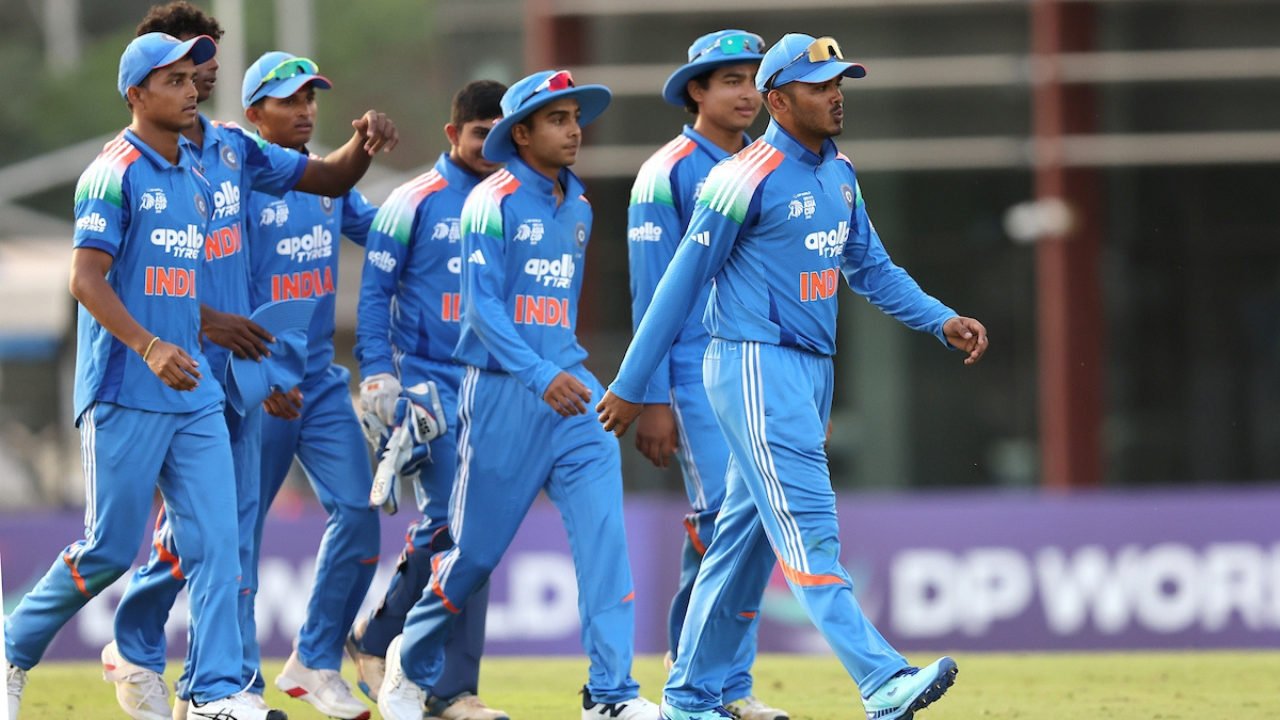
Even as the geopolitical tension lingered in the background, India’s U-19 squad delivered a dominant performance against their Pakistani counterparts, sealing a 90-run victory in Dubai and extending their no-handshake policy in the aftermath.
Put in to bat under overcast conditions, India recovered from early blows to post a competitive 240. Aaron George was the standout performer, anchoring the innings with an assured 85, while Kanishk Chouhan added a valuable 46 lower down the order. The pair of Abdul Subhan and Mohammad Sayyam did well to strike regularly, but India’s middle order held firm long enough to post a par-plus score in the rain-shortened 49-over game.
Pakistan’s reply never really got going. Deepesh Devendran led India’s bowling charge with three early strikes, leaving Pakistan reeling at 30 for 4. Huzaifa Ahsan’s 70 was the lone resistance, but with wickets tumbling around him, the chase fell apart, and the team folded for 150.
In the lead-up to the match, headlines were dominated not by cricket but by pre-match diplomacy. Despite the ICC’s push for neutrality, India’s skipper Ayush Mhatre pointedly declined to shake hands with his Pakistani counterpart at the toss — a continuation of a stance introduced during the senior Asia Cup following the Pahalgam terror incident. The symbolic posture continued after the match as well, maintaining a now-familiar scene of teams walking away without the customary show of sportsmanship.
Vaibhav Sooryavanshi, who had starred in the tournament opener with a record-breaking 171, was dismissed early, his wicket triggering a visibly jubilant reaction in the Pakistan dugout. But that breakthrough failed to spark a turnaround, as India held their nerve with both bat and ball.
Kanishk Chouhan, for his all-round brilliance with bat and ball, walked away with the Player-of-the-Match honours, underscoring India’s growing strength in the tournament despite the emotionally charged setting.
A delicate balancing act for the ICC
With tensions between India and Pakistan continuing to shape cricketing engagements beyond the boundary, the ICC’s challenge remains navigating diplomacy while preserving the spirit of the game. The recent U-19 Asia Cup clash in Dubai served as yet another reminder of how political dynamics can seep into sporting arenas — from the pre-match no-handshake tension to the post-match optics.
For the ICC, maintaining neutrality and encouraging standard protocol in junior cricket remains a pressing concern. But as the events in Dubai showed, even at the U-19 level, cricket’s biggest rivalries often reflect the deeper geopolitical divide — making the job of global cricket governance an increasingly complex task.