Today, September 30, 557 names go into the Abu Dhabi T10 player draft. They are what remains of a registration list that ran past 1,200, filtered down over weeks into a pool the organisers consider signable. Some will be internationals with IPL contracts and World Cup medals. Some will be UAE domestic players for whom a T10 fee is a meaningful share of an annual income.
The draft is routine. What sits behind it is not.
Under the restructured Abu Dhabi T10, every one of those player fees must be funded before the tournament begins — not held on a franchise’s balance sheet, not promised against sponsorship revenue still to land, but paid in advance into an account controlled by Abu Dhabi Cricket & Sports Hub, with the tournament itself responsible for paying the players.
“The big change, really, for the headline, is that centrally we are receiving 100% of the player payments in advance of the event,” says Matt Boucher, CEO of Abu Dhabi Cricket & Sports Hub (ADCSH) and CEO of the Abu Dhabi T10. “So the government will be paying the players.”
What the structure actually does
The mechanism is straightforward, which is part of its force.
Ownership of the Abu Dhabi T10 now sits with ASHRA Events LLC – S.P.C., a wholly owned subsidiary of ADCSH, operating within a government-backed sporting framework alongside the Abu Dhabi Sports Council and the Emirates Cricket Board.
Under the new franchise arrangements, 100% of the funds required for player payments must be received in advance of the event into an ADCSH-controlled account. The tournament then administers payment centrally rather than leaving it in the hands of individual franchises. Players are expected to receive their money in two instalments, one shortly before the event and one shortly afterwards.
That arrangement is new. The tournament was founded in 2017 by Shaji Ul Mulk and run by T10 Sports Management, with ADCSH hosting it at Zayed Cricket Stadium under a destination agreement struck in 2019 that brought the event from Sharjah. Earlier this year, ADCSH assumed majority ownership and commercial rights control, converting a privately owned competition that the government hosted into one the government owns and manages as what His Excellency Aref Al Awani, Chairman of the Board at ADCSH and General Secretary of ADSC, described as a long-term national sporting asset. Al Awani called the change a strategic evolution signalling strengthened governance and institutional credibility. Ul Mulk, who retains a stake through Mulk International, publicly backed the transition, saying the tournament now has the structure, expertise and institutional backing required to realise its full potential.

The practical consequence is that the party responsible for the tournament’s commercial decisions is now a government entity with a balance sheet and a reputation to protect, rather than a promoter dependent on the event’s own revenues or franchise owners that fall across a wide spectrum of credibility. That is what made a centralised payment guarantee possible in the first place.
“We’ve worked with the ICC on that, and all of the new franchise agreements have the prepayment of the player fees into an account owned, really, by the government,” Boucher says. “So we are taking the responsibility of paying the players on time, which is obviously an absolute paramount piece of any event.”
Verification ran earlier still. Franchise finances were examined before signatures went on paper. “A lot of what we’ve done has been receiving the financials before the agreements are signed, proving that we have both the franchise fee and the player payments in the pot,” Boucher says, “and then we will not have the same player issues as the event has had in the past.”
The problem it is answering
The Abu Dhabi T10 had payment problems under its previous ownership. That is one of the main reasons the new payment structure was created.
In a guest post in cricexec in July 2025, Tom Moffat, Chief Executive of the World Cricketers’ Association, named the tournament directly in a piece on the epidemic of player non-payment across the sport: “Major offenders on late and non payment in sanctioned domestic leagues have historically included… Abu Dhabi T10 and other T10 leagues.”
He was describing a pattern, not an isolated failure. The guest post named the Bangladesh Premier League, the Lanka Premier League and various legends leagues alongside the T10 circuit, and cited a WCA global player survey completed by more than 320 professional players, a majority of them internationals, in which 29% said they had experienced late or non-payment in cricket sanctioned by the ICC or its members. The WCA’s Leagues Hub, which catalogues 53 men’s and women’s competitions, has logged reports of late or non-payment issues in 17 of them. Moffat described what follows as a well-trodden path: agents and the WCA pushing both league management and team owners to pay, while each duly points the finger at the other.
Agents know the routine intimately. “Previously what was happening was we were constantly just chasing,” says one UK-based agent with several players in the tournament, who asked not to be named. “Sometimes franchises take longer than others, we’ve had bonuses not given.”
He supplies the detail that says more about the old model than any survey figure. “We’re still owed money from previous owners, but once they’ve sold and moved on, seems like that’s a lost cause. But this new move will certainly help everybody.”
That is the structural flaw throughout franchise leagues worldwide that this new arrangement targets. When an owner exits, the obligation exits with them.
The reform the players asked for
What makes this more than a local fix is that the WCA has been asking for precisely this mechanism, in public, for years.
Among the safeguards the WCA has called for is an escrow requirement for sanctioned leagues, where money is held securely and transparently until it falls due to players, alongside minimum contract standards and a dispute-resolution body with real enforcement behind it. The model is simple enough: franchises pay their full wage bill into a controlled account before a season begins, and the league distributes from there, closing the gap in which league and franchise blame each other while a player waits.
Few sanctioned leagues have adopted it. Abu Dhabi has, and has gone further than most versions of the proposal by putting a government-owned entity at the centre of it.
Moffat’s response to what Abu Dhabi has built is supportive. “It’s pleasing to see another domestic league signal its intention to strengthen player payment protections,” Moffat says. “In a competitive global environment, working constructively with players collectively to embed strong minimum standards and protections, alongside balanced terms and conditions, is becoming increasingly important.” He points to the WCA’s Leagues Hub, which tracks sanctioned major domestic leagues against metrics that matter to players, their associations and agents, “with the aim of helping to lift standards, strengthen professionalism and drive greater consistency across the global leagues landscape.” On Abu Dhabi specifically: “We welcome the direction of travel including the proposed changes in the Abu Dhabi T10, and look forward to seeing continued positive progress across more leagues.”

Agents are equally positive. “The Abu Dhabi T10 has become a mainstay of the franchise calendar and whilst the majority of player experiences remain positive, the competition has had some issues relating to player payments which have overshadowed a lot of the good work being done by many franchises,” says Thomas Harwood, Director of Cricket at TGI Sport, one of the leading — and largest — agencies representing players, coaches and broadcasters globally.
“It is really positive to see the league recognise this and undertake a rigorous tender process for franchise ownership,” Harwood says. “In turn, the league has put in place protocols designed to protect player payments, with the goal of eliminating payment issues altogether. This can only be a good thing for players and the competition as a whole.” He is direct about the timing: “Whilst these processes are long overdue and necessary it should be recognised and applauded.”
Dean Ahmed, CEO of Global Sport Ventures, whose roster includes many global stars and players who have appeared in the tournament, frames it as a welfare question and a sector-wide one. “From a player welfare point of view, this is a really positive move,” he says. “We’ve seen more payment uncertainty in franchise cricket over the past 18 months than I can remember, so securing player funds upfront should become the minimum standard.”
Why ownership was the precondition
Boucher’s account of how the reform became possible is, in effect, an argument that payment failure is an ownership failure.
“We never had the decision, because we weren’t the owners of the event,” he says. “And now we can make the decision.”
The first task was the paperwork. Every franchise agreement had been negotiated separately, on different terms, with different obligations. “One of the real core agreements we wanted to get hold of was a standardised franchise agreement,” Boucher says, together with verified due diligence documents and financial information. Deloitte ran a two-stage invitation-to-bid process, assessing prospective owners on governance, integrity and operational capability as well as finances.
Behind all of it sat turnover. Eighteen different teams have competed across nine seasons of an eight-team tournament, and five team owners changed in the last edition alone. “There’s been far too much churn in the team ownership,” Boucher says. “It means that we’re chasing our tails. It means that we’re not providing a sound and structured foundation with repeat and reliable team owners.”
Churn and non-payment are the same story told from two angles. An owner who does not expect to be in the competition in three years has limited incentive to clear an invoice in three months. Ten-year licences, standardised agreements and a guaranteed share of central pool income are designed to make continuity the rational choice. Prepayment is what protects the players while that proves itself.
The test is November
The names the tournament attracts are not marginal. Recent editions have featured Nicholas Pooran, Andre Russell, Kieron Pollard, Sunil Narine, Trent Boult, Faf du Plessis, Moeen Ali, Shimron Hetmyer, Tim David, Phil Salt, Rovman Powell, Marcus Stoinis, Alex Hales and Harbhajan Singh, with Andy Flower coaching the defending champion UAE Bulls.
Boucher wants the treatment to match the billing. “We want players to return to being right at the forefront of the event,” he says, citing the standard set by another property on Abu Dhabi’s calendar. “We want all of the VIP treatment that we do at the Abu Dhabi HSBC Championship for the players. That will take a couple of years, but put them back really centrally into the best five-star hotels in Abu Dhabi and rolling out the red carpet for them.” Asked what success looks like in year one, his answer runs through reliable owners, the ICC’s anti-corruption unit working in partnership with the tournament, and a draft list of “players that we trust, players that we want in Abu Dhabi.”
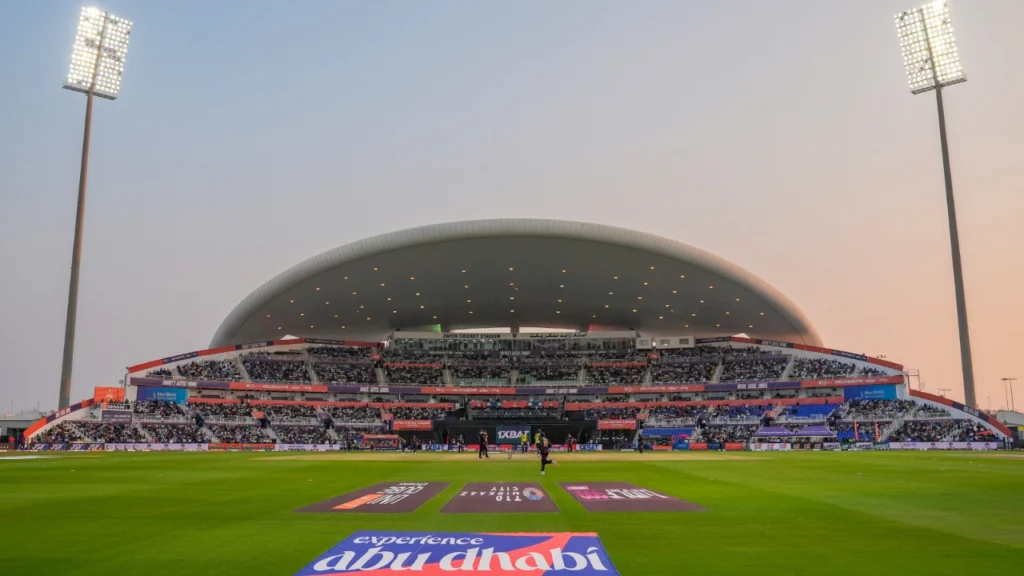
The 2026 Abu Dhabi T10 runs from 7 to 20 November at Zayed Cricket Stadium, the first full edition under the new structure.
A promise to pay is not a payment, and the sport’s recent history contains a great deal of both. What Abu Dhabi has changed is the sequence. The money is collected before the cricket is played rather than chased after it, and it sits with the tournament rather than with an owner who may not be there next year. If that holds through a full cycle, the question becomes whether one league’s protocol turns into the game’s standard — whether the boards that sanction competitions, and the ICC above them, begin requiring what Abu Dhabi has chosen to do voluntarily. The agents who have spent years chasing the money have already said where they stand. “The Abu Dhabi T10 deserves real credit for taking the lead,” Ahmed says, “and hopefully other leagues will follow.” Harwood, independently, echoes the same sentiment: “We do hope other leagues follow.”