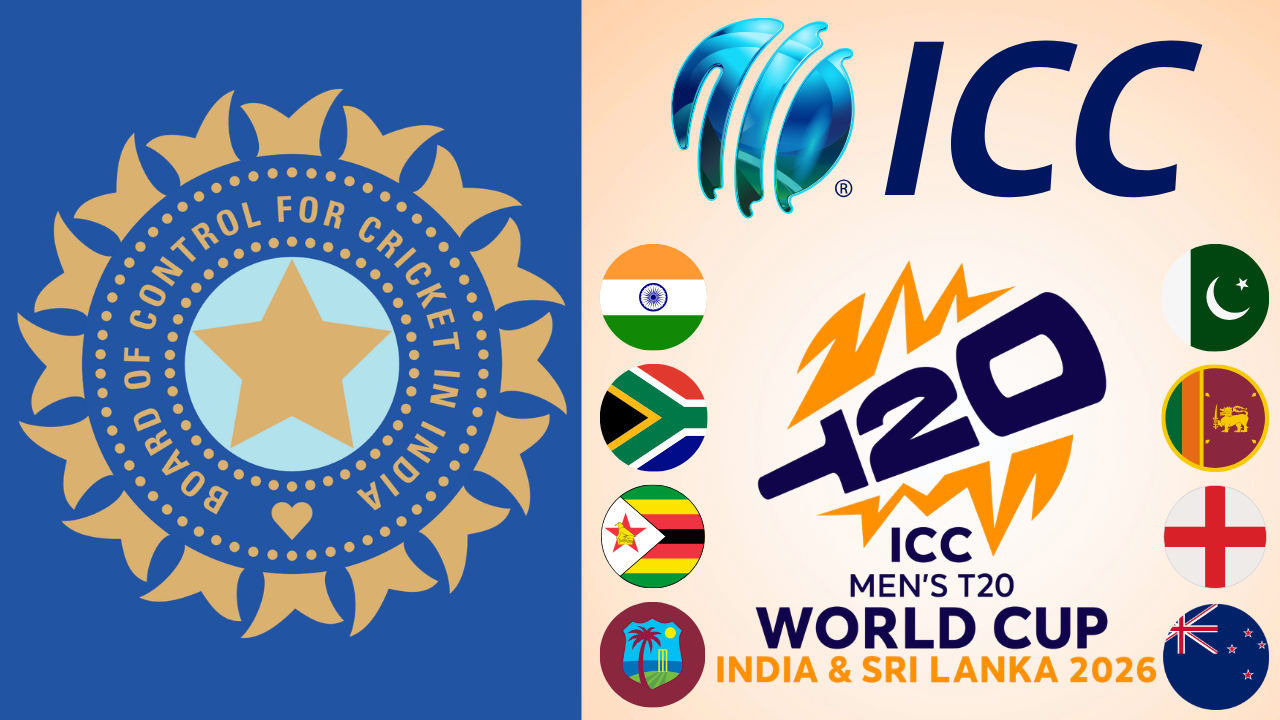
The ICC’s Super 8 format at the T20 World Cup 2026 has triggered one of the tournament’s biggest off-field controversies — and this time, the debate is about structure, not scores.
As the second stage began across India and Sri Lanka, criticism mounted over the pre-seeding system that has placed all four group winners — India, South Africa, West Indies and Zimbabwe — into the same Super 8 pool, while England, Sri Lanka, Pakistan and New Zealand, all runners-up, occupy the other group. The issue has ignited allegations of imbalance and, in some corners of social media, suggestions of undue advantage toward India and the BCCI.
How the Super 8 pre-seeding created the imbalance
Before the tournament began, the ICC allocated fixed Super 8 slots based on T20I rankings rather than final group-stage outcomes. Teams were pre-assigned positions such as A1, B1, C1 and D1 months in advance to streamline venue planning and travel logistics across the two host nations.
The result is a structure that guarantees at least two group-stage toppers will be eliminated before the semi-finals. Meanwhile, one runner-up is assured progression to the last four.
South Africa’s situation has become emblematic of the controversy. Despite topping their group, they are effectively seeded lower than New Zealand, who advanced as runners-up but were pre-assigned a superior slot. Critics argue this undermines the traditional reward for finishing first and reduces the competitive significance of final group-stage matches.
Sri Lanka’s supporters have also voiced concern. Although the co-host has played its campaign at home, the pre-determined knockout bracket means a potential semi-final appearance would require travel to India, denying Colombo a marquee knockout fixture.
The ICC has defended the model, citing logistical and operational necessities linked to co-hosting across two countries, including venue allocation, travel coordination and broadcast scheduling.
Gavaskar questions timing of outrage
Amid the backlash, former India captain Sunil Gavaskar questioned why criticism surfaced only after the tournament reached its decisive phase.
“Why bring this up now? Why was this not brought up before the start of the tournament? Those are the questions that need to be asked of the people who are raising these points now. The reason that I can think of, maybe the ICC can explain it better, is that the logistics, the tournament is being played in two countries,” Gavaskar told India Today.
Expanding on the operational realities of staging a multinational ICC event, he added: “There’s international travel, there’s immigration, and there’s customs, all those things to be taken care of. There is still the question of airline and hotel bookings; not every team travels with the same number of people. Some teams travel with a support staff team of 15, so maybe they need 35-40 rooms. Some teams may travel with 20-22 people altogether, so they may need fewer rooms. All these things need to be taken into account, and perhaps this is the reason why the pre-seeding took place,” Gavaskar said.
His remarks shift the debate from competitive balance to operational feasibility — a core tension in modern global tournaments.
Aakash Chopra dismisses BCCI favouritism claims
While the structural imbalance has drawn scrutiny, allegations that the grouping was manipulated to benefit India have been forcefully rejected.
Former India opener Aakash Chopra pushed back strongly against claims circulating online. “Many people are saying that all of this is favoring BCCI, and is happening to favor BCCI only. To those people, I want to ask something, Dimaag khaali hai kya yaar? (Is your brain empty?) Why would we want to keep South Africa and West Indies in our group? How does it help us anyway which way? That Australia would lose, who knew? And Zimbabwe topped the group. So, don’t consider it as the weaker group. Do some research at least. Faltu ki baatey mat kiya karo, sobha nahi deta (Don’t talk rubbish, it does not suit you).” Chopra said in a video posted on his X.
Are preseeded Super 8 groups unfair? Does it give India an advantage? Let's look at why it's being done and the reasoning behind this.#aakashvani #cricket #T20WorldCup pic.twitter.com/qw5DhQqRYy
— Aakash Chopra (@cricketaakash) February 20, 2026
He also highlighted the logistical imperatives created by hosting duties split between India and Sri Lanka.
“This tournament is happening in two countries. So, India have to play all their matches in India, and Sri Lanka and Pakistan have to play all their matches in Sri Lanka. So, it is mandatory to keep Sri Lanka and Pakistan in one group, and India must be in a different group. Nahi toh kaam kaise chalega?” Chopra added..
Chopra further noted that similar tournament structures have precedent in past editions. “People are saying that how can you do this and all, what is this pre-seeding here, there is no advantage of topping the group. But we have to understand that this is not happening for the first time. This happened in 2007, 2009, 2010, and even in 2012. In 2012, the exact same scenario as now unfolded where the table toppers were together in one group,” he said.
Zimbabwe’s surge sharpens format debate
The structural debate intensified after Zimbabwe completed an unbeaten group-stage campaign, including a six-wicket win over Sri Lanka in Colombo to chase down 179 with three balls to spare.
Zimbabwe captain Sikandar Raza, reflecting on his side’s composure during the chase, focused on preparation and role clarity instead of their Super 8s group placement. “We have trained for every situation. Then we have the right personnel to send in at the right time,” Raza said at the post-match presentation ceremony.
He added: “We have got all those roles clear and that is why you see the confidence in the changing room.”
On the other side, Sri Lanka wicketkeeper-batter Kusal Mendis remained focused on the path ahead despite the defeat. “It’s been a good campaign for us. We have three big games coming up and we have played these three teams frequently in the last 12 months – going to be an interesting week,” Mendis said at the post-match press conference.
Looking ahead to the knockouts, he added: “I have never played a semi-final of an ICC event and looking forward to do well and book a semi-final berth.”
Competitive integrity vs operational reality
The Super 8 pre-seeding controversy at the T20 World Cup 2026 ultimately highlights a broader governance dilemma for the ICC: how to balance competitive fairness with the logistical demands of staging multi-country events.