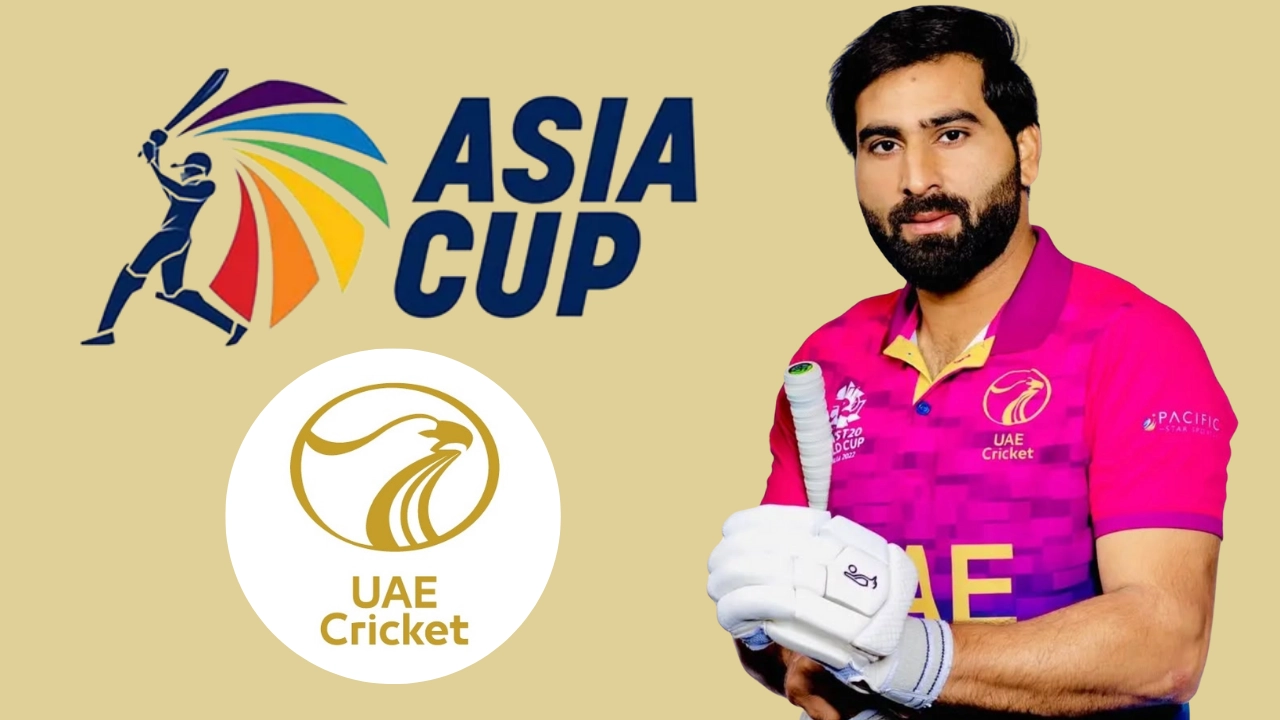
Strong start, narrow finish: UAE fall short in spirited battle
In a match that began under contentious circumstances and ended in a hard-fought defeat, the UAE cricket team showed grit against Pakistan in the T20 Asia Cup 2025. Despite losing by 41 runs, their performance on the field—and the message off it—left a lasting impression.
Speaking at the post-match press conference, UAE captain Muhammad Waseem addressed two major talking points: the hour-long delay caused by Pakistan’s protest, and swirling speculation about internal rifts in the UAE squad along national lines.
Team unity amid Indo-Pak tensions
With the geopolitical climate adding pressure around India-Pakistan encounters in the tournament, questions had emerged about whether similar divides existed within the UAE team—comprising players of both Indian and Pakistani origin.
But Waseem made it clear that nationality has never defined the squad’s identity or chemistry.
“No, we are not talking about that (Indo-Pak tensions) as we play a lot of cricket together. We are like a family here. There is no Indian and no Pakistani. We play for UAE team. We play as a family and live as a family,” he said.
The UAE squad represents a diverse makeup. Indian-origin players include Simranjeet Singh, Rahul Chopra, Harshit Kaushik, Dhruv Parashar, and Alishan Sharafu. The Pakistani-origin group features Waseem himself, Haider Ali, Junaid Siddique, Muhammad Rohid Khan, and Asif Khan.
Despite this split in background, Waseem insisted the group is unified in purpose and camaraderie.
Delayed start and walkover questions
Tensions escalated before the match when the Pakistan team arrived late following their objections to match referee Andy Pycroft’s role in an earlier handshake controversy involving India. The resulting delay pushed the start time to 7:30 pm local time—an hour later than scheduled.
While tournament rules could have allowed UAE to seek a walkover due to Pakistan’s late arrival, Waseem dismissed the idea entirely.
“First of all, this is not our responsibility or our work. We were focusing on our game. We came here to play the game, and we did that,” Waseem said.
He emphasized that the delay did not disrupt his team’s focus or preparation.
“Didn’t matter if we were playing on time or we were playing late. Doesn’t matter if we are playing at 6:30 or 7:30 pm. This is not our work. This is organiser’s work. We came here to play the game and we played the game,” he added.
A competitive outing against a stronger side
On the field, UAE delivered a competitive performance. Junaid Siddique made early breakthroughs by removing both openers, Saim Ayub and Sahibzada Farhan. Simranjeet Singh followed with a three-wicket burst that rattled Pakistan’s middle order. Even after Fakhar Zaman’s 36-ball fifty, Pakistan struggled before a late cameo from Shaheen Afridi helped them reach 146/9.
In response, UAE’s batting unit failed to convert the strong bowling foundation into a winning total. The team was bowled out for 105 in 17.4 overs, ending their campaign just short of a historic upset.
For the Emirates Cricket Board, such public affirmations of unity are critical as the team seeks to cement its place on the world stage.
Still, the message from Waseem and his team was clear: the UAE is focused, united, and determined to rise above political narratives as they build toward a stronger cricketing future.