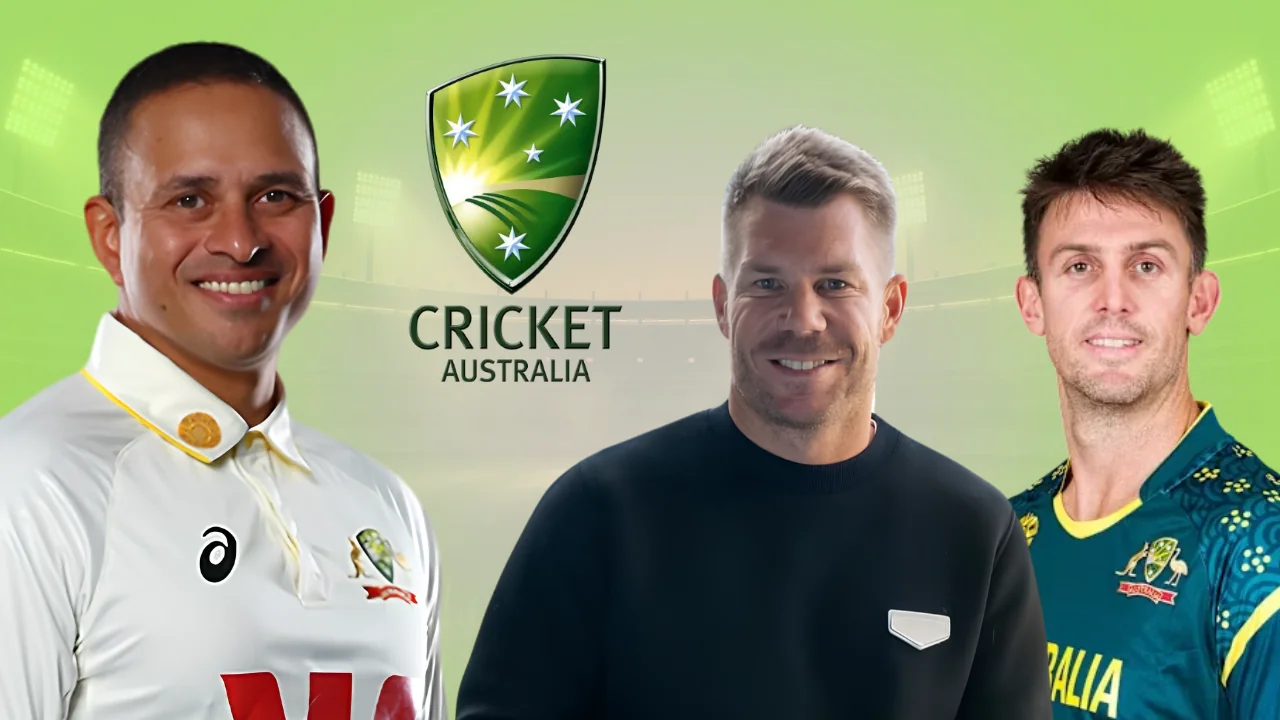
Former Australia opener Usman Khawaja has refused to identify which of his former teammates knew about the 2018 Sandpapergate scandal, even as his autobiography Sabr triggers a widening dispute involving David Warner, Graeme Hick, Ian Healy and Mitchell Marsh.
Khawaja’s claims that responsibility for the ball-tampering incident extended beyond the three sanctioned players have been challenged by former members of Australia’s setup. The controversy has also prompted questions about the promotional schedule for his book, with publisher Penguin denying that the tour has been cancelled.
Khawaja refuses to identify players involved in Sandpapergate
During an interview with ABC, Khawaja declined to clarify whether Australia Test Captain Pat Cummins had known about the use of sandpaper during the 2018 Test series against South Africa.
When asked directly about Cummins’ knowledge, Khawaja replied: “I’m not going to answer that.”
The former batter explained that he had deliberately withheld certain names and details from his autobiography rather than publicly accuse individual teammates. Khawaja told ABC: “It’s never been for me about pointing fingers and saying, ‘he did this, he said that’. That’s why even when I first wrote my edit there were names, there were lots of things, and I pulled it back.”
His central argument is that the Australian team should acknowledge a broader responsibility for what happened in Cape Town, where Cameron Bancroft was caught using sandpaper to alter the condition of the ball.
Khawaja added: “My main objective here is always to try and take accountability as a team, to say, yes, this was happening. And even though one person did it or the captain knew about it and Davey Warner always took the heat for it, that it wasn’t just them, that we were all involved in it as a team.”
Cricket Australia suspended then Captain Steve Smith and Vice-Captain David Warner for 12 months each, while Bancroft received a nine-month ban. Khawaja has questioned whether the original investigation adequately established the extent of knowledge within the touring squad.
Penguin clarifies Khawaja’s book tour status
The fallout from Khawaja’s ABC interview prompted Australian media reports suggesting that he had withdrawn from several promotional engagements.
However, his publisher Penguin disputed suggestions that the tour had been abandoned.
In a statement to ABC, Penguin said: “The book tour is 100% still going ahead, we’ve just had to make some adjustments this week, but no major cancellation of the tour at all.”
The publisher’s clarification came as the autobiography continued to attract attention beyond Khawaja’s account of the ball-tampering scandal.
David Warner challenges Graeme Hick after Sandpapergate denial
One of the sharpest disagreements has emerged between Warner and former Australia Batting Coach Graeme Hick.
Hick, who worked with the national team during the 2018 South Africa tour, rejected the suggestion that the entire Australian setup had been aware of discussions about using sandpaper. He maintained that he first learned of the incident when footage appeared on the stadium screen in Cape Town.
Speaking to The Sydney Morning Herald, Hick said: “To me what Khawaja is implying here is absolutely false. In regard to any discussions around the ball tampering in Port Elizabeth or Cape Town that took place, I will say in true honesty that I did not hear or know anything!!”
Warner, who has publicly supported Khawaja’s account, responded by raising an entirely different issue: the circumstances surrounding Hick’s appointment as Australia’s batting coach.
Writing on X in response to a post about Hick’s interview, Warner stated: “Let’s get the facts straight. Graeme Hick was only appointed because Cricket Australia was unwilling to pay Michael Di Venuto what he deserved. As players, we valued Michael so highly that we even offered to contribute from our own salaries to retain him. These discussions were taking place during the New Zealand tour. That alone speaks volumes about how highly we regarded him and how determined we were to keep him involved. Adds to why Graeme has spoken!!”
Let’s get the facts straight. Graeme Hick was only appointed because Cricket Australia was unwilling to pay Michael Di Venuto what he deserved. As players, we valued Michael so highly that we even offered to contribute from our own salaries to retain him. These discussions were taking place during the New Zealand tour. That alone speaks volumes about how highly we regarded him and how determined we were to keep him involved. Adds to why Graeme has spoken!!
— David Warner (@davidwarner31) November 11, 2026
Ian Healy questions Khawaja’s Queensland injury claim
A separate controversy involving Khawaja’s autobiography has emerged over his absence from a Queensland Sheffield Shield match while attending the Australian Grand Prix in Melbourne.
Khawaja has maintained that a hamstring injury prevented him from playing. Former Australia ODI Captain and Queensland Cricket Deputy Chair Ian Healy has disputed that explanation, claiming that medical staff did not support the injury assessment.
Speaking on SEN radio on Thursday, Healy said: “Then he claimed an injury, so I then sussed out with all sorts of medicos in our dressing room and our head of high performance, and they denied the injury.”
Healy also alleged that Khawaja declined an opportunity to undergo further medical testing.
He added: “And then they (medicos) said, ‘but let’s get it scanned this afternoon,’ and he refused to scan. So, that’s what I was going on.”
Those allegations concern Khawaja’s availability for Queensland rather than his account of Sandpapergate. They remain Healy’s claims, with Khawaja’s stated position being that he was unavailable because of a hamstring injury.
Mitchell Marsh declines to revisit the scandal
While former players and coaches have offered conflicting accounts, Australia ODI Captain Mitchell Marsh has chosen not to disclose his recollections of the 2018 South Africa tour.
Marsh played in the series and was questioned repeatedly about the scandal during a pre-series press conference in Perth on Thursday, ahead of Australia’s one-day international series against England.
Addressing reporters, Marsh said: “There’s obviously been a lot of noise around this week, and I respect that certain people have told their stories, but I’m not here to share mine today. I know that might sound weird, but it’s a big week for us, and it’s an important time for this one-day group, and my sole focus has been on preparing for tomorrow.”
Marsh was also asked why he had not signed the 2021 statement issued by Cummins, Josh Hazlewood, Nathan Lyon and Mitchell Starc, in which the four bowlers denied prior knowledge of a foreign substance being taken onto the field.
He declined to explain his decision or speak on behalf of the other players.
Marsh later said: “My honest answer is because I’ve personally moved on. I respect that others probably haven’t, but I have, and I hope that’s respected.”
Cricket Australia backs Cummins as Turnbull responds
Cricket Australia has indicated that Khawaja’s autobiography does not provide sufficient grounds to reopen its investigation into the 2018 incident.
The governing body’s Interim Chair David Boon also expressed confidence in Cummins, who has faced renewed questions over what Australia’s bowlers knew.
Speaking to The Australian, Boon said: “We absolutely support Pat.”
Former Australian Prime Minister Malcolm Turnbull has separately challenged Khawaja’s portrayal of the political response to the scandal.
Turnbull, who publicly condemned the incident while in office, rejected the suggestion that his intervention was driven by political considerations.
He told The Sydney Morning Herald: “I’m surprised that Usman thinks the only reason this was a big deal was because the prime minister said he was disappointed.”
Turnbull also questioned why Khawaja had waited until the publication of his autobiography to make the allegations. Speaking to the Australian Financial Review, he asked: “Why didn’t he speak up at the time?”
The publication of _Sabr_ has therefore reopened disagreements extending beyond the original disciplinary findings, with Khawaja seeking collective accountability while other figures dispute his account or decline to revisit the events of 2018.