
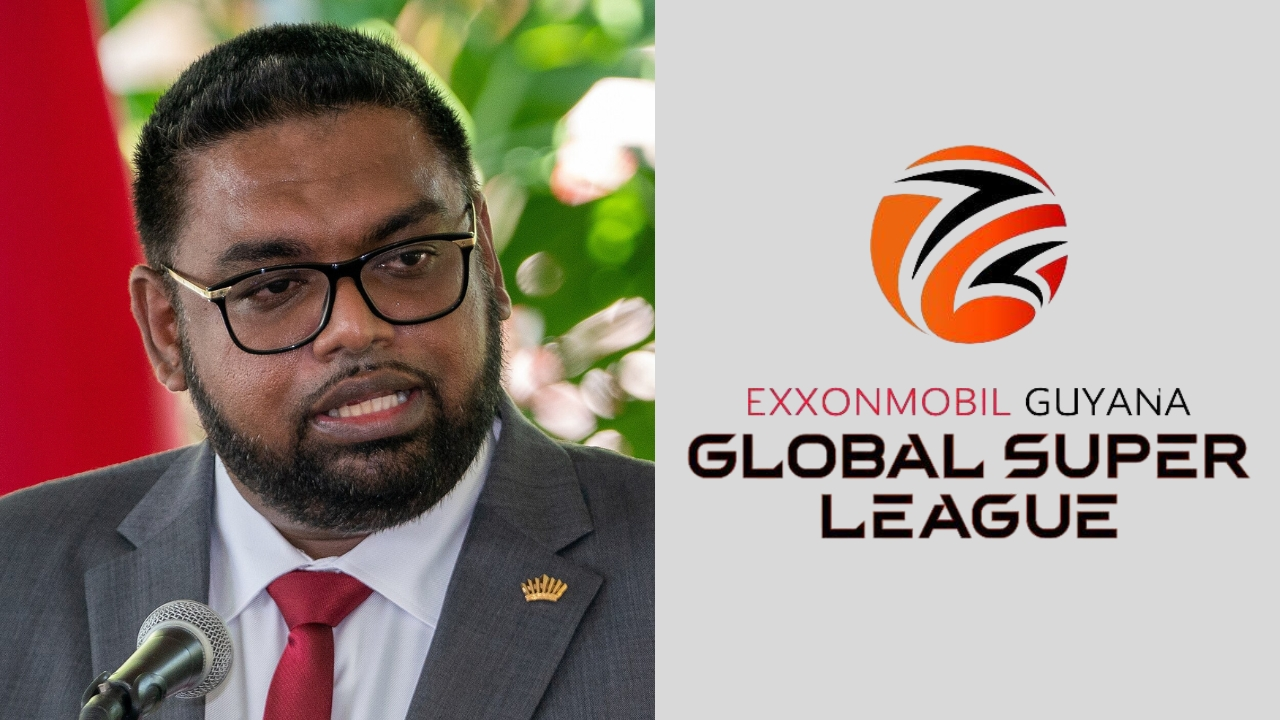
GSL positions itself as a global partner, not rival
The newly launched Global Super League (GSL) has made waves in its first couple of seasons — and its ambitions go far beyond cricket. Spearheaded by Guyana and backed by Cricket West Indies, the league is aiming to become a unifying platform for top T20 teams from across the world, combining sport, development, entertainment, and culture into a broader economic and diplomatic play.
According to Times of India, Guyanese President Dr. Mohamed Irfaan Ali described the GSL as part of a larger strategy to position Guyana at the center of global cricket and regional sports tourism.
“We are just a few hours away from the USA with huge Asian diaspora that are very cricket-oriented, whether that is Bangladesh, Pakistan, India, and then the natural West Indian diaspora. So we have decided to put in place an ecosystem to support cricket as a major plan of that sports tourism,” said President Ali.
From legacy to opportunity: why Guyana is going all in on cricket
Drawing on a rich cricketing legacy that produced legends like Clive Lloyd, Shivnarine Chanderpaul, and Rohan Kanhai, Guyana is aiming to re-establish itself as a cricketing hub. But unlike the now-defunct Champions League T20 (CLT20), which struggled with audience and commercial sustainability, the GSL is being built as a cross-league partnership from the ground up.
“On the economic side, we strongly believe that the product that we have launched – the Global Super League – is not meant to be in competition with any product. It is meant to be in partnership with all the different T20 products. That is why the Global Super League sought to, first of all, engage the ICC. In having the ICC understand what we want to achieve, and having the ICC on board.”
Dr. Ali added that the tournament seeks to replicate the Champions League-style model — bringing together winners from leagues such as the CPL, BPL, PSL, ILT20, Big Bash, and more.
“In developing the Global Super League, we then went to all the major boards. And seek to involve the winners, just like what the (now defunct) Champions League (CLT20) did – the winners of the different T20 leagues. And to bring them into this format. But this format is not only about cricket. It is about cricket, it’s about development, it’s about entertainment, it’s about culture.”
“A league powered by a small developing nation”
Despite its modest origins, GSL has already made a splash. “In the first year, I believe it has ruffled enough feathers. And created enough news for people to understand this is a serious league. And this is a league powered by a small developing nation,” said Dr. Ali.
He emphasized that Guyana is setting high standards. “It’s a league that has not cut any corners. Or taken any shortcut to the level of professionalism and the quality of product that we want to achieve,” he added.
A bold appeal to the BCCI
One of the key hurdles facing the GSL — and other emerging leagues — is the BCCI’s longstanding policy of not allowing Indian players to compete in overseas T20 competitions unless they retire from all Indian cricket, including domestic matches and the IPL.
Dr. Ali called on the Indian board to reimagine this approach, both in the interest of global cricket and in service of India’s vast talent pool.
“India cannot be developing the level of talent that it is developing just for its borders. It’s like boxing. You can’t be a world champion if you only want to fight in your borders. And BCCI is doing an enormous disservice to the magnitude of talent that India has by not allowing participation in this league,” he stressed.
“This (the tournament) should not be seen a criticism or competition but as an opportunity. Because we want to partner with India. We are naturally part of the diaspora. And I believe that India itself, the BCCI, should have a Diaspora 11 even to start with. Because cricket is much more than a game. It’s a cultural identity.”
Diaspora diplomacy and India-Guyana collaboration
Dr. Ali framed the GSL within a broader diplomatic and cultural vision — one that aligns with India’s global outreach to its diaspora communities. He even discussed the idea with Prime Minister Narendra Modi.
“And I even raised this with Prime Minister (Narendra) Modi. That if you really want to reach out to the diaspora, which is a big part of his agenda. If you really want to integrate the diaspora in what you do, it has to be in every sphere of life. Not only political, economic, investment and trade. Culture and sports is the most impactful way in which you can integrate the diaspora.”
“Because if you have your talent coming down to play in the league. And you give them an opportunity also to be seen. India will have five (playing) XIs,” said Dr. Ali.
Looking ahead: partnerships, infrastructure, and inclusion
With Guyana’s general elections scheduled for 1 September, Dr. Ali indicated that he would resume efforts to build support for the GSL and strengthen international cricket ties — particularly with India and the ICC.
“We’re here to build a product that is beyond the ecosystem. We want to support what India is doing and what the ICC is doing. We have already engaged the West Indies board as part of this. We want to engage them to play a deeper part in this. And we want India to really reconsider this approach to the Champions League.”
“We’re building. We’re investing in the facilities here. We’re investing to keep cricket alive in this part of the world. And if India really wants to make a breakthrough in this massive market that exists. Then they have a very natural partner in us,” Dr. Ali said.
He closed with a vision that frames cricket as much more than a game — a strategic tool for trade, tourism, and global cultural diplomacy.
“So we see cricket like India does. As having trade importance, business importance, economic importance, tourism importance, cultural importance. And also of course the game itself,” he concluded.


