
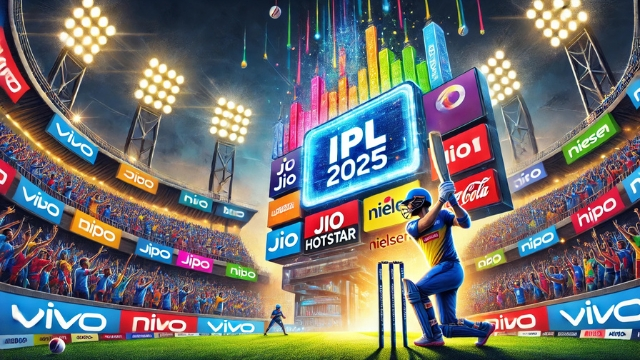
As the 18th edition of the Indian Premier League (IPL) approaches, the landscape of sports marketing and sponsorships is undergoing a significant transformation. From skyrocketing team sponsorship revenues to the evolution of digital advertising measurement, IPL 2025 is setting new benchmarks. With streaming giant JioHotstar implementing advanced analytics and franchises seeing unprecedented brand investments, this year’s IPL is poised to redefine how brands connect with consumers.
Sponsorship boom: IPL teams rake in record revenues
The financial stakes for IPL teams have never been higher. Sponsorship revenue is surging across franchises, with teams securing lucrative partnerships in record numbers. Punjab Kings, Kolkata Knight Riders (KKR), and Gujarat Titans are leading the charge, reporting a 30-40% increase in sponsorship revenue compared to last season.
According to the Punjab Kings’ CEO Satish Menon: “We (Punjab Kings) have boarded over 20 sponsors for IPL 2025, compared to 15 in 2024. We have added several new partners this season, including Freemans Measuring Tools, Kshema General Insurance, EcoLink, Adidas Perfumes, Neo Wheels, Highland Real Estate, and Amul.”
Gujarat Titans, similarly, has expanded its sponsor portfolio from 27 in 2024 to 32 in 2025, onboarding brands such as Torrent Group, The Pokémon Company, Spinner, AMUL Protein, LordsMed, Dream Game Studios, Finkeda, Euro Foods, Fujifilm Instax, and Cricket Icons Figurines & PlayR. The team’s Chief Operating Officer, Colonel Arvinder Singh, attributes this growth to strong team performance and an effective branding strategy, according to Moneycontrol.
In addition, KKR has increased its sponsors from 21 to 25, drawing interest from brands like RR Kabel and Vikram Solar. KKR’s Chief Marketing Officer, Binda Dey, highlighted the team’s robust digital engagement and fan base as key factors in attracting brand partnerships. Punjab Kings also experienced a sponsorship surge, growing from 15 sponsors in 2024 to over 20 in 2025. Among its new partners are Kingfisher, Adidas Perfumes, and Highland Real Estate, while it has renewed agreements with brands like Dream11, Jio, and Kent.
Multi-team sponsorships and strategic branding
The trend of brands sponsoring multiple teams continues to gain momentum. Companies like Reliance Jio, Dream11, and BKT Tires are investing heavily in securing visibility across multiple franchises. Spinner, a new sports drink from Reliance, has partnered with five teams, while Coca-Cola, through various brands, has cemented its presence across multiple squads. BKT Tires has positioned itself as a dominant presence by securing sponsorships with most teams as their official tire partner.
Franchise sponsorship revenues in IPL 2025 are expected to grow by approximately 15-20%, reaching an estimated Rs 1,300 crore (approximately $156 million). Top franchises such as Mumbai Indians and Chennai Super Kings are expected to generate Rs 100-150 crore (approximately $12-18 million) each from sponsorship deals alone. Jersey sponsorships have become particularly valuable, with Mumbai Indians securing a record Rs 40 crore (approximately $4.8 million) (approximately $40 million) per year for its front-of-jersey spot—a 33% increase from the previous season. Chennai Super Kings also upgraded their front-of-jersey sponsorship, reflecting the increasing demand for premier branding locations.
Beyond jerseys, brands are engaging with fans through innovative activations. Gujarat Titans has partnered with The Pokémon Company to bring Pikachu to match days at the Narendra Modi Stadium, while Fujifilm Instax is integrating augmented reality into fan interactions. KKR is leveraging digital content, brand intellectual properties, licensing partnerships, and in-stadium activations to enhance engagement. Punjab Kings is launching branded content campaigns, influencer collaborations, and interactive digital experiences to maximize fan involvement.
Advertising landscape: smart spending over big budgets
While sponsorships are booming, the effectiveness of traditional advertising is being scrutinized. A report by Kadence International and CrispInsight found that despite over 100 brands advertising during IPL 2024, only a select few achieved significant consumer recall. Dream11, for example, emerged as the most effective advertiser, with a 37.7% recall rate, despite spending less on gross rating points (GRPs) than brands like Vimal and Parle, which struggled to surpass a 4% recall rate despite larger ad spends.
This data suggests that strategic ad placement and engagement-driven campaigns yield better results than sheer advertising volume. Brands are increasingly looking at non-traditional ways to create impact, including in-game sponsorships, digital activations, and content-driven campaigns. Brands such as Adidas Perfumes, Neo Wheels, and Amul Ice Cream are utilizing influencer collaborations and branded storytelling rather than relying solely on traditional advertising placements.
Additionally, brands that integrate storytelling into their campaigns—whether through social media activations, digital exclusives, or in-match advertising segments—are seeing increased audience engagement. For instance, Dream11’s latest campaign featuring Bollywood superstars Ranbir Kapoor and Aamir Khan alongside cricket icons like Rohit Sharma and Hardik Pandya has gained immense traction, demonstrating the power of entertainment-driven sports marketing.
The rise of JioHotstar and the future of digital advertising
The IPL’s digital reach in 2024 spanned between 550 and 600 million viewers, a number expected to rise in 2025. Recognizing this immense viewership potential, JioHotstar has partnered with Nielsen to introduce advanced ad measurement tools that will transform how advertisers assess campaign performance.
These tools will allow advertisers to fine-tune their strategies based on precise data rather than estimations. Industry experts believe this shift is long overdue.
“The merger of JioCinema and Disney+ Hotstar has created a streaming behemoth, offering a vast content library across sports and premium entertainment. This consolidation presents advertisers with an opportunity to leverage an unparalleled viewership base with high accountability,” said Maya Nair, Head of dentsu Programmatic, speaking to e4m.
The financial implications of these advancements are significant. JioHotstar alone expects to generate Rs 4,500 crore (approximately $540 million) in advertising revenue, marking a notable increase from the Rs 4,000 crore (approximately $480 million) generated in 2024. This is part of an overall IPL advertising ecosystem projected to generate between Rs 6,000 and Rs 7,000 crore (approximately $720 to $840 million) across digital, television, team sponsorships, and in-stadium branding.
JioHotstar’s subscription-based tier system, however, is likely to alter digital ad reach. With some viewers opting out of free ad-supported content, a shift toward TV advertising may emerge, compelling brands to reevaluate their cross-platform ad spend. Despite this challenge, JioHotstar’s detailed insights into user interactions will allow advertisers to tailor campaigns to targeted audience segments more effectively, ensuring maximum return on investment.
Ultimately, the JioHotstar-Nielsen partnership is not just a milestone for IPL advertisers but a potential game-changer for digital sports broadcasting overall.
As Nair states: “This push for transparency could compel other platforms to set new standards in analytics and attribution. If Jio Ads can deliver attribution and enhanced engagement metrics across Jio’s ecosystem, it could drive advertisers to rethink their spending strategies.”
Advertisers can expect greater transparency, more actionable insights, and enhanced targeting capabilities that will elevate the effectiveness of digital campaigns in IPL 2025 and beyond.
A new era for IPL advertising and sponsorships
IPL 2025 is redefining the way brands approach sports marketing. Franchises are experiencing unprecedented sponsorship growth, digital platforms are introducing cutting-edge analytics, and advertisers are shifting toward more engagement-driven strategies. With strategic brand placements proving more effective than high ad spend, the IPL continues to be the ultimate battleground for marketers aiming to capture the attention of millions.
With evolving consumer behavior, the pressure is on advertisers to innovate. Whether through experiential marketing, integrated digital activations, or leveraging multiple team sponsorships, IPL 2025 is proving that the future of sports marketing lies not in sheer spending power, but in strategic engagement.
For brands, teams, and advertisers alike, the message is clear: success in IPL 2025 will not be determined just by who spends the most, but also by who spends the smartest. The game has changed, and the competition for consumer attention is more fierce than ever.


