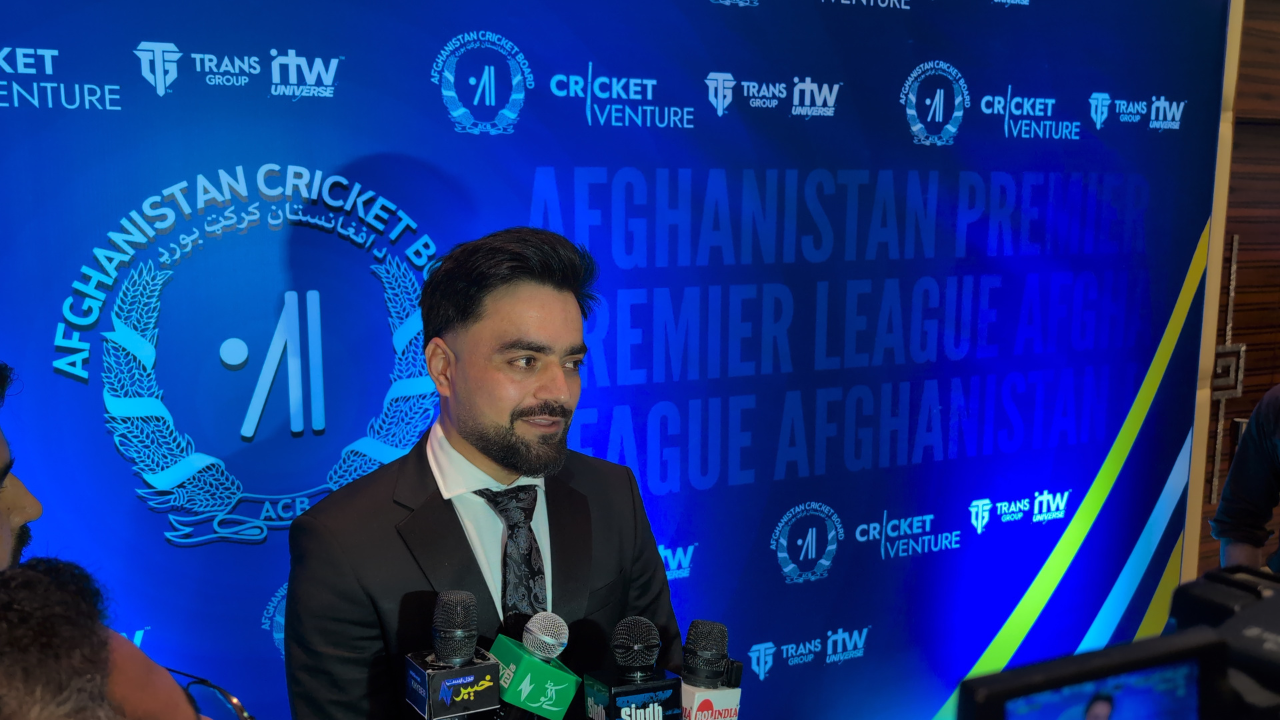
Over 200 attendees filled the Westin Mina Seyahi ballroom on Saturday night, December 20 — virtually every member of Afghanistan’s men’s cricket team, senior officials from the Afghanistan Cricket Board, Emirates Cricket Board leadership, ILT20 executives, and a conspicuous contingent of UAE-based Afghan businessmen. Among them, according to knowledgeable insiders, were potential franchise owners sizing up what could become one of cricket’s most intriguing new properties.
This wasn’t Afghanistan cricket’s first attempt at a premier league. The original version launched in 2018 with Chris Gayle, Brendon McCullum, and Shahid Afridi, but payment disputes and integrity concerns ended it after one season. Seven years later, the Afghanistan Cricket Board returned with a fundamentally different proposition: a league built on financial sustainability, commercial partnerships, and institutional credibility.
“When we took over the responsibility of the Afghanistan Cricket Board, we were on the cusp of the 2021 World Cup,” said Naseeb Khan, the ACB’s CEO, speaking at the event. “And we were not bothered about doing the preparations – we were thinking about ‘will we prepare the flight? How will we be able to secure the visas?’ And that was how tough it was for us to start managing things.”
But Khan emphasized that the challenges were overcome through dedication. “All this happens because we have the dedication among the people who are working at the Afghanistan Cricket Board to make it right, and it’s also the players who have the strong commitment to this game of cricket.”
What followed was a recalibration. The ACB delayed the league relaunch, methodically identified commercial partners, and waited for the right moment. “We wanted to make it right,” Khan said. “So that’s why we had to make sure that we identified the right partner who has the background and the expertise in this world. We didn’t want to rush it, we wanted to make sure that we did things right for the Afghanistan Premier League, and here we are, witnessing the launch.”

That moment arrived in Dubai, where the Afghanistan Premier League — now rebranded simply as APL — was unveiled with a detailed roadmap, a planned October 2026 launch window in the UAE, and backing from Cricket Venture, a joint venture between ITW Universe and Trans Group.
The partnership architecture
The commercial structure reflects a deliberate effort to avoid 2018’s mistakes. Trans Group, a Pakistan-based agency with over 40 years in sports advertising, brings expertise in broadcast production and sponsorship rights. ITW Universe, headquartered in India with a strong Middle East presence, specializes in marketing and digital strategy. Together, they formed Cricket Venture specifically to operate the APL.
One of the first highlights of the night was a panel of four key executives involved in the creation and launch of the league:
- Naseeb Khan – CEO of Afghanistan Cricket Board (ACB)
- Mubashshir Usmani – General Secretary of the Emirates Cricket Board and Chair, ICC Associate Members
- Rao Usman Khan – COO, Trans Group
- Vivek Chandra – Director & Head of Business – ITW Middle East & Africa
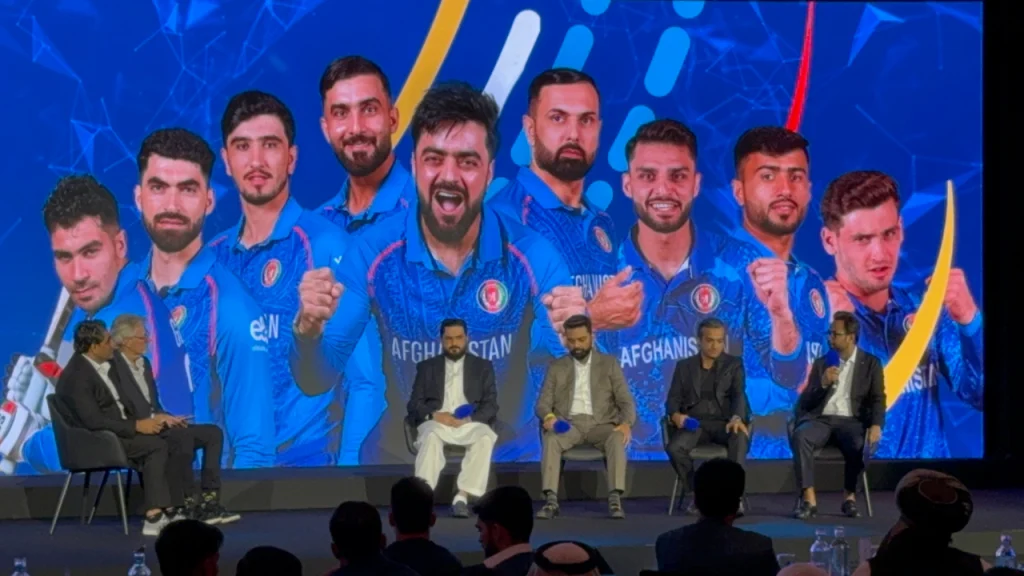
Mubashshir Usmani, whose involvement with Afghanistan cricket stretches back to 2018 when he joined the Emirates Cricket Board, provided a crucial institutional perspective. “From that point in time I’ve been involved in Afghanistan cricket,” he said. “I’m one of the people who have seen the journey of Afghanistan up close. I witnessed the first version of the APL, and I have seen its success. It was unfortunate that it had to halt for a certain period. But now it’s going to be back, and especially with the talent and the growth Afghanistan cricket has seen all over the world. It’s high time now to give the opportunity to all the millions of Afghans who don’t have the opportunity to come out and showcase their talent in a league of their own. And we really welcome such a league on the global stage, and we look forward to it.”
For Rao Usman Khan, the moment represented validation of Afghanistan’s journey. “It’s a big milestone for Afghanistan players, for all the stakeholders, for Afghanistan cricket fans, and all the partners involved in this – so I want to congratulate everyone,” he said. “This is a very big moment because as cricket fans, as a sports management company, we have worked around the globe, we have seen superstars of Afghanistan cricket going and playing in global leagues around the world as foreign players. So this is the time they will play in their own league as local players and they will invite and host the foreign players.”
Vivek Chandra emphasized both the patience and the purpose behind the APL’s development. “Afghanistan cricket has talent in most of the leagues globally – they put up at least five or six players in most of them – and when you have that kind of player pool you deserve one of your own,” he said. “In 2023 we started together for the first time. And there were questions about where it was headed. This is where it was headed, this is where we are. We wanted to build something very strong before the sunrise, in the dawn before the morning. And that morning is still not there. We’re in the evening prior to that morning – the morning will come up in a few months.”
Chandra was explicit about the league’s ambition to establish its own identity. “Afghan cricket has a lot of talent, and we are putting up a league of our own which will be a very distinct league in itself,” he said. “We are not doing a ‘copy and paste’ of any other league. In the many aspects that over time will unfold, you’ll find that this league will have its own unique identity, right from franchises to all the staff.”
He also acknowledged the emotional connection driving the partnership. “One thing that we partners all have in common is that we really love Afghan cricket. Right from 2007, 2008 when this all started and they were the underdogs who ended up punching way beyond their weight. That was the heart and emotion that made us build something from the ground up.”
The financial discipline
Later in the panel, when discussion turned to what distinguishes the APL from other franchise competitions, Chandra addressed the issue head-on. “One of the common problems that you see in most of the leagues right now is a struggling financial model,” he said. “It’s that elephant that is usually not addressed in the room. But here we have created a financial system around it – a full model. It’s very friendly towards franchises. We are ensuring that it is a strong financial model that has a good possibility of returns for the franchises. Many leagues have failed majorly or are struggling for this reason, and we want to ensure that doesn’t happen.”
Rao Usman Khan reinforced the point, noting that the league’s commercial architecture had been designed with all stakeholders in mind. “The majority of the people here belong to the sports industry, and understand how important the commercial planning of each league is,” he said. “We have planned and incorporated the right mix of ingredients. The main ingredient is the players. Afghanistan’s stars and emerging players. The financial model and commercial model should benefit the players. It should be focused on the sustainability of the partners, the franchises, and all.”
This emphasis on financial sustainability – repeated by multiple speakers throughout the evening – represented a clear departure from the 2018 version of the league. The message was clear: this time, the infrastructure is being designed to last.
The player imperative
If the executive panel outlined the APL’s commercial framework, the player panel which followed made clear why it matters. Moderated once again by Mike Haysman, the session featured Rashid Khan, Mohammad Nabi, Hashmatullah Shahidi, and Rahmanullah Gurbaz — four pillars of Afghanistan’s recent cricketing success.
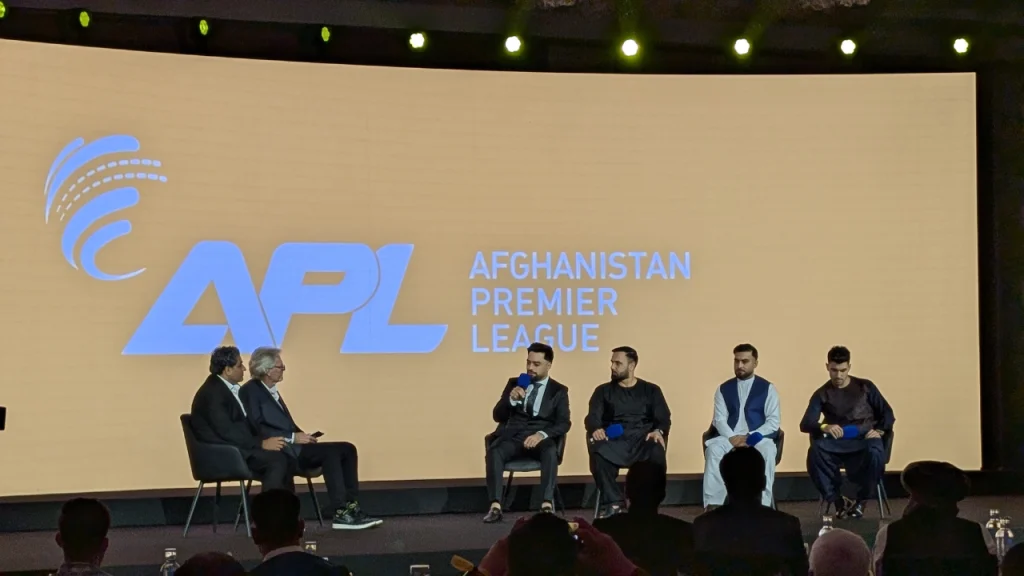
Rashid Khan, arguably Afghanistan’s most globally recognized player, framed the APL as an opportunity to compress the learning curve for emerging talent. “This means a lot to me,” he said. “The best thing will be to share the dressing room with a youngster back home in Afghanistan. I think that’s something which is more important than anything else – and they get here, spend that three weeks, four weeks with you — that is more than enough to learn something and go back home and work on their skills. I feel like that’s the kind of platform youngsters back home want.”
It’s a sentiment grounded in experience. Afghanistan’s players have thrived in global franchise leagues — the IPL, BBL, PSL, CPL — but domestic cricket in Afghanistan remains limited to the Shpageeza Cricket League, a shorter domestic annual tournament that lacks the depth, resources, and international exposure of a premier league.
The APL, in theory, changes that. “Everywhere around the world we go, we play different leagues, all the youngsters spending that one month, one and a half months, I think they learn so much and they get better year by year,” Rashid added. “You see the difference in them and then they call up for the national team and they represent the country. So I feel like that’s something which is missing in Afghanistan cricket.”
Mohammad Nabi emphasized the practical dimensions of the opportunity. “It’s really important for those youngsters who are performing back home in Afghanistan domestics,” he said. “This kind of a platform is really good for them to learn a lot from the senior players and also from the overseas players, sharing the dressing room and learning a lot from them.”
Haysman recalled a vivid example from the 2025 Shpageeza Cricket League: Nabi gave his bat to a young player named Khaled Tanwal, who then smashed the tournament’s first century. “That’s what role these senior players play in the lives of these young cricketers,” Haysman observed. Rashid Khan, with characteristic humor, acknowledged it was rare: “That’s the first time I see Nabi giving away a bat in the last 10 years. I asked him so many times, he never gave it to me.”
Gurbaz, one of Afghanistan’s most explosive young batters, brought a deeply personal perspective. He revealed that his $20,000 contract from the original 2018 APL had been transformative. “That $20,000 helped me to be in this situation,” he said. “That gives motivation because that is what the young players want in their life. Financial support so they can stand on their feet and be the next Rahmanullah Gurbaz of Afghanistan. They are not only Afghanistan’s players. Remember they are global players. They go all around the world and entertain everyone with their wonderful skills.”
Later in the discussion, Rashid returned to the theme of mentorship and senior player responsibility. “The senior players’ responsibilities are how they manage the youngsters — I feel that will be so important to give them the kind of platform in the team so that they don’t feel extra pressure,” he said. “The freedom should be there — the kind of batting and the kind of bowling and cricketing style they want. That freedom should be given from all the seniors to help all the youngsters come up and to welcome them with both hands..”
Shahidi, Afghanistan’s Test and ODI captain, spoke to the broader aspirations when asked about the message to overseas players. “APL is going to be a big league for all of us, not only for Afghanistan but for all the overseas players as well,” he said. “I think our ACB will try to bring quality players to the league which can help our youngsters as well.”
Institutional alignment
The depth of institutional support distinguished this from a typical corporate unveiling. Besides Usmani and the other members of the executive panel, Khalid al-Zarooni, Chairman of the Emirates Cricket Board, attended alongside senior ILT20 officials including Tournament Director Salman Hanif and Head of Media and Comms Emmad Hameed. Javed Afridi, owner of the PSL’s Peshawar Zalmi franchise, was also present, suggesting potential crossover interest.
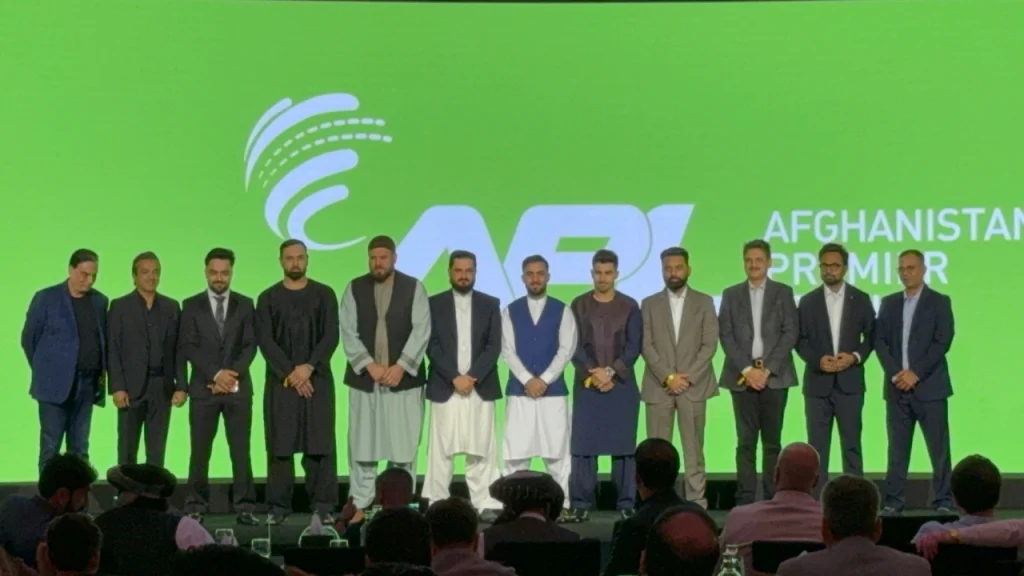
But the most significant signal came from the players themselves. Virtually the entire Afghan men’s national squad attended, many in Dubai for the ongoing ILT20. Their presence wasn’t obligatory — it was a statement of investment in the APL’s success.
The elephant in the room
For all the optimism, one reality remained officially unspoken but still palpable: the fate of Afghanistan’s women cricketers.
Since the Taliban’s return to power in 2021, women have been banned from sports in Afghanistan. The women’s national cricket team was formally disbanded, with its players now living in exile, primarily in Australia, where they continue to play under makeshift banners.
The ICC has attempted to provide support, announcing programs to offer displaced Afghan women cricketers engagement opportunities at ICC events. In September, the exiled squad toured India in the runup to the Women’s World Cup, competing against domestic teams in symbolic matches wearing kits featuring a tulip and cricket ball — Afghanistan’s national flower — but not the country’s flag, a poignant statement of both disconnection and pride.
At the APL launch, there were obviously no panel discussions about women’s cricket, no statements of solidarity, no acknowledgement of the exiled players, and the omission was conspicuous. Pakistani former cricketer and women’s captain Urooj Mumtaz, a prominent advocate for women’s cricket in South Asia (and a trained dentist), was spotted briefly in the audience — a quiet presence that underscored the issue’s persistence even in its silence.
The APL, for now, is a men’s competition. But the question of Afghanistan’s women cricketers remains the most significant unresolved tension in Afghan cricket, one that no amount of commercial success can erase and one that will not go away in the face of international pressure from prominent ICC members such as Australia and England.
What comes next
The launch event demonstrated commitment to presentation. High-quality video content traced Afghanistan cricket’s journey from refugee camps to World Cup stages and was used to unveil the official logo as well. These were organisers that clearly understood the importance of first impressions.
Franchise identities will be finalized in the first half of 2026, followed by a player draft in mid-year. The inaugural season takes place in October 2026 in the UAE, featuring five city-based teams with international players integrated alongside Afghanistan’s domestic talent.
In that regard, the APL also faces structural challenges. Afghanistan continues to play home matches abroad due to security concerns and lack of a fully operational international stadium in Kabul. The ACB recently announced plans to resume construction of the Alokhel Cricket Stadium, halted due to legal disputes over land ownership. Once completed, it could eventually host the APL, though that timeline remains uncertain.
For now, the UAE serves as the APL’s home — a de facto hub for displaced cricket, hosting leagues like the ILT20 and providing infrastructure that Afghanistan cannot yet offer domestically.
A league reborn
The Afghanistan Premier League that emerged from the Westin Mina Seyahi on December 20 bears little resemblance to the 2018 version that collapsed under financial mismanagement by a little-known outside partners. This iteration is backed by established commercial partners, supported by cricket’s institutional heavyweights, and structured around financial sustainability rather than short-term spectacle.
But it also carries the weight of Afghanistan’s broader story — a nation whose cricket team has achieved remarkable success on the global stage while navigating political upheaval, displacement, and the exclusion of half its population from the sport entirely.
The APL’s success will not be measured solely in broadcast deals, franchise valuations, or player development. It will also be judged by whether it can reconcile Afghanistan cricket’s soaring ambitions with the realities it cannot yet change — and whether the voices present in – and absent from – the Dubai ballroom will all find their place in the story being written.