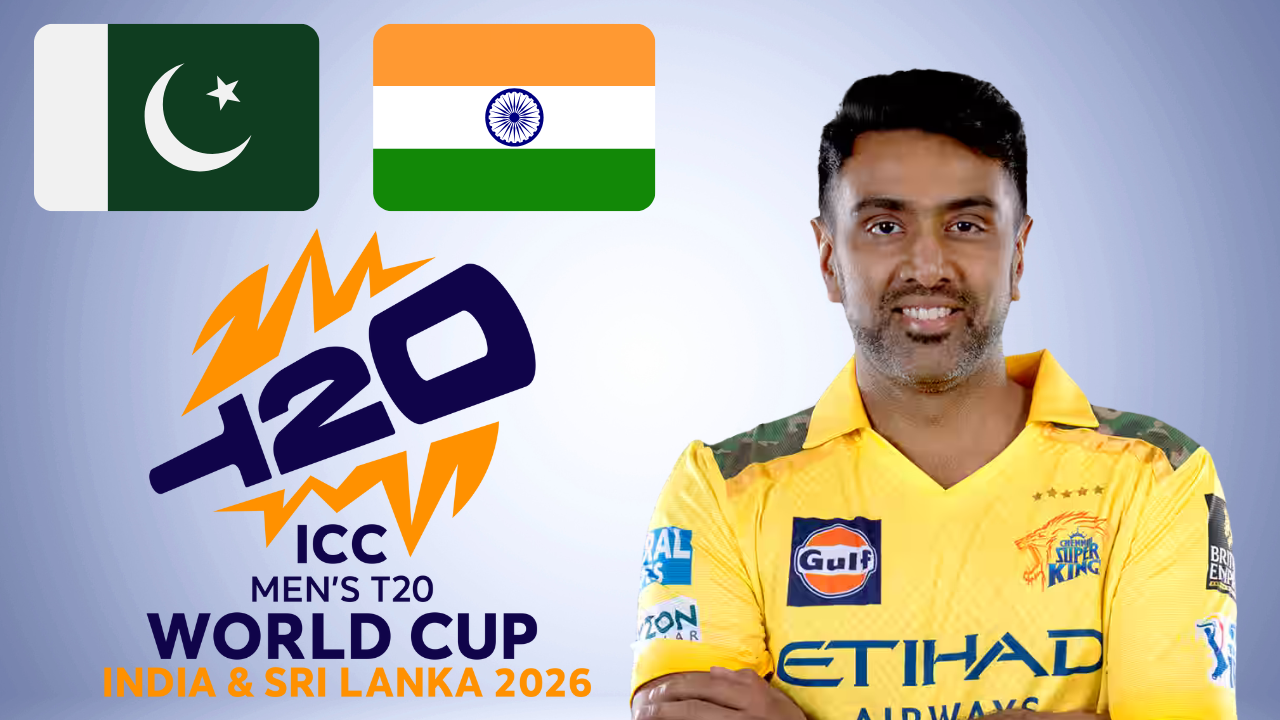
Ashwin confident Pakistan will reverse India boycott within days
With tensions simmering ahead of the much-anticipated India-Pakistan clash at the T20 World Cup 2026, former India spinner Ravichandran Ashwin has predicted a dramatic U-turn from the Pakistan Cricket Board.
Speaking on his YouTube channel, Ashwin suggested the current standoff won’t last long, pointing to financial repercussions and internal cricket politics as decisive factors. “100 percent, the match between India and Pakistan will happen. I feel that it will happen. The next 3-4 days will see these decisions being overturned. And that’s my hunch and I hope I want to see the India-Pakistan encounter. Because there are a lot of business decisions in this. Pakistan has another problem. There may also be financial loss as you will have to reimburse the broadcasters whatever loss they have incurred. So I think they will have to come for a compromise. The financial thing involved in this will mean that other ICC member countries too will face a loss. In the ICC meeting, all these members will say because of Pakistan, we are getting these losses. PSL is also going to happen. Even in PSL, players can say that we will not come,” he said.
The February 15 fixture in Colombo has been thrown into doubt after Pakistan’s government announced its team would not take the field against India in protest, though it has allowed the squad to participate in the overall tournament.
Ashwin draws contrast with historical World Cup boycotts
Ashwin dismissed comparisons between Pakistan’s current stance and past tournament boycotts, stressing that the present situation is fundamentally different. He pointed out that previous withdrawals were venue-specific and driven by safety concerns, unlike Pakistan’s current objection which targets a specific opponent.
“We will talk of the 1996 World Cup and also of the 2003 World Cup. Teams refused to travel to Sri Lanka. They fortified the matches. In the 2003 World Cup also, teams forfeited matches due to security and travel. But those are venue based problems. Right now. Pakistan and India will be playing in a neutral venue. There is no problem with the venue also. So after all of this. To say I will not play a particular opponent is just not acceptable in many ways. I hope better sense prevails and these matches do take place,” Ashwin said on his channel.
His comments align with wider concerns in the cricketing community, as the standoff has raised alarms over the credibility of ICC tournaments and their commercial underpinnings.
ICC warns of serious implications if boycott continues
The International Cricket Council has also weighed in, urging Pakistan to reconsider its decision. In a formal statement, the ICC noted the risk of long-term damage to Pakistan’s cricket ecosystem and its standing within the global game.
“The ICC hopes that the PCB will consider the significant and long-term implications for cricket in its own country as this is likely to impact the global cricket ecosystem, which it is itself a member and beneficiary of,” the governing body said.
Despite the warning, the PCB has yet to officially communicate its final decision to the ICC, leaving the fate of the match in limbo less than two weeks before the scheduled encounter.
Ashwin sees Pakistan as potential tournament contender
While strongly opposing Pakistan’s boycott stance, Ashwin also acknowledged the team’s potential to make a deep run in the tournament—if it focuses on performance rather than political distractions.
“I would not be surprised if they go the distance. Pakistan’s biggest enemy is itself. It’s all about their mindset. If you tell them you can’t lose against India, then that would be a big problem,” he said, emphasizing the psychological hurdles that have historically plagued the team.
India and Pakistan have been drawn in Group A alongside the Netherlands, Namibia, and the USA. Both teams will kick off their campaigns on February 7, with India facing the USA and Pakistan taking on the Netherlands in their opening matches.
As the countdown to cricket’s most-watched rivalry continues, Ashwin’s forecast of a course correction adds a new layer to the unfolding drama—one driven not just by sport, but by the high-stakes economics and geopolitics surrounding it.