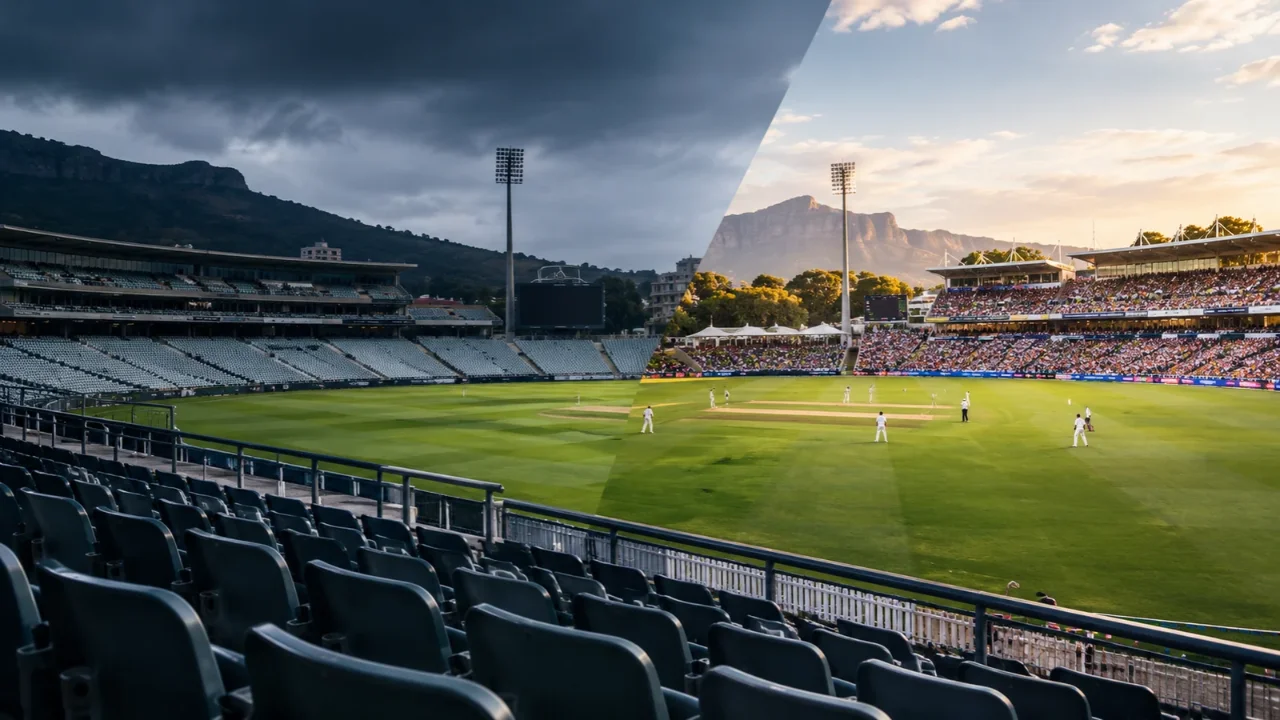
“We keep hearing how important Test cricket is, but where are the fans in South Africa?”
That was David Warner, writing on X after the opening Test of South Africa’s series against Australia played out in front of a largely empty Kingsmead. He didn’t hold back: “Empty stands, no atmosphere, and we’re supposed to believe the format is thriving? You can’t keep calling Test cricket the pinnacle of the game if no one turns up to watch it. Harsh reality, but someone has to say it. Pathetic.”
The next day, Kevin Pietersen offered a fix. “Test Cricket in places that struggle for crowds should make it FREE to enter!” he wrote. “Boards should make their money off their franchise tournaments.”
Warner is right that we have a problem. Pietersen is right that something has to change. But free tickets are the wrong answer, because the problem was never the price.
Yes, we have a problem
The numbers from Durban are hard to defend. The first Test drew fewer than 20,000 spectators across five days, less than one-fifth of Kingsmead’s capacity over the match. That is fewer than 4,000 people a day. In Gqeberha, the crowds were thin again, though rain wiped out much of the first two days.
This should have been an easy sell. Australia arrived as the world’s top-ranked Test side. South Africa are the reigning World Test champions, playing their first home Test since lifting the mace. It was Australia’s first Test tour of South Africa since the ball-tampering series of 2018. As Michael Atherton put it on the Sky Sports Cricket Podcast: “If you can’t drag a crowd in given that context, it’s a worrying sign.”
Those who stayed away missed something special. In Gqeberha, South Africa recovered from 97 for 5 to win by an innings and 31 runs and level the series.
Why free is the wrong fix
Pietersen deserves credit for being honest about the economics. At fewer than 4,000 people a day, gate receipts are not what pays for a Test match like Durban. Outside the marquee holiday fixtures, the real value of a home Test sits in the broadcast deal. And broadcasters would much rather show a full ground than an empty one. A packed stand is part of the product.
But free is not free. The ground still has to open, and security, stewards, cleaning and catering still have to be paid for. Price is also a signal. Tell supporters a Test match is worth nothing this year, and it becomes very hard to convince them it is worth something next year.
The funding model has a flaw too. “Make your money off your franchise tournaments” only works if you have a franchise tournament that makes money. South Africa has the SA20. Few other boards have a league profitable enough to subsidise their Test cricket, and for them, home Test revenue is part of the business, not something they can afford to give away.
The demand is there
The bigger problem with the free-ticket idea is the assumption underneath it: that South Africans won’t pay to watch Test cricket. South Africa’s own summer says otherwise.
In May, Cricket South Africa put tickets on sale for the New Year’s Test against England at Newlands. The first release sold out within minutes. Only about 13 per cent of tickets were set aside for the general public, and 39 per cent of general-access tickets went to travel packages. Much of the rest went to hospitality, sponsors and complimentary allocations, and CSA later apologised for how it communicated all of this.
Whatever you think of that allocation, it tells you something important. At Newlands at New Year, CSA isn’t struggling to fill seats. It is rationing them, and selling them as packages.
Then there is the SA20, the very kind of competition Pietersen wants paying the bills. Last season, 22 of its 34 matches sold out, and the league reports 84 per cent of total stadium capacity filled.
So South Africa does not have a cricket demand problem. It does not really have a Test cricket demand problem either. It has a problem with which Test matches people treat as events.
Be realistic about five days
We also need to be honest about the format itself. A Test match lasts five days, so by definition most of it falls on weekdays. Under normal circumstances, very few people can spend five full days at a cricket ground, or even one working day. That isn’t a South African problem. Outside the great occasions, such as a summer Test in England or Boxing Day in Melbourne, thin weekday crowds are a reality of Test cricket around the world. It is the age we live in.
That doesn’t mean the audience has gone. Plenty of supporters follow every session on the radio, on television and on their phones. We should fight to preserve Test cricket, but we should stop judging its health by whether every day of every Test is full. The realistic goal is to make the right days, and the right Tests, unmissable.
Sell Tests as events, not fixtures
Newlands at New Year is a holiday, a festival and a destination for touring supporters. Durban in October is a working week, a school term and, as Nasser Hussain pointed out, the risk of being “sent home at 3.30 pm due to bad light.” Hussain asked the right question: “What can we do to make sure that sitting in a stand on a hot day is very much a good experience for the people that have paid their money?”
That is where the answer lies. Not in giving Test cricket away, but in scheduling, packaging and presenting it so that people want to be there. That means putting the biggest series in holiday windows, protecting a full day’s play for the ticket-holder, and building an occasion around the match, the way the SA20 does every summer.
The KwaZulu-Natal Cricket Union has started in the right place. It has launched an internal review into what drives attendance, and Chief Executive Heinrich Strydom has acknowledged that supporters “face competing demands on their time and finances.” It is the right question, and it isn’t a new one. When Australia last played a Test at Kingsmead, in 2018, Pietersen was already lamenting the empty stands on day one. Same ground, same opponent, eight years apart.
The empty seats in Durban do not prove that Test cricket is dying in South Africa. Newlands proves it isn’t. What they show is that Test cricket is still being scheduled as a fixture, when fans buy it as an event.
Free tickets might put a few more people into Kingsmead. They won’t turn a weekday in October into the New Year’s Test.