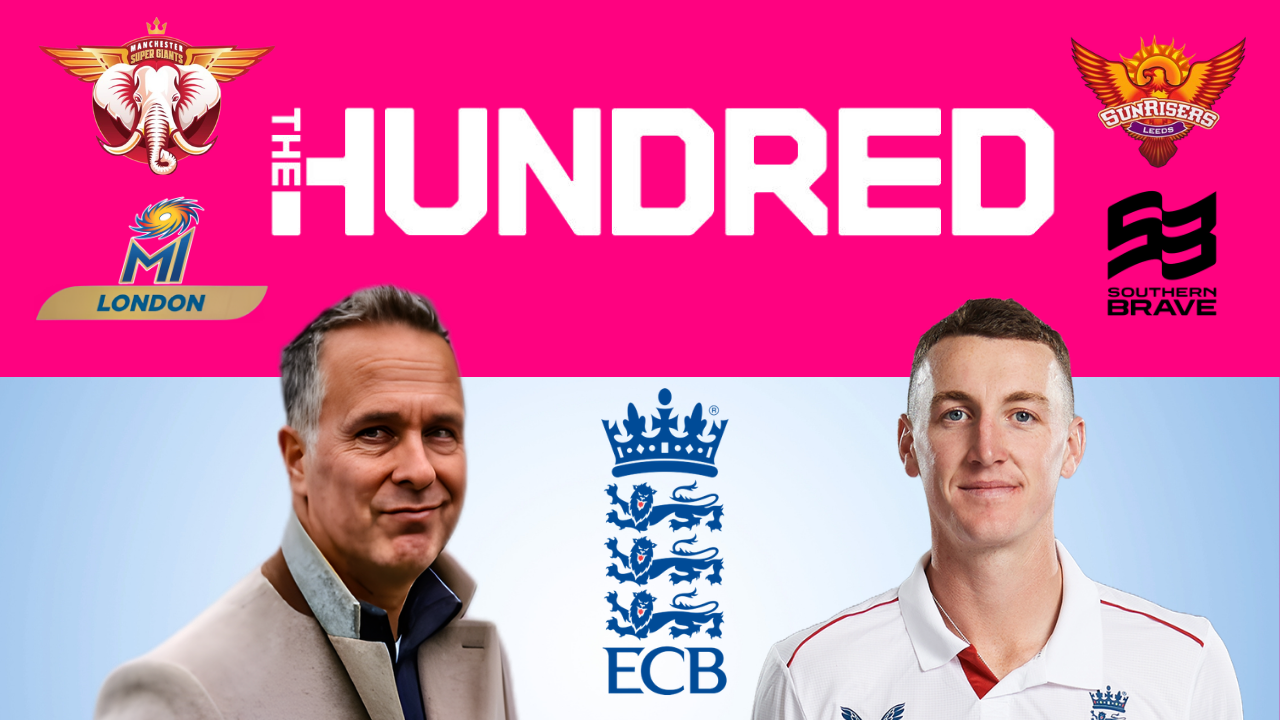
The Hundred’s next auction has become more than a squad-building exercise. It is now a test of governance, inclusivity and franchise influence in English cricket.
The England and Wales Cricket Board has written to the directors of cricket at all eight Hundred teams, reminding them of their responsibilities regarding discrimination and warning that disciplinary action could follow if any breach is established during the recruitment process. The letters mark a formal intervention ahead of the March 11–12 auction in London.
The move follows reports last week that suggested Pakistan players’ involvement in this year’s competition may be limited to franchises without Indian ownership. BBC Sport reported one agent was told by an ECB official that his Pakistan-based clients would attract interest primarily from teams not connected to IPL ownership.
Four teams — MI London, Manchester Super Giants, Southern Brave and Sunrisers Leeds — are backed by IPL-linked investors following last year’s equity sales.
Michael Vaughan demands clarity from ECB
Former England captain Michael Vaughan has been among the most prominent voices responding to the controversy, framing it as a question of leadership as much as selection policy.
“The ECB need to act fast on this .. they own the league, and this should not be allowed to happen .. The most inclusive sport in the country is not one that allows this to happen.” Vaughan posted on X.
The ECB need to act fast on this .. they own the league and this should not be allowed to happen .. the most inclusive sport in the country is not one that allows this to happen .. https://t.co/IYysTSIYHt
— Michael Vaughan (@MichaelVaughan) February 20, 2026
In his Telegraph column, Vaughan argued that the issue strikes at the core identity of the competition.
“The Hundred was set up to be an inclusive competition designed to appeal to a different audience, which is why the England and Wales Cricket Board has to act quickly if reports are true that new Indian owners will not select Pakistani players,” Vaughan wrote.
He warned that excluding Pakistan players would undermine both credibility and community engagement within England.
“I am a huge fan of the Hundred, but it has to appeal to all supporters for it to have any credibility. This has the potential to turn away the large Pakistan population that lives in England and loves cricket. What message does that send about our game? If true, it makes a mockery of the stated aim of Richard Thompson, the ECB chairman, to make English cricket the most inclusive sport in the country,” he added.
Vaughan also suggested that the outcome of the auction would reveal where authority ultimately sits within the tournament structure.
“If no Pakistan players are signed by the Indian-owned franchises, then we have our answer. I would then like to hear a proper explanation from a senior ECB figure. We need to know if the owners indicated to the ECB they would not consider Pakistan players. Fundamentally, if India can play Pakistan in a World Cup match, then surely Indian owners can pick Pakistan players in a foreign league. I can understand it is too sensitive in the IPL, but this has exported the problem to other countries,” he wrote.
He concluded with a warning about long-term implications.
“You also wonder what precedent this could set. The ECB runs the Hundred but if this informal ban on Pakistan players happens then we know who really runs the competition and it is not the governing body. If they are not signed for political reasons we cannot allow that to happen in the UK because it will eventually affect our own players with Pakistani heritage. It will also damage Pakistan cricket as well, and we cannot be a part of that,” Vaughan said.
Harry Brook points to sporting and commercial value
England captain Harry Brook addressed the situation while speaking ahead of the T20 World Cup Super 8s match against Sri Lanka in Pallekele, distancing the national team from franchise matters but acknowledging the broader impact.
“Our main focus now is what’s coming up in the T20 World Cup. It’s not really any of our business, to be honest, but what I would say is that Pakistan have been a great cricket nation for many years. I think there’s about 50, 60 players in the auction, and it would be a shame not to see some of them in there,” Brook told reporters on Saturday ahead of the T20 World Cup Super 8s match against Sri Lanka in Pallekele.
He also emphasised the draw Pakistani players can bring to the tournament.
“There are some amazing cricketers and, yeah, they bring some great crowds as well. So it would be a shame not to see some of the Pakistan players in there and make the tournament and competition even better,” he added.
Around 60 Pakistan players have registered for the auction, part of a wider pool of nearly 1,000 cricketers. With each team permitted four overseas players — and only 16 overseas slots available after retentions — selection decisions are tightly contested.
ECB reiterates inclusive framework
After the BBC report surfaced, the ECB issued a public statement underlining its position on global representation within The Hundred.
“The Hundred welcomes men’s and women’s players from all over the world and we would expect the eight teams to reflect that.” England and Wales Cricket Board (ECB) said in an official statement.
The governing body also highlighted the international breadth of the auction list.
“Almost 1,000 cricketers from 18 nations have registered for the Hundred auction, with representation on the longlist of over 50 players respectively from Australia, South Africa, New Zealand, Pakistan and West Indies.” the England and Wales Cricket Board (ECB) said in the same official statement.
The subsequent letters to franchises reinforce that message from a regulatory standpoint, as the board seeks to ensure compliance with its anti-discrimination framework.
Commercial influence and long-term questions
Writing in The Sunday Times, Simon Wilde argued that the controversy extends beyond auction mechanics and into the broader identity of the competition, particularly after last year’s equity sales valued The Hundred at almost £1 billion (approx. US$ 1.34 billion), strengthening franchise leverage within the tournament structure.
“Far from creating a celebration of the sport’s multi-cultural character, the Hundred is in danger of providing a focal point for its worst prejudices,” Wilde wrote.
He also noted that while the ECB governs the competition, compelling franchises to recruit particular players would be legally and practically complex within a system built on subjective sporting assessments.