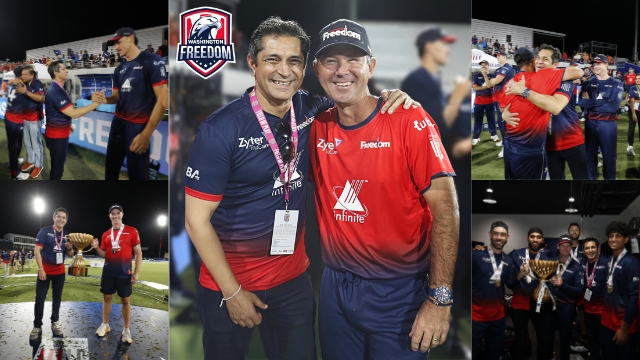
When Dhiraj Malhotra accepted the role of CEO of the Washington Freedom, he wasn’t simply joining another cricket franchise — he was stepping into a bold, untapped frontier. A cricket executive with 24 years of experience, including tenures with the ICC, IPL, BCCI, and Delhi Capitals, Malhotra has chosen to channel his global expertise into building a distinctly American cricket identity — from scratch.
In this exclusive cricexec interview, he opens up about building a brand, cultivating a community, and why his past experience uniquely positions him to grow cricket in the U.S. — not just for now, but for generations to come.
Standing for the DMV — and something more
“Our goal has been the same,” Malhotra says, “we’re trying to build a brand, build a name for ourselves in Washington.”
The Washington Freedom’s mission under his leadership is as much about identity as it is about cricket.
“We want to stand for the area, for the DMV region. We want to stand for Washington.”
The team has leaned heavily into community integration and branding. “We revamped our logo. We’ve given it an international appeal. We’ve integrated an eagle, so we can now build a mascot,” he explains. “We’re also working with a DC-based band for our team anthem — something we didn’t have last year — and it’s come out really well with a strong local flavor.”
The Freedom are doing more than playing matches. They’re engaging with festivals — “be it Easter, Holi, Diwali,” Malhotra says — and reaching out to small businesses for cross-promotions. “We’re trying to integrate our brand with them.”
“Whenever we talk about the team, it’s excitement. Most fortunately, a lot of them have heard of us. A lot of them know that we won the tournament.”
But there’s one question Malhotra keeps hearing from fans:
“When are we playing at home?”
The stadium question — and the long-term answer
That’s about to change. Malhotra shares that the Washington Freedom are working on three stadium projects in the DMV area.
“We’re hoping to play next year in Washington,” he says. “If not 2026, then definitely 2027.”
Beyond hosting Freedom matches, Malhotra sees these venues as potential hosts for international games.
“We’re also talking about hosting international matches here… talking to a few boards to see if they would like to host a few games,” he says. “That will also change how the brand is built and how it is perceived in the community.”
Investing in the next generation
If the Washington Freedom are about building a cricketing identity, Malhotra knows that identity has to start young.
“We’re trying to get into grassroots,” he says. “Initially we started with getting some of our players to talk to them, to basically show that there is actually a career that you can make playing cricket in the U.S.”
He highlights the role of two landmark events — the recent T20 World Cup and cricket’s inclusion in the 2028 Olympics.
“Once cricket is in the Olympics and the people of this country actually get to witness it and see how big it is… that’s the validation.”
But Malhotra is realistic. “Right now it is all done by the parents and it’s all extracurricular activity. It’s not part of the school sporting culture,” he says. “That’s what we’re hoping for. It’ll take time, but we’re here to build it.”
“It’s not like we are fly-by operators and we just run a league a month and go away. The aim is to be present eight, nine months a year — when the weather allows it.”
The defending champions — and the logic of loyalty
On the field, the Washington Freedom are the reigning MLC champion. Remarkably, the team retained almost their entire domestic squad.
“As you said, we won the tournament with these guys,” Malhotra explains. “The faith they put in us and we put in them — it just kind of paid back.”
There was only one addition in the domestic draft: young left-arm spinner Abhishek Paradkar.
“He’s a young, dynamic bowler. He’s got a lot of passion, got a lot of drive… We want to be part of his journey.”
The Freedom have also kept Yasir Mohammad, the exciting leg-spinner who joined the U.S. national team last year.
“He’s just grown from strength to strength,” Malhotra says. “I think he’s always been a very talented player. Playing the amount of cricket that he’s playing just gives your confidence a boost.”
A culture you can’t fake
What made the Freedom special, especially for its players, wasn’t just success — it was the atmosphere.
“Sanjay [Govil] was very clear from day one,” Malhotra recalls. “Winning is important, but what’s most important is building the family culture.”
“Every player was treated as one of our own. He wasn’t just someone playing for the team for a month and leaving.”
Led by Ricky Ponting and reinforced by staff and ownership, team bonding was part of the DNA.
“Ponting is very strong about building a team culture,” he says. “Having a get-together after every game. Win or lose — it’s mandatory. You come for one drink. You can leave after one drink, but everybody gets together.”
“We don’t discuss the game at all. Just people having fun.”
The result?
“Even if we hadn’t won, the bond we created, the family atmosphere we created, the friendship — that’s here to stay.”
The IPL-backed rivals — and Freedom’s independent edge
In a league where several franchises are backed by IPL juggernauts, the Freedom have carved out their own lane.
“It’s helpful in a way,” Malhotra says of the independent setup. “We’re a small unit. We can actually give all our attention here.”
“Instead of having five children, we have one child. So we’re able to concentrate more on that one child.”
Malhotra acknowledges the brand power of IPL franchises but notes that the Freedom’s single-team focus gives them flexibility and intimacy.
“Right now, these guys are so busy with the IPL… they treat their teams well, but we have more time. We have more bandwidth to give.”
Govil’s recent acquisition of a 50% stake in Welsh Fire has added another layer.
“We’re trying to build a synergy between the two teams,” he says. “It should be a very smooth transfer from the Washington Freedom to Welsh Fire or the other way.”
A career built on trust, timing — and transformation
Malhotra’s resume is unmatched — IPL tournament director during the league’s launch in 2008, senior roles at IMG, Wasserman, ICC, CEO of Delhi Capitals, General Manager of BCCI. But his path into sports was almost accidental.
“I was in the army. I had left the army and come to Delhi to join the business,” he recalls. “I got a call from Ravi Krishnan… they were looking for someone to do a rafting tournament with IMG.”
From there, he worked on India’s 2004 tour of Pakistan. In 2007, he was assigned to the inaugural T20 World Cup — and by 2008, he was part of launching the IPL.
“We had the Who’s Who at the opening ceremony, but it was 2008. We didn’t know what to expect. 5:30 we opened the gates. 6 o’clock, the stadium was full.”
He vividly recalls the chaos and electricity of Brendon McCullum’s 158*.
“Yuvraj looked at me and said, ‘That must be the team score,’” Malhotra laughs. “No man can score 158 in T20 — that’s what we thought.”
Other highlights: helping Delhi Capitals reach their first IPL final and steering BCCI’s game development under Jay Shah.
Lessons from legends
Malhotra has worked closely with some of the biggest names in cricket — Dhoni, Kohli, Rohit — and seen their rise from early on.
“Dhoni is just one of the nicest human beings you’ll meet… I told him last year when I met him: ‘I think you should play till you’re 60. Even if he scores a duck at every game, it is his mind that’s so valuable. The players who play for him – they may have played for 10 different IPL teams, but the performance they have under him, it’s just not the same. It’s just what he brings out in the players. It’s just his brain.
“Virat — the most hardworking guy, even today. I remember him as a youngster — wasn’t as fit as he is now. Seeing how he’s transformed himself, I think today he’s one of the fittest, if not the fittest player in the world, even at this age.”
“I’ve known Rohit, since he was a child. He was always super talented. The talent he has was crazy. He figured out how to combined that with hard work and became unstoppable.”
Gratitude and guidance
Malhotra credits numerous mentors and organizations along the way.
“Ravi Krishnan believed in me. Campbell at ICC told me — go do IPL. Lalit Modi, Mr. Srinivasan, Jay Shah, the Delhi Capitals owners — they all trusted me.”
And today?
“Sanjay Govil has given us full support and freedom to build something the right way. That’s what you need — trust and backing.”
The road ahead
As the Freedom prepare for MLC 2025, Malhotra is focused, realistic, and committed.
“We’re here to build something long-term. A brand. A culture. A home. And hopefully, a movement.”
With Dhiraj Malhotra leading the charge, the Washington Freedom are more than just a team — they are a vision for cricket’s future in America.