
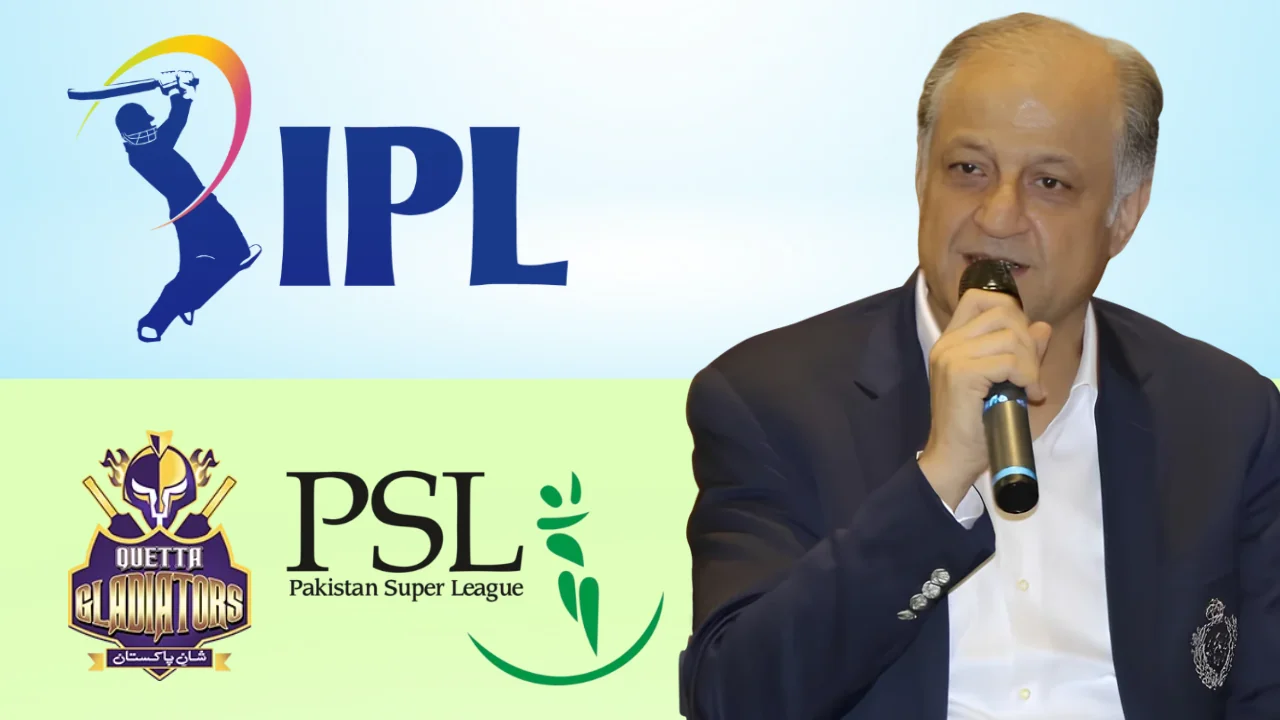
After 11 seasons in the Pakistan Super League (PSL), one of the competition’s founding franchise owners is contemplating an exit — and his explanation offers a revealing look at the economics of Pakistan’s biggest domestic cricket competition.
Nadeem Omar, Owner of Quetta Gladiators and President of the Karachi City Cricket Association, has confirmed he is willing to sell the franchise if an acceptable offer emerges, although negotiations remain preliminary.
Speaking to journalist Waheed Khan on _Smash It_, Omar revealed that Quetta operated at a loss for seven years and only generated a small profit in its tenth season.
He also questioned the PSL’s attempts to compete commercially with the Indian Premier League (IPL), criticised rising player expenditure and highlighted the difficulties franchises face in generating merchandise, ticketing and other commercial revenues.
“I think it is the right time for us to say goodbye to the PSL and if we get the right offer and few of our conditions are met we are prepared to sell the Quetta Gladiators franchise,” Omar said.
His remarks raise questions about whether the PSL’s rapid financial expansion is delivering sustainable returns for the investors who helped establish the competition.
Quetta Gladiators sale talks: Omar insists franchise must retain its identity
Despite speculation surrounding a potential multibillion-rupee sale, Omar indicated that no transaction has been finalised.
He pushed back against reports suggesting that an offer of approximately PKR 3 billion had already been agreed, explaining that discussions were still at an early stage.
Omar also made clear that he would not consider selling purely on the basis of the highest financial offer.
The franchise’s identity and its association with Balochistan remain important considerations.
“There are two or three conditions. One is that Quetta must remain Quetta, because the name has a legacy,” Omar said, in comments translated from Urdu.
He emphasised that Quetta Gladiators represent Balochistan in the PSL, making the team’s regional identity a central part of its value.
For Omar, the possibility of selling reflects the growing difficulty of sustaining the financial commitments associated with franchise ownership.
“These things are getting out of our hands. You’re talking about teams worth two-and-a-half or three billion rupees. We’re small businessmen who got involved because of our passion for cricket,” he explained.
However, he stopped short of suggesting that his departure was inevitable.
“We’re not giving up. Discussions are still taking place. You never know what might happen,” Omar said.
Seven years of losses and only a small profit in year ten
One of the most striking revelations concerned Quetta Gladiators’ financial performance.
Despite the franchise’s success on the field, Omar admitted that the business struggled to generate profits throughout much of its first decade.
“For seven years, we were in the red. I had a lot of plans but I don’t think we achieved all of them,” he said.
Quetta entered the PSL in 2016 with an annual franchise fee of approximately $1.1 million, the lowest among the original teams.
That relatively modest financial commitment helped Omar manage the costs of ownership, but profitability remained elusive.
“We started breaking even after the seventh or eighth year. In the tenth year, we made a small profit. But when you’ve invested for ten years, you’re not really talking about a small profit,” Omar explained.
The franchise’s financial performance illustrates the distinction between the increasing value of PSL teams and the actual returns generated by their owners.
Omar acknowledged that he had been willing to continue investing because of his passion for cricket and the profile associated with owning a professional franchise.
“If we can afford it, then let it continue. Cricket is being played, we’re enjoying it, we’re in the limelight, people are watching. It’s a brand,” he said.
But that willingness to accept modest financial returns has become harder to sustain as the league’s costs have increased.
‘We can’t compete with the IPL’: Omar questions PSL’s commercial ambitions
Omar was particularly critical of the PSL’s attempts to compete with the Indian Premier League.
The two competitions have increasingly operated in overlapping windows, with the PSL moving into the March-May period from 2025.
But Omar believes comparisons between the leagues overlook the enormous differences between the Indian and Pakistani markets.
“We can’t compete with the IPL or with their market. Our market is very limited compared to them. Unfortunately, we don’t have sponsors and commercial entities putting money into the PSL like it is done in the IPL.”
During the interview, he expanded on why he believes direct commercial competition with India is unrealistic.
“We want to compete with India. That’s not possible. The reasons are different — they have nothing to do with cricket. It’s because of Pakistan’s economic situation,” Omar explained.
He pointed to the enormous valuations achieved by IPL franchises, including the approximately $900 million originally paid for Lucknow Super Giants, as evidence of the disparity.
“Just look at the value of teams in the IPL and there is no competition.”
Omar acknowledged that the PSL’s financial numbers had grown substantially since its launch.
However, he suggested that the league should have pursued more measured expansion rather than attempting to replicate the financial model of a competition operating in a much larger commercial market.
“We should have grown steadily, watching our cricket improve,” he said.
For Omar, the PSL’s strongest selling point has always been the standard of its cricket rather than the financial power of its franchises.
Rising player salaries are changing the economics of PSL ownership
Omar also highlighted the growing cost of assembling competitive squads.
During the interview, he discussed how the PSL’s player budget had increased from approximately $1.1 million to $1.8 million, placing additional pressure on franchise owners.
He referenced the substantial sums now being committed to individual players, including Saim Ayub and Khawaja Nafay.
“These are astronomical figures. I don’t see how individuals like us can keep doing this,” Omar said.
He acknowledged that some PSL franchises now have access to investors with significantly greater financial resources.
“Other teams bring in good players from outside. They have deep pockets. They can do justice to that. Probably we haven’t been able to,” he admitted.
Omar suggested that some newer owners may be willing to accept different financial outcomes because of the broader opportunities associated with owning a team.
“People coming in now understand that this opens a door for other things, other businesses. It helps you a lot,” he explained.
For longstanding owners, however, the increased financial demands are becoming harder to justify.
“Unfortunately, I think the league has become too big for us in many ways. I felt it should have remained confined. The increase in the amount of money spent on teams now for me is difficult to comprehend.”
Merchandise piracy is costing PSL franchises valuable revenue
Beyond rising expenditure, Omar identified the lack of reliable commercial revenue streams as a major problem for PSL franchises.
Merchandising was one of his clearest examples.
He explained that Quetta Gladiators had attempted to sell official replica shirts for PKR 1,000, only for counterfeit versions to appear in the market for approximately PKR 200.
“In Pakistan merchandising is impossible. We put out an official shirt for PNR 1000. The same thing is copied and sold in the market PNR 200, and that robs us of a big source of revenue,” he said.
For franchises attempting to monetise large fan bases, the widespread availability of cheaper unofficial merchandise significantly reduces the potential value of licensing and retail operations.
Omar contrasted Pakistan’s situation with the IPL, where teams can generate meaningful income from merchandise and matchday operations.
“Merchandising in the IPL is huge, and the gate money for home and away matches are big earners for franchises in the IPL apart from their broadcasting share.”
He also pointed to the limited purchasing power of Pakistani spectators as a constraint on ticketing income.
While stadium attendance remains an important part of the PSL’s appeal, Omar argued that teams cannot necessarily charge prices that would generate comparable revenues to those available in the IPL.
Omar questions PSL’s central revenue-sharing and home-and-away model
Another significant issue raised during the interview concerned the PSL’s central revenue distribution system.
Omar explained that franchise revenues are heavily dependent on the central pool, particularly broadcasting income.
He also questioned whether equal distributions adequately reflect the different amounts being invested by franchise owners.
With newer teams attracting substantially higher valuations, the gap between franchise costs and central revenue entitlements has become an increasingly important consideration.
Omar suggested that a more developed home-and-away model could help teams generate additional revenue directly from their local markets.
“There’s a concept of home-and-away matches, and it’s essential. Wherever you look, if Delhi plays in Mumbai and Mumbai plays in Delhi, the revenue generated in Delhi goes to the Delhi team, and Mumbai’s revenue goes to Mumbai,” he explained.
For Quetta Gladiators, however, the absence of regular PSL matches in Quetta has made that model difficult to implement.
“Unfortunately, matches cannot be played in Quetta. They haven’t happened there. They haven’t happened in Peshawar either. So how are these two teams supposed to benefit?” Omar asked.
‘I didn’t buy the team just as a business’: Quetta’s unfulfilled ambitions
Despite his financial frustrations, Omar suggested that one of his biggest disappointments was failing to deliver on the broader sporting ambitions behind his original investment.
Quetta Gladiators were intended to provide a platform for players from Balochistan and help bring major cricket to the province.
“I didn’t buy the team just as a business. I also wanted to do something for Pakistan cricket. I wanted matches in Quetta. I wanted to give exposure to players from Balochistan. It didn’t happen for many reasons.”
During the interview, Omar expressed particular regret that the franchise had not been able to create a stronger pathway for local cricketers.
“I felt it was our obligation to bring players from Quetta into the game, or to find good talent from Balochistan. That’s one regret I’ve always had,” he said.
He mentioned Bismillah Khan as an example of a player he believed had the potential to progress further in Pakistan cricket.
Although Quetta Gladiators became one of the PSL’s most recognisable teams, Omar believes that wider mission remains incomplete.
Quetta Gladiators’ sporting success was not enough for Omar
On the field, Quetta Gladiators established themselves as one of the PSL’s strongest early franchises, winning the championship in 2019 and reaching multiple finals.
But Omar believes the team could have achieved considerably more.
“I feel the success we could have given to Quetta Gladiators we could not do that.”
He recalled the franchise’s early dominance and the popularity it enjoyed across Pakistan.
“We had a beautiful journey and good memories. In the first four or five years, Quetta was one of the most popular teams. People used to say Quetta was everyone’s second-favourite team,” he said.
However, he expressed frustration over missed opportunities to win additional titles, including campaigns affected by the unavailability of overseas players.
“We had that hunger to win titles. Unfortunately, we could only win one,” Omar said.
His disappointment also reflects his broader involvement in cricket development.
As President of the Karachi City Cricket Association and a longstanding supporter of Pakistan Cricket Club, Omar has spent decades helping players progress through the domestic system.
During the interview, he highlighted Pakistan Cricket Club’s record of producing international and first-class cricketers.
“We have 22 players who have played for Pakistan, and 118 players who have played first-class cricket,” he said.
He also credited Azam Khan for his contribution to the club’s success.
That background helps explain why Omar views Quetta Gladiators’ achievements through a wider lens than financial performance or trophies alone.
PSL still among world’s top three T20 leagues, says Omar
Despite his criticism of the league’s financial direction, Omar remains convinced that the PSL has retained its reputation as a highly competitive cricket tournament.
He recalled how international stars such as Kevin Pietersen and Shane Watson regarded the PSL as an especially demanding competition.
“When KP or Shane Watson came, they would say that if you wanted to play serious cricket, you should go to the PSL,” Omar recalled.
He also highlighted the role the league played in developing players who subsequently established themselves at international level, including England batter Harry Brook.
For Omar, the PSL’s early success was built on the intensity of its cricket, the quality of its fast bowling and its ability to attract respected overseas players.
He suggested that those strengths remain more important than attempting to match the IPL’s financial scale.
“My thing is that given our limitations in terms of a share of the pie, we should have focussed on our initial success factors.”
Asked where the PSL stands among the growing number of T20 competitions around the world, Omar suggested that it still deserves to be ranked among the top three.
He also pointed to the league’s reputation for financial integrity as an important element of its early appeal.
In his view, the PSL should concentrate on protecting those strengths rather than pursuing expansion that places increasing financial demands on owners.
What a Quetta Gladiators sale would mean for the PSL
Omar’s potential departure comes at an important stage in the PSL’s development.
The league is attracting greater investment, franchise valuations are rising and new ownership groups are bringing additional financial resources into Pakistan cricket.
But Omar’s experience raises questions about whether the competition’s commercial growth is delivering adequate returns for its existing investors.
Seven years of losses, followed by only modest profitability, illustrate the challenges of operating a PSL franchise even during a period of increasing league-wide valuations.
For prospective investors, the key question is whether the PSL can generate sufficient commercial revenue to justify rising franchise costs.
For existing owners, it is whether they can continue competing in a league where the financial expectations are increasingly different from those at its launch.
And for the Pakistan Cricket Board and PSL management, Omar’s comments offer a warning about the importance of balancing expansion with sustainable franchise economics.
A Quetta Gladiators sale remains uncertain, and Omar has not ruled out continuing his involvement.
But his assessment of the PSL’s financial model is significant precisely because it comes from one of the investors who helped build the league.
The PSL has grown enormously since 2016. The challenge, according to Omar, now is ensuring that the business of owning a team can grow sustainably alongside it.


