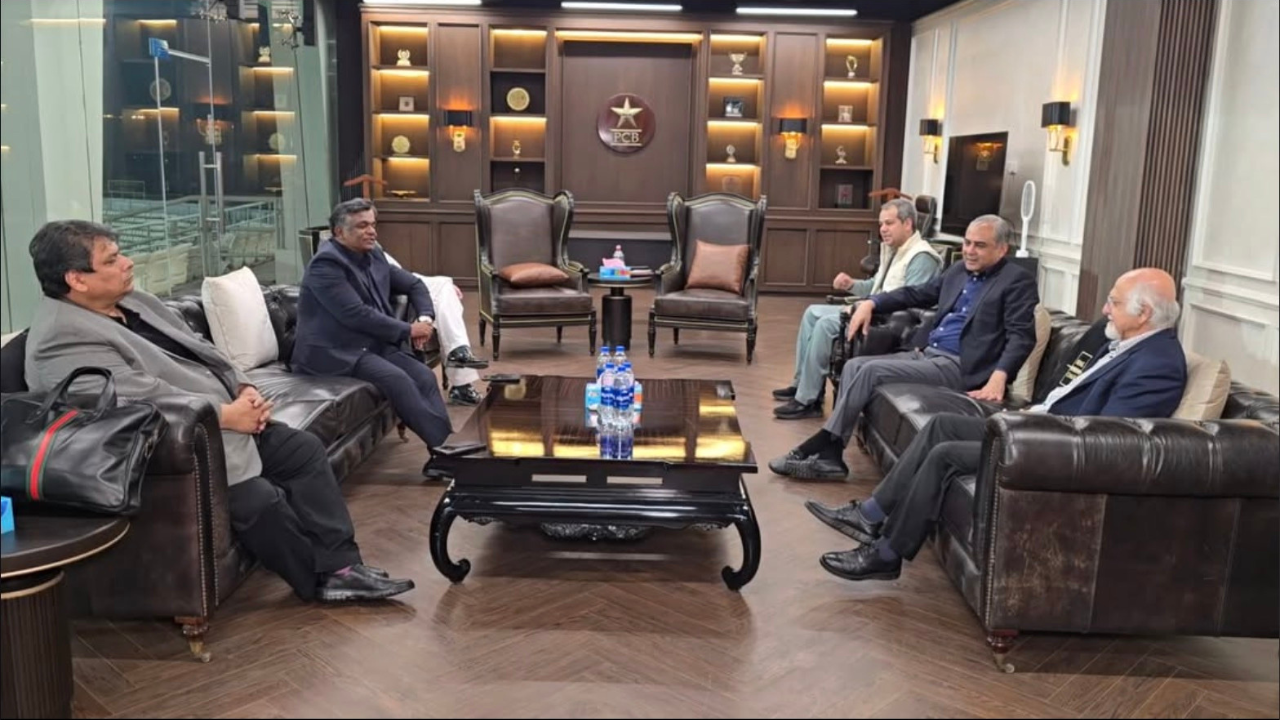
A rare, high‑stakes gathering of cricket powerbrokers unfolded in Lahore as the sport’s most commercially and politically sensitive fixture edged closer to a breaking point. Senior officials from the International Cricket Council, the Pakistan Cricket Board and the Bangladesh Cricket Board met in person on Sunday to try to defuse the growing crisis around Pakistan’s planned boycott of its T20 World Cup clash against India, according to a report by Geo Super.
A physical meeting to tackle an escalating crisis
The talks were held in Lahore rather than online, underscoring the urgency of the situation as the February 15 fixture looms. The ICC delegation was led by deputy chairman Imran Khawaja, who met directly with PCB chairman Mohsin Naqvi. Bangladesh Cricket Board President Aminul Islam was also present, bringing Bangladesh firmly into discussions that have increasingly shaped the tournament’s narrative.
The PCB publicly confirmed the high‑level engagement during the day, stating on X that “PCB Chairman Mohsin Naqvi meets ICC Deputy Chairman Imran Khwaja at Gaddafi Stadium Lahore.” The wording, released via official board channels, underlined that the discussions were already underway as administrators sought common ground.
PCB Chairman Mohsin Naqvi meets with ICC Deputy Chairman Imran Khwaja at Gaddafi Stadium, Lahore. pic.twitter.com/tER8mjMqVT
— PCB Media (@TheRealPCBMedia) February 8, 2026
Upon arriving in Lahore, Pakistan, Bangladesh Cricket Board President Aminul Islam was welcomed at the airport by PSL CEO Salman Naseer and other senior PCB officials. The gesture underscored the significance of Bangladesh’s role in the ongoing World Cup standoff. According to NDTV, Islam later held a closed-door meeting with PCB Chairman Mohsin Naqvi ahead of the broader session involving ICC representatives. The bilateral talks were aimed at consolidating the positions of both boards before they presented a unified front to the ICC leadership later on Sunday.
Bangladesh Cricket Board (BCP) President Mr Aminul Islam being received at the Lahore Airport by Mr Salman Naseer and others۔ pic.twitter.com/LrMbaiJlNb
— Amir Mir (@AmirMirpcb) February 8, 2026
How Bangladesh became central to the dispute
Bangladesh’s involvement has been pivotal since the ICC removed the team from the tournament after it declined to travel for its group matches in India. That decision followed a rejected request to relocate Bangladesh’s fixtures to Sri Lanka, after which Scotland was drafted into the competition as a replacement.
Pakistan subsequently aligned itself with Bangladesh’s position, framing its refusal to play India as an act of solidarity rather than an isolated protest. The move elevated what began as a scheduling and security dispute into a broader governance issue confronting the ICC.
Behind‑the‑scenes engagement before Lahore
Even before Sunday’s in‑person talks, dialogue had been taking place away from the spotlight. As reported earlier by Hindustan Times, informal exchanges between the PCB and the ICC had already begun in an attempt to explore possible off‑ramps from the impasse, setting the stage for the Lahore meeting.
Those contacts followed a formal exchange of correspondence in which Pakistan cited government instructions for its stance, while the ICC sought clarity on how such a position could be reconciled with tournament regulations.
Government backing hardens Pakistan’s position
The PCB’s approach has been shaped decisively by Pakistan’s federal government. Speaking to the cabinet last week, Prime Minister Shehbaz Sharif made clear that the decision carried political weight, saying, “We have taken a clear stand regarding the T20 World Cup that we will not play the match against India,” he said.
Sharif framed the move as a principled one, adding, “There should be no politics in sports,” and stressing that, “We have taken this stand after deliberating on it carefully,” he said, describing the choice as an appropriate response to the circumstances.
Conflicting narratives over who approached whom
As negotiations intensified, public claims and counter‑claims also surfaced. Indian sports journalist Vikrant Gupta suggested on social media platform X that Pakistan had initiated fresh dialogue with the ICC, writing, “BIG BREAKING: PCB has now reached out to ICC for a dialogue on the India-Pakistan World Cup after the ICC replied to their official communication: PCB first wrote to ICC saying they were pulling out of that game implying the ‘Force Majeure’, attaching their Govt’s tweet. The ICC then wrote back, asking what factors under ‘Force Majeure’ were they trying to imply, and telling PCB of legal ramifications and sanctions the ICC could hit them with. The PCB has now approached ICC for a dialogue to ‘resolve’ the issue. Watch this space for details.”
BIG BREAKING: PCB has now reached out to ICC for a dialogue on the India-Pakistan World Cup after the ICC replied to their official communication: PCB first wrote to ICC saying they were pulling out of that game implying the ‘Force Majeure’, attaching their Govt’s tweet.
The ICC…— Vikrant Gupta (@vikrantgupta73) February 7, 2026
That account was firmly rejected by the PCB. Responding in an official statement, board spokesperson Amir Mir said, “I categorically reject the claim by Indian sports journalist Vikrant Gupta that PCB approached the ICC. As usual, sections of Indian media are busy circulating fiction. A little patience and time will clearly show who actually went knocking and who didn’t.”
"I categorically reject the claim by Indian sports journalist Vikrant Gupta that PCB approached the ICC. As usual, sections of Indian media are busy circulating fiction. A little patience and time will clearly show who actually went knocking and who didn’t."
PCB Spokesperson Amir…— Pakistan Cricket (@TheRealPCB) February 7, 2026
Decision now rests with Pakistan’s leadership
While Sunday’s talks did not produce an immediate resolution, they did clarify the next step. At the ICC’s request, Naqvi is expected to brief Prime Minister Sharif again on the discussions and seek guidance on how Pakistan should proceed. According to Geo Super, a final decision on whether the India match will go ahead is expected within the next 48 hours.
With the tournament already underway and the sport’s most watched rivalry hanging in the balance, the outcome of that political consultation is likely to shape not just this World Cup, but the ICC’s authority in navigating future crises at the intersection of cricket and geopolitics.