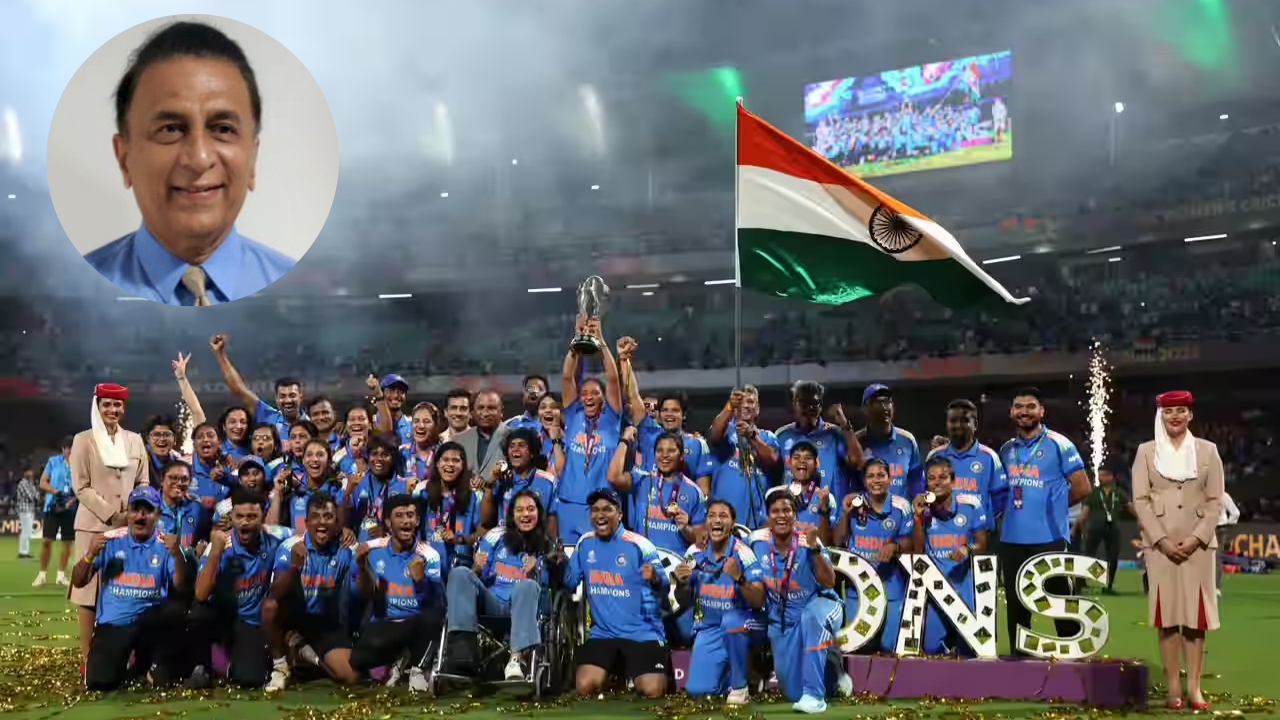
A golden generation delivers India its first women’s World Cup
India’s women’s cricket team finally ended a decades-long wait by winning the 2025 ICC Women’s ODI World Cup, defeating South Africa by 52 runs in the final. The win, led by Harmanpreet Kaur’s captaincy, not only made history but ignited a wave of national euphoria, official recognition, and emotional reflection across the cricketing community.
While the team secured ₹40 crore (approx. US$4.5 million) in prize money from the ICC, the BCCI added a ₹51 crore (approx. US$5.8 million) bonus in recognition of their achievement. Yet amid the nationwide celebrations, cricket legend Sunil Gavaskar offered a sober reminder.
Gavaskar’s warning: “Don’t get disappointed”
Writing in his column for Mid-Day, Gavaskar urged the players to manage expectations amid the flurry of praise and promised rewards.
“Just a word of caution to the girls. Please don’t get disappointed if some of the promised awards don’t come to you,” he wrote.
Gavaskar’s message, while celebratory in tone, highlighted the practical realities that can follow a major sporting triumph. His perspective served as a reminder that public promises made in the aftermath of glory often don’t translate into tangible benefits for athletes.
He critiqued the wave of opportunistic branding and self-promotion that often follows such victories.
“In India, advertisers, brands, and individuals are quick to jump on the bandwagon to get free publicity. Unless they are official sponsors, most of these congratulatory messages are just self-promotion.”
Drawing on his own experience after the 1983 men’s World Cup win, he added:
“The 1983 team too was made many promises, but almost all never materialised.”
By drawing a parallel with the 1983 World Cup–winning men’s team, Gavaskar framed his advice not as criticism, but as wisdom gained from lived experience. His intention was clearly to prepare the players for the possibility that not all recognition comes in the form of money or endorsements.
Despite the cautionary note, Gavaskar reassured the team that their true legacy lies elsewhere.
“Decades later, the affection of the Indian cricket lover remains our greatest wealth and it will be yours too.”
“Heartiest congratulations once again. The nation is proud of you. Jai Hind.”
Harmanpreet’s disbelief: “It feels like a dream”
For Harmanpreet Kaur, the enormity of becoming India’s first women’s World Cup–winning captain hasn’t fully sunk in. Speaking on the ICC Review Show, she shared the surreal nature of the moment.
“To be honest, I am not even able to think about this right now.”
Still processing the magnitude of the achievement, Harmanpreet admitted that the reality of the moment hadn’t yet taken hold. The immediate aftermath, she suggested, felt less like history in the making and more like just another match.
“Maybe I will realise after a few months what we have achieved, what we have given to the country. I can’t process it right now. I spoke about the same with Amol [Muzumdar] sir. It feels like we have won some bilateral series and we’re going home.”
“The impact of it is something that we will realise in a few months. Right now, it just feels like a dream. Even on the day we won, when we were dancing, everyone who would touch the trophy, asked ‘Is it real?’ We have been watching this trophy from afar for so many years and never got the opportunity to touch it, to click pictures with it. I mean, what happened that night was magic.”
That dreamlike state extended from the post-match celebration to the defining final moment of the game — the catch that sealed India’s place in history.
She also recalled the emotional high of sealing the win with a catch.
“The moment I took that catch, I simply wanted to run. I didn’t know what to do. Arundhati Reddy then came towards me and said ‘Harry di’. I said ‘Aru… we won.’ I can’t express that feeling in words. I just wanted to keep running around the ground in that moment. We wanted to thank the fans. It was really an emotional moment.”
As Harmanpreet soaked in the magnitude of the occasion, her coach Amol Muzumdar offered a broader reflection — not only on the journey that led to this title but on the system that made it possible.
Amol Muzumdar: “This victory is the result of deep-rooted change”
Head coach Amol Muzumdar, appearing on JioStar’s Celebrating Champions, credited structural transformation and past generations of women cricketers for laying the groundwork for this historic win.
For Muzumdar, India’s World Cup win wasn’t just a sporting triumph — it was a tribute to the pioneers who fought silently for recognition and progress. The post-match celebration, he noted, carried deeper meaning as current players acknowledged those who came before them.
“I truly enjoyed watching Harmanpreet Kaur, Smriti Mandhana and all our players take the trophy around the boundary to their seniors who helped build women’s cricket. We must respect our history to secure our future. Full credit goes to pioneers like Jhulan Goswami, Mithali Raj, Anjum Chopra, Reema Malhotra and all the seniors from their era, hats off to them for laying the foundation for this success in the Women’s World Cup.”
He highlighted the BCCI’s policy shifts in recent years as key factors:
“The BCCI’s work for women’s cricket in the last three years has been phenomenal. While they took over in 2006, the recent changes have been revolutionary. We’ve had three WPL editions that uncovered tremendous talent for us to develop. The pay parity introduced in 2022 was another landmark decision. Credit to BCCI for these wonderful initiatives that are now showing results in our World Cup victory.”
While institutional support helped shape the foundation, Muzumdar pointed to a key turning point during the tournament that galvanized the team after a rocky group stage.
Reflecting on a pivotal moment during the tournament, he recalled: “After three consecutive losses against Australia, South Africa and England in the group stage, we had a very honest team meeting. I felt we needed a blunt conversation where no barriers existed, and I’m glad the players responded positively. Though the scoreboard showed losses to South Africa, Australia, and England, we knew internally that we were playing well but failing to finish games. That realisation became our turning point in the tournament.”
With renewed clarity, the team entered the knockout rounds with a sharpened mindset — but Muzumdar knew that emotional management after victory was just as important as tactical preparation.
He stressed the importance of mental focus after the semi-final win.
“All our hard work over the past two years wasn’t just for winning the semi-final against Australia on October 30th, it was meant for playing in the final of the world cup on November 2nd, 2025. If we had stayed in that euphoria after beating Australia, we might not have reached our ultimate goal. I wanted the team to leave that celebration behind and stay focused on the present moment. That approach made November 2nd truly special when we finally achieved our dream of lifting the Women’s World Cup trophy.”
That clarity and focus also extended to India’s next generation. Muzumdar credited the WPL for accelerating pathways and highlighted rising stars as early proof of its impact.
He cited two young cricketers to demonstrate the WPL’s role in talent development:
“Shree Charani and Kranti Goud are perfect examples of WPL’s success. We identified them during the February tournament, and by May they were playing international cricket. This shows how WPL accelerates player development. In the next four-five years, we’ll see many more talented women cricketers emerging through WPL and domestic tournaments, strengthening Indian cricket tremendously.”
Summing up his journey, Muzumdar said: “I first visited the National Cricket Academy in November 2023 and met the Indian team for the first time. From that day, our journey began with one clear goal; to become the world’s best team. We made some necessary changes in the support staff, team composition, and most importantly, in our mindset. All these efforts have now culminated in this World Cup victory. It has been absolutely magical working with these talented players, and I couldn’t have asked for a better group of players and human beings.”
As Muzumdar reflected on the journey behind the triumph, BCCI President Mithun Manhas offered a broader institutional perspective — one rooted in policy, leadership, and the long arc of progress.
Mithun Manhas: “Jay Shah’s vision changed everything”
BCCI President Mithun Manhas, speaking to IANS, reflected on the long journey that culminated in this World Cup win and gave credit where it was due — especially to former BCCI secretary and current ICC Chair Jay Shah.
Manhas traced the roots of India’s historic achievement to nearly two decades of quiet, determined reform — a process that accelerated significantly under Shah’s leadership.
“Our women’s team that won the 2025 World Cup began its journey almost two decades ago, around 2006 or 2007, when the BCCI took charge. A lot of work has been done since then, but a major role has been played by Jay Shah, whose contribution has been instrumental in taking the women’s game to this level. He ensured that women cricketers received equal pay, just like the men’s team.”
“After that, the Women’s Premier League (WPL) was launched, and recently, even the Under-15 women’s tournament began. The kind of initiatives he has undertaken, even as ICC Chair, such as increasing salaries and prize money, are truly praiseworthy. He deserves a lot of credit for this transformation.”
While acknowledging Shah’s administrative influence, Manhas made sure to spotlight the foundational efforts of past players whose sacrifices shaped the present.
He also honored the pioneers of women’s cricket in India.
“As far as this recent victory is concerned, credit must also go to the former players of the Indian women’s team, who worked tirelessly for years. Their contributions are invaluable, and they are our real heroes.”
Looking ahead, Manhas sees this moment as the beginning of a new chapter.
“This victory has given a huge boost to women’s cricket, even at the grassroots level. We hope that, just as boys once played gully (street) cricket, young girls will now do the same. The future of women’s cricket in India looks brighter than ever.”
With the sport now entering what many see as a golden era, Manhas also turned inward — reflecting on his role as steward of Indian cricket’s evolving legacy.
And he acknowledged the responsibility he carries as the head of Indian cricket.
“The role of BCCI President comes with a great responsibility – it is a legacy that must be carried forward. We are ready for it; our team is capable, and we will strive to continue the good work so that not only the women’s team but also the men’s team reaches even greater heights and Indian cricket continues to rise.”
From the shoulders of trailblazers to the leadership of administrators, India’s first Women’s World Cup title is a triumph built on belief, structure, and collective vision. As the celebrations continue, the moment offers more than glory — it signals the arrival of a new era for Indian cricket, where women’s achievements are finally given the spotlight they’ve long deserved.