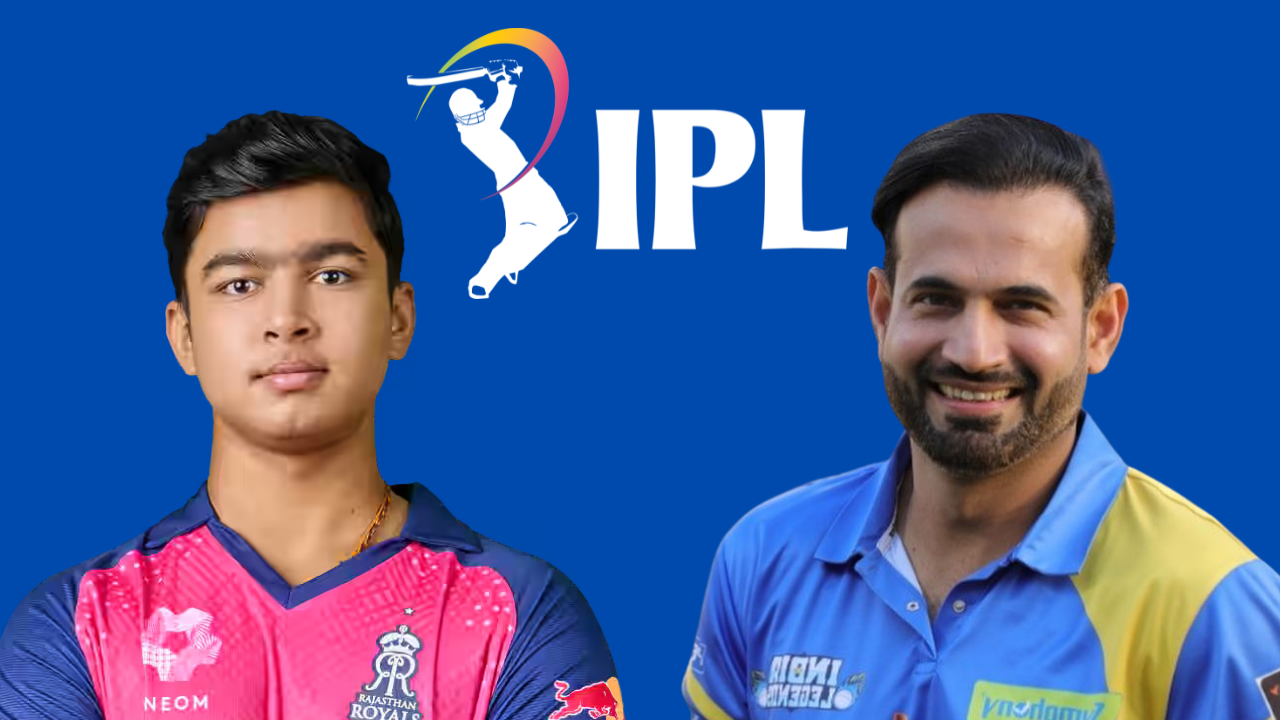
The rapid rise of Vaibhav Sooryavanshi has already sparked conversations around how the teenager approaches elite bowling attacks, with his fearless strokeplay against some of the biggest names in the Indian Premier League prompting early theories about his intent at the crease—conversations that took a sharper turn after a brief outing against Sunrisers Hyderabad offered a contrasting moment and drew a pointed reaction from Irfan Pathan.
“So my theory for Vaibhav Sooryavanshi isn’t wrong ;)” he said on X.
So my theory for Vaibhav Suyanvanshi isn’t wrong 😉
— Irfan Pathan (@IrfanPathan) April 13, 2026
Golden duck becomes turning point
The remark followed an unexpected sequence where debutant Praful Hinge dismissed Sooryavanshi on the very first ball he faced. Attempting to assert himself early, the young opener miscued an attacking shot that resulted in a straightforward catch, registering the first golden duck of his T20 career.
The moment stood in stark contrast to his recent outings, especially given the bowler’s limited experience at the top level. That contrast is what brought renewed attention to Pathan’s earlier observation, turning a single delivery into a wider talking point.
Original theory rooted in big-match aggression
Pathan’s idea had first emerged during a high-profile clash in which Sooryavanshi dominated some of the competition’s most established bowlers. Opening the innings, he produced a striking 78 from just 26 deliveries, combining eight fours with seven sixes while taking on bowlers such as Bhuvneshwar Kumar and Josh Hazlewood.
“Does Vaibhav target big bowlers purposely? I like to think so,” he said on X.
The statement framed the youngster’s approach as potentially deliberate rather than purely instinctive. As the discussion evolved, Pathan later returned to underline that viewpoint by quote-tweeting his original post with a brief follow-up.
“my theory”
My Theory ;). https://t.co/1apjXeRa9l
— Irfan Pathan (@IrfanPathan) April 13, 2026
Debate reflects contrasting interpretations
The sequence of performances—aggression against leading bowlers followed by a first-ball dismissal against a relatively untested opponent—has driven a split in interpretation. While Pathan’s perspective points towards a pattern linked to opposition quality, others see it as a natural extension of an attacking mindset that does not discriminate between bowlers.
Such variability is inherent to the format, particularly for young batters establishing themselves at the highest level. Early success can quickly shape expectations, but isolated setbacks often add complexity to those narratives.
Leadership backs long-term growth
Amid the debate, Riyan Parag, Captain of Rajasthan Royals, emphasised development over immediate outcomes, pointing to the broader experience Sooryavanshi continues to accumulate.
“I feel one thing you gain every time you step onto a cricket field is experience. Regardless of his age — he might be 15 — he has gained a lot from playing last year,” he said in the post-match press conference.
Parag highlighted how exposure across formats and competitions has contributed to the youngster’s understanding of the game.
“Even from the sidelines, you understand how the game works, how the IPL works. He has played games, carried that momentum into the Under-19 World Cup and Asia Cups, and scored runs everywhere.”
He concluded by reinforcing the long-term value of those experiences.
“I think he has earned a lot of experience from those situations — winning games, scoring big runs, like daddy hundreds.”