The business of global cricket shared centre stage with high-stakes Super 8 action in Ahmedabad.
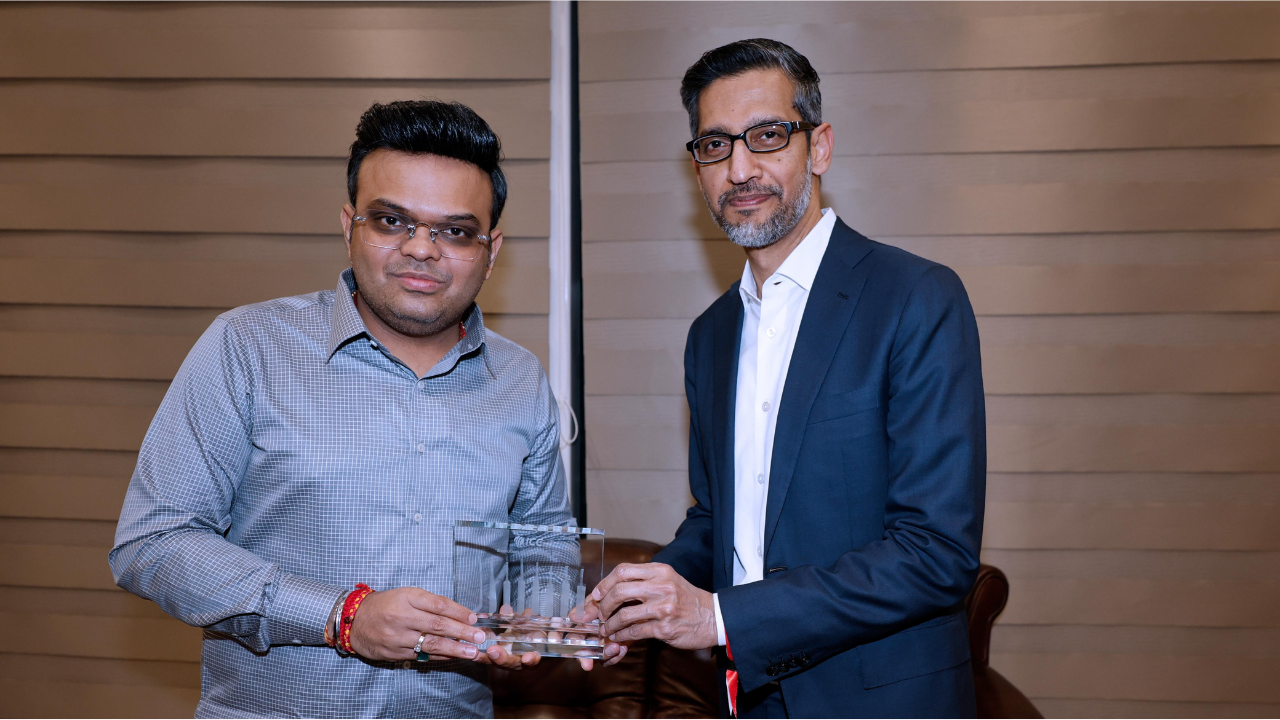
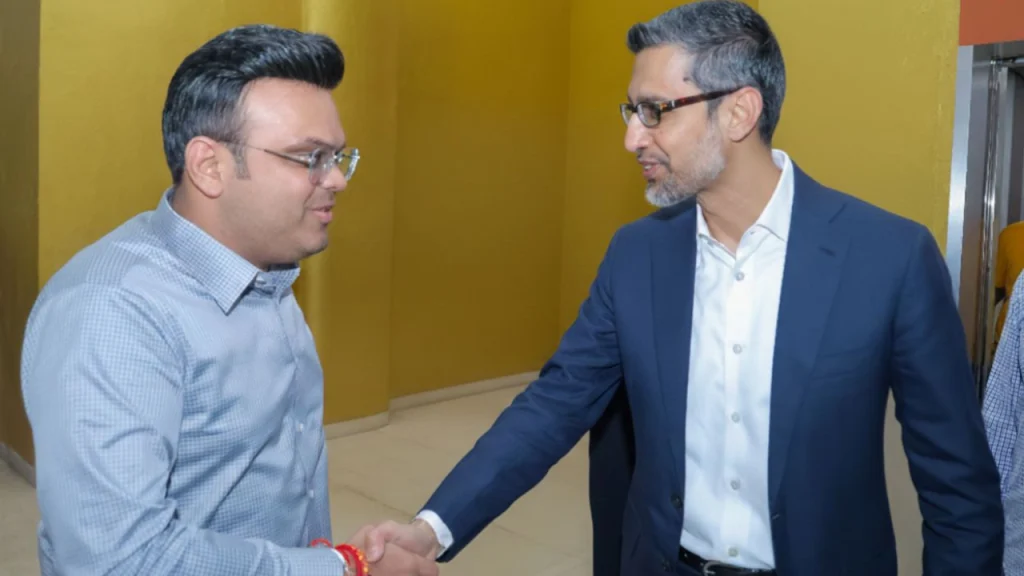
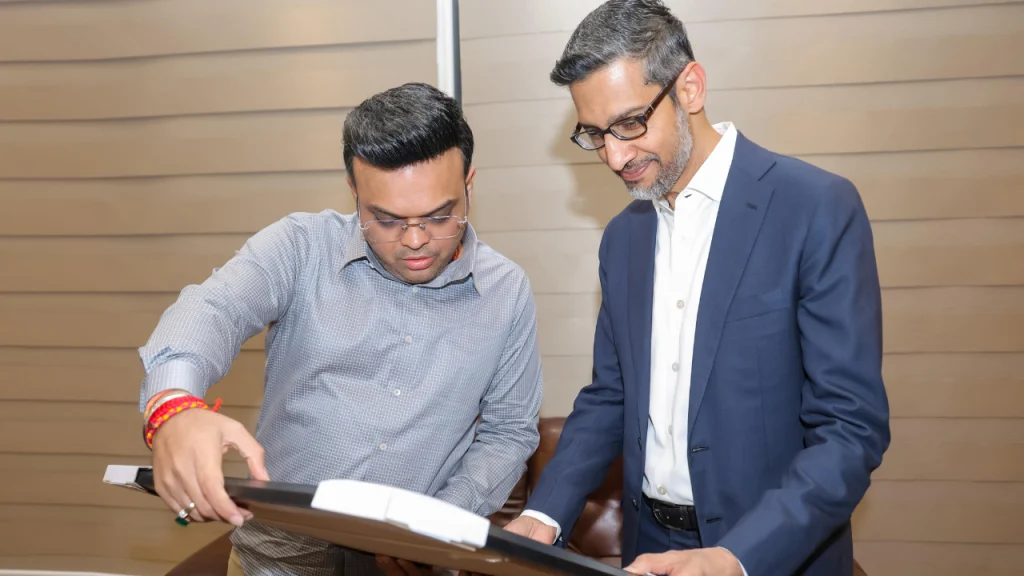
ICC Chair Jay Shah hosted Google and Alphabet CEO Sundar Pichai during the ICC Men’s T20 World Cup 2026 Super 8 clash between India and South Africa at the Narendra Modi Stadium — a fixture that ended in a commanding 76-run victory for South Africa in Group 1.
ICC and Google partnership in focus at Super 8
Pichai’s high-profile presence at the venue underscored the growing convergence between technology and international cricket.
Pichai was also present on the field during the pre-match proceedings.
The appearance comes amid ICC’s expanding commercial collaboration with Google. The technology giant has been integrated into the tournament ecosystem, with Google Gemini serving as the Official AI Fan Companion and Google Pixel designated as the Official Smartphone of the ICC Men’s T20 World Cup 2026.
Pichai is also a co-owner of the London Spirit in The Hundred.
The partnership is positioned around AI-driven fan engagement and immersive in-stadium capture, reflecting the ICC’s push toward digital-first audience growth strategies.
Jay Shah highlights growing ICC–Google collaboration
Shah also addressed the partnership publicly, emphasising its role in deepening global fan connection.
“It is a pleasure for @ICC to host Google and Alphabet CEO @sundarpichai at India and South Africa’s #T20WorldCup match at the Narendra Modi Stadium in Ahmedabad. Our partnership with @GoogleIndia continues to grow our sport across and bring fans closer to the game than ever.” Jay Shah wrote on his official X handle.
It is a pleasure for @ICC to host Google and Alphabet CEO @sundarpichai at India and South Africa's #T20WorldCup match at the Narendra Modi Stadium in Ahmedabad.
Our partnership with @GoogleIndia continues to grow our sport across and bring fans closer to the game than ever. pic.twitter.com/YiIbp4BxmI— Jay Shah (@JayShah) February 22, 2026
The optics of the ICC Chair hosting one of the world’s most influential technology executives during a marquee Super 8 encounter underscores cricket’s increasing alignment with global digital platforms.
South Africa recover from early blows to post 187
On the field, South Africa overcame an early collapse after winning the toss and electing to bat.
Jasprit Bumrah and Arshdeep Singh reduced the Proteas to 20 for 3 inside four overs, with Bumrah accounting for key breakthroughs and Arshdeep removing captain Aiden Markram. The early damage placed South Africa under immediate pressure.
The momentum shifted dramatically through a counter-attacking fourth-wicket stand of 97 between David Miller and Dewald Brevis, rebuilding the innings after the early damage. Miller scored 63 off 35 deliveries, while Brevis narrowly missed his half-century with 45.
After Miller’s dismissal in the 16th over, Tristan Stubbs provided a decisive late surge, finishing unbeaten on 44 off 24 balls. His back-to-back sixes off Hardik Pandya on the penultimate and final deliveries of the innings lifted South Africa to 187 for 7.
For India, Bumrah returned figures of 3 for 15, while Arshdeep Singh claimed 2 for 28. Varun Chakravarthy and Shivam Dubey picked up one wicket each.
India collapse under Jansen and Maharaj pressure
India’s chase never recovered from a chaotic start.
The hosts lost their first wicket in the opening over and were quickly reduced to 26 for 3. The slide continued to 43 for 4 and 51 for 5, as South Africa’s pace and spin attack tightened control.
Marco Jansen led the assault with 4 for 22, striking at crucial intervals. Keshav Maharaj supported with 3 for 24, while Corbin Bosch claimed 2 for 12. Aiden Markram added one wicket, and Lungi Ngidi delivered an economical spell, conceding just 15 runs in his four overs.
Shivam Dubey top-scored with 42 off 37 deliveries, while Suryakumar Yadav and Hardik Pandya managed 18 each. India were eventually bowled out for 111, handing South Africa a comprehensive 76-run victory to open their Super 8 campaign.
Super 8 implications for Group 1
The result places South Africa in early command of Super 8 Group 1, strengthening their net run rate and applying immediate pressure on India, West Indies and Zimbabwe in what is shaping up as a tightly contested Super 8 Group 1.
Beyond the scoreboard, however, the fixture also highlighted cricket’s evolving commercial ecosystem — where boardroom partnerships, AI innovation and marquee international contests now increasingly intersect on the sport’s biggest stage.