The International Cricket Council (ICC) is facing strong criticism over what many are calling a double standard in its enforcement of political neutrality, following Chairman Jay Shah’s public endorsement of the Indian armed forces.
The controversy erupted after Shah—who previously served as Secretary of the Board of Control for Cricket in India (BCCI)—posted a now-deleted message on Instagram praising India’s military in the wake of recent cross-border tensions with Pakistan.
“Our Armed Forces are our pride, and no words are enough to express their valour and commitment in protecting our motherland and people,” Shah wrote.
He added, “We salute our brave men and women in the armed forces who are shielding our nation from terrorism,” and, “Let us unite to honour our heroes and build a stronger, more united India.”
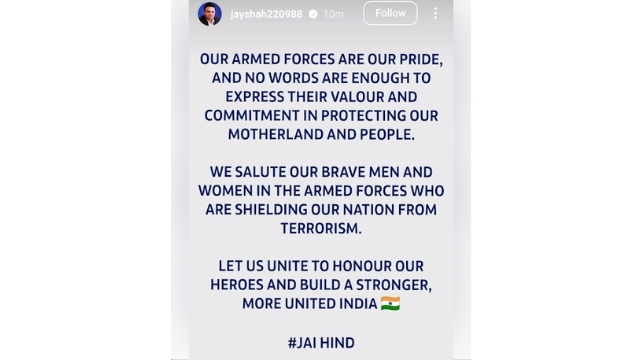
Shah’s post was quickly deleted, but not before igniting a wave of criticism about the ICC’s apparent inconsistency—especially when contrasted with the handling of Australian cricketer Usman Khawaja, who was reprimanded in 2023 for wearing a dove symbol and the phrase “All lives are equal” to advocate for peace in the Middle East.
Malcolm Conn leads the charge
One of the most vocal critics has been veteran Australian cricket journalist Malcolm Conn, who condemned the ICC’s inconsistent handling of both situations.
“So [Usman Khawaja] is banned by the [ICC] from putting a dove on his bat supporting peace in the Middle East but [ICC] chairman Jay Shah, son of India’s home affairs minister, can openly support the Indian military during conflict. Staggering hypocrisy,” Conn posted on X, formerly Twitter.
Conn later followed up with a pointed question: “Had he resigned as ICC Chief?”
His remarks have sparked a broader debate about whether the ICC can still claim neutrality, particularly when its own top official appears to violate the very policies it enforces on players.
Critics accuse ICC of selective enforcement
The ICC has long maintained strict policies against political messaging on the field. But critics argue those rules are being applied unevenly—punishing players like Khawaja for such gestures while turning a blind eye to patriotic messaging from leadership.
According to WE News, “Critics argue that while players like Usman Khawaja face harsh penalties for promoting peace, the ICC’s top official appears to receive a free pass for aligning with national military sentiment, fuelling accusations of a troubling double standard—punishing peace while permitting patriotism when it suits those in power.”
In Khawaja’s case, even a compromise—donning a black armband—wasn’t enough to satisfy the ICC, which still issued a reprimand for displaying a “personal message.” The contrast to Shah’s now-removed tribute to the military has raised questions about fairness and impartiality.
The blurred lines of power and neutrality
Shah’s familial connection to Indian Home Minister Amit Shah has further intensified concerns about political influence creeping into cricket’s global governance.
According to WE News, “In a sport that prides itself on bringing people together across national boundaries, allowing political messages—especially those tied to military conflict—undermines the spirit of the game.”
The deleted post hasn’t quelled the controversy. If anything, it has added to perceptions that the ICC is struggling to enforce its own rules uniformly, especially when powerful figures are involved.
What’s next for the ICC?
Despite mounting criticism, the ICC has yet to issue a public statement on Shah’s post or address the growing demands for a clarification of its policies.
The silence is fueling fears that cricket’s governing body is at risk of losing credibility—not just with fans, but with the players and administrators who expect fairness and impartiality at the international level.