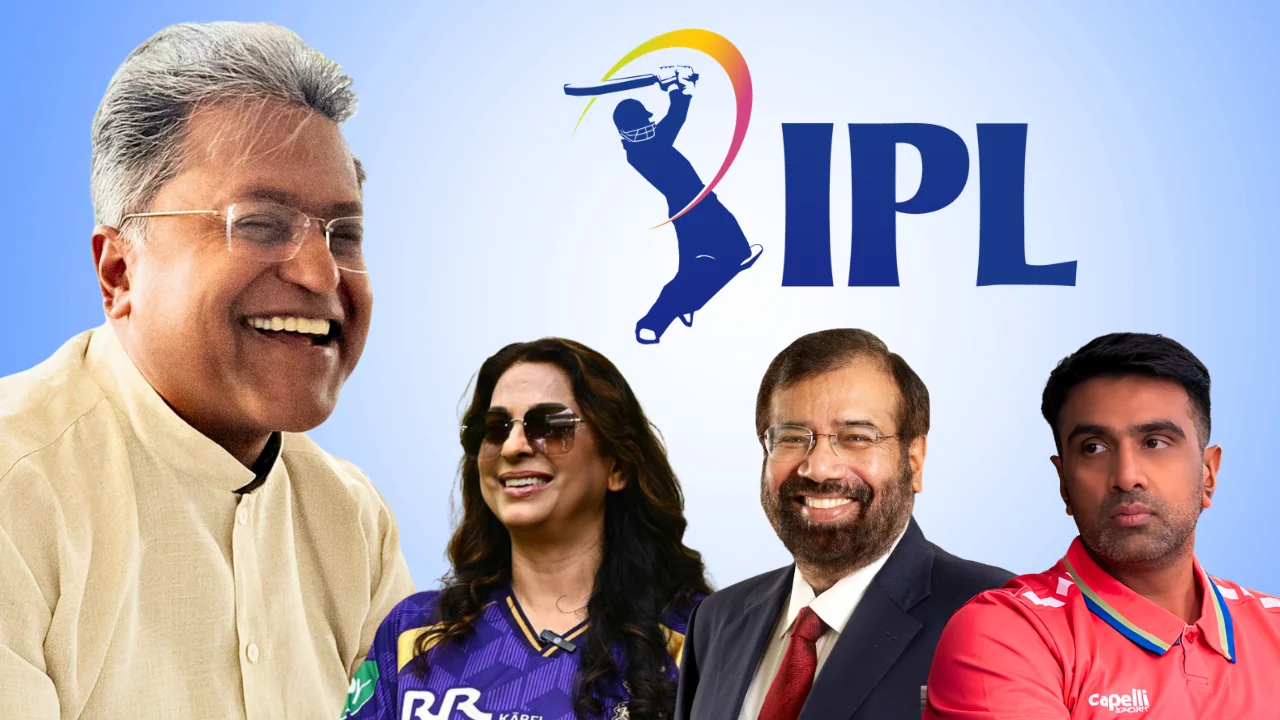
Lalit Modi‘s call for the Indian Premier League (IPL) to abandon its traditional summer schedule has gathered support from Kolkata Knight Riders (KKR) Co-owner Juhi Chawla, RPG Enterprises Chairman Harsh Goenka and former India spinner Ravichandran Ashwin, turning a proposal for better playing conditions into a wider debate about the tournament’s commercial influence and its place in world cricket.
The IPL Founder and Former Chairman wants the Board of Control for Cricket in India (BCCI) to consider starting the competition in January or developing a longer October–April calendar. His argument extends beyond India’s increasingly difficult summer conditions to the league’s relationship with the international cricket calendar.
Modi made that position clear in a lengthy post on X, headed: “THE IPL DOES NOT NEED A WINDOW. IT CREATES ITS OWN.”
THE IPL DOES NOT NEED A WINDOW. IT CREATES ITS OWN.
By Lalit Modi | Founder, Indian Premier League
There seems to be a fundamental misunderstanding about the IPL and the international cricket calendar. A lot of cricket journalists and Cricket Administrators have reached out to me either scared or giving me Gyan on value chain. I thought it best I tell my views bluntly
The IPL does not need the ICC to give it a window.
The IPL is a domestic tournament owned and operated by the BCCI. The BCCI can decide when to stage it. Of course, international commitments and player releases must be managed, but that is entirely different from seeking permission to exist in a particular part of the calendar.
And here is the bigger point.
The IPL is no longer a tournament trying to find its place in world cricket. World cricket must recognise the place the IPL has already earned.
I know this better than most. I created the IPL when many believed it would never work.
In 2008, India’s movie, television and entertainment industries initially thought they could compete with it. They learnt very quickly what happens when the IPL captures the attention of a nation. Film releases were postponed, prime-time television was disrupted and entertainment schedules were rewritten.
The IPL didn’t ask Bollywood for a window. Bollywood adjusted to the IPL.
Now imagine the IPL choosing its own optimal calendar.
Others may try to counter-programme it. They are free to do so. But commercial reality is a very unforgiving umpire.
The world’s leading cricketers understand where the financial opportunities are. For many international players, an IPL contract can represent a substantial proportion of their annual cricket earnings. That economic gravity is not going away.
The IPL has become to cricket what the English Premier League is to football: a global sporting and commercial powerhouse with the ability to shape the wider ecosystem.
And like the EPL, its strength comes from the product, the clubs, the supporters, the talent and the commercial model—not from asking competing competitions to clear the calendar.
Why I don’t support reviving the Champions League T20
I was involved in creating the original Champions League concept. It made commercial sense in its time.
But the world has changed.
Today, IPL franchise ownership groups have expanded across several international T20 leagues. The prospect of teams under common ownership competing against each other creates obvious governance and conflict-of-interest questions.
More importantly, why create another tournament competing for the same players, broadcasters, sponsors and increasingly stretched cricket calendar?
We don’t need another competition. We need to strengthen the competition that already works.
My proposal is to seriously examine moving the IPL from the increasingly punishing April–May heat, with two alternatives: a January start or a carefully structured October–April competition calendar.
The objective should be a commercially sustainable expansion, better playing conditions, more valuable broadcasting inventory and a stronger long-term economic foundation for Indian cricket.
The BCCI has the asset. It has the audience. It has the commercial strength.
It needs the confidence to use them.
The ICC and other cricket boards should recognise the economic reality and work constructively around it. The IPL cannot be expected to subsidise an outdated global calendar indefinitely.
The writing has been on the wall. Unfortunately, some people only read it when it appears on a balance sheet.
You cannot run tomorrow’s cricket on yesterday’s economics.
And remember one thing:
The IPL was never built to follow the market. It was built to change the market.
Lalit Modi
Founder, Indian Premier League@IPL #cricket #bcci
— Lalit Kumar Modi (@LalitKModi) November 9, 2026
Lalit Modi wants the IPL to control its own calendar
Modi’s proposal distinguishes between the BCCI’s authority to schedule its domestic competition and the practical arrangements required to accommodate international players.
He argues that the IPL’s growth since its launch in 2008 has changed its relationship with the wider cricket ecosystem.
Modi wrote: “The IPL does not need the ICC to give it a window.”
“The IPL is a domestic tournament owned and operated by the BCCI. The BCCI can decide when to stage it. Of course, international commitments and player releases must be managed, but that is entirely different from seeking permission to exist in a particular part of the calendar.”
He added: “The IPL is no longer a tournament trying to find its place in world cricket. World cricket must recognise the place the IPL has already earned.”
Modi also drew on the tournament’s early years to illustrate its influence beyond cricket. He recalled how India’s film and television industries adjusted their schedules after the IPL began attracting substantial national attention, including changes to movie releases and prime-time programming.
His comparison reflects the wider question raised by the proposed calendar change: how much influence can the IPL exercise over the scheduling decisions of other cricket organisations?
January or October–April: Modi’s proposed IPL windows
Although much of the discussion has focused on January, Modi has outlined two possible alternatives to the IPL’s established summer schedule.
His proposal also raises the possibility of a longer competition, with implications for the number of matches, broadcasting arrangements and the tournament’s commercial model.
Modi explained: “My proposal is to seriously examine moving the IPL from the increasingly punishing April–May heat, with two alternatives: a January start or a carefully structured October–April competition calendar.”
“The objective should be a commercially sustainable expansion, better playing conditions, more valuable broadcasting inventory and a stronger long-term economic foundation for Indian cricket.”
The IPL has generally occupied the March-to-May period, sometimes extending into early June. A winter schedule would require adjustments to international fixtures, overseas player availability and other domestic competitions.
Modi believes the financial importance of IPL contracts would be a significant factor in those negotiations.
He wrote: “Now imagine the IPL choosing its own optimal calendar.”
“Others may try to counter-programme it. They are free to do so. But commercial reality is a very unforgiving umpire.”
“The world’s leading cricketers understand where the financial opportunities are. For many international players, an IPL contract can represent a substantial proportion of their annual cricket earnings. That economic gravity is not going away.”
Drawing a parallel with football’s leading domestic competition, Modi added: “The IPL has become to cricket what the English Premier League is to football: a global sporting and commercial powerhouse with the ability to shape the wider ecosystem.”
“And like the EPL, its strength comes from the product, the clubs, the supporters, the talent and the commercial model—not from asking competing competitions to clear the calendar.”
Juhi Chawla and Harsh Goenka back a winter IPL
Modi’s proposal subsequently received public support from Juhi Chawla, whose involvement as a KKR Co-owner brought a franchise stakeholder into the discussion.
Chawla responded on X: “The IPL no longer needs to find its place in the cricket calendar. It has earned the right to influence it.”
“So why keep playing the biggest cricket tournament on the planet in the harshest heat? And if the calendar is being reconsidered, why not January instead of April-May?<br>Better conditions. Better cricket. A better experience for everyone overall!”
“The IPL has evolved. Perhaps its calendar should too now!” #JustAThought”
The IPL no longer needs to find its place in the cricket calendar. It has earned the right to influence it.
So why keep playing the biggest cricket tournament on the planet in the harshest heat? And if the calendar is being reconsidered, why not January instead of April-May?
Better conditions. Better cricket. A better experience for everyone overall!The IPL has evolved. Perhaps its calendar should too now!
#JustAThought
— Juhi Chawla Mehta (@iam_juhi) November 9, 2026
Her endorsement was followed by Harsh Goenka, Chairman of RPG Enterprises and brother of Lucknow Super Giants Principal Owner Sanjiv Goenka.
The RPG group includes CEAT, which has been associated with the IPL as its Strategic Time-out Partner.
Goenka wrote on X:
“Juhi Chawla and Lalit Modi are right about moving the IPL to winter.
Reasons:
1. Better cricket- players perform better in pleasant weather than in 40°C heat.
2. Better fan experience. Families can enjoy packed stadiums without battling the summer furnace.
3. Fewer disruptions. Less extreme heat and potentially fewer pre-monsoon weather interruptions.
Time for a winter IPL!”
Juhi Chawla and Lalit Modi are right about moving the IPL to winter.
Reasons:
1. Better cricket- players perform better in pleasant weather than in 40°C heat.
2. Better fan experience. Families can enjoy packed stadiums without battling the summer furnace.
3. Fewer disruptions. Less extreme heat and potentially fewer pre-monsoon weather interruptions.
Time for a winter IPL!— Harsh Goenka (@hvgoenka) November 10, 2026
Modi welcomed the growing support in subsequent posts, including a direct response to Goenka. He highlighted the involvement of franchise stakeholders and commercial sponsors in a debate that had initially centred on his own proposal.
In another post, Modi wrote: “When franchise owners and major commercial sponsors start questioning the calendar, perhaps it’s time the administrators started listening!”
🚨 BREAKING: THE WINTER IPL DEBATE IS HEATING UP! 🏏🔥🤣
First my dear friend Juhi Chawla Mehta, co-owner of KKR.
Now my dear friend Harsh Goenka, Chairman of RPG Group, whose CEAT Tyres is one of the IPL’s major sponsors.
Harsh has publicly backed our call for a WINTER IPL!
His arguments are simple:
🏏 Better cricket in better weather.
🏟️ Better experience for families and fans.
🌤️ Fewer disruptions from extreme heat.
When franchise owners and major commercial sponsors start questioning the calendar, perhaps it’s time the administrators started listening! 🤣
I created the IPL to challenge conventional thinking, not preserve it.
And with reports of 12 teams from 2028, potentially 136 matches under a full home-and-away format, the need to rethink the calendar becomes even more compelling.
January or a carefully structured October–April window deserves serious commercial examination.
The IPL doesn’t need the ICC to give it a window. IT CREATES ITS OWN.
Thank you, Harsh. Welcome to the winter IPL debate! ❤️
The IPL was never built to follow the market.
IT WAS BUILT TO CHANGE THE MARKET. 🚀
Lalit Modi
Founder, Indian Premier League@hvgoenka @iam_juhi @IPL @ICC
#IPL #WinterIPL #LalitModi #HarshGoenka #CEAT #BCCI #FutureOfCricket
— Lalit Kumar Modi (@LalitKModi) November 10, 2026
The endorsements have given the winter IPL proposal a broader audience, although neither represents an official decision by the BCCI to change the competition’s schedule.
A 12-team IPL could change the economics of expansion
The calendar debate has also become connected to reports of a possible expansion of the IPL.
According to a report by Mint, the BCCI is exploring the addition of two franchises that could take the IPL from 10 to 12 teams beginning with the 2028 season. Pune and Vadodara have emerged as potential locations, although no final decision on the cities has been announced. The proposed expansion could coincide with the next IPL media rights cycle, covering 2028–2032, with broadcaster interest, franchise valuations and player availability among the considerations.
Modi has welcomed the reported expansion and outlined a potential competition format involving 132 league fixtures and four playoff matches.
He wrote on X: “12 teams. 22 league matches per team. 132 league games. Four playoffs. 136 MATCHES!”
“That’s 84% more match inventory than today’s 74-match format.”
“Imagine the opportunities for Indian cricketers, new franchise investors, regional fans, broadcasters, sponsors and digital subscribers.”
“A match every weekday at 7:30 PM. Two every Saturday and Sunday at 3:30 and 7:30 PM.”
“Nine matches a week. A bigger, more valuable commercial ecosystem.”
“But let’s be clear: more matches must translate into sustainable economics, not just impressive headlines.”
🚨 12 IPL TEAMS FROM 2028? THIS COULD BE THE BEST NEWS FOR INDIAN CRICKET! 🏏🔥
When I created the IPL in 2008 with eight teams, my vision was always to build a truly PAN-INDIA sporting powerhouse.
Now reports suggest 12 teams from 2028. I welcome that ambition!
Look at the NFL: 32 teams.
NBA: 30 teams.
EPL: 20 clubs.
NHL: 32 teams.These great sporting leagues build audiences, loyalty and commercial value across extended seasons.
Why should the IPL think small?
12 teams. 22 league matches per team. 132 league games. Four playoffs. 136 MATCHES!
That’s 84% more match inventory than today’s 74-match format.
Imagine the opportunities for Indian cricketers, new franchise investors, regional fans, broadcasters, sponsors and digital subscribers.
A match every weekday at 7:30 PM. Two every Saturday and Sunday at 3:30 and 7:30 PM.
Nine matches a week. A bigger, more valuable commercial ecosystem.
But let’s be clear: more matches must translate into sustainable economics, not just impressive headlines.
THE CALENDAR MUST EVOLVE WITH THE PRODUCT.
A winter-oriented IPL deserves serious examination. Better playing conditions, a more comfortable fan experience and a longer, predictable broadcasting season.
The IPL is a domestic tournament. The BCCI has the power to rethink its future.
THE IPL DOESN’T NEED A WINDOW. IT CREATES ITS OWN.
I built the IPL to change the market. Nearly two decades later, that ambition should only be getting bigger! 🚀
Lalit Modi
Founder, Indian Premier League#IPL #IPL2028 #WinterIPL #BCCI #LalitModi #Cricket
— Lalit Kumar Modi (@LalitKModi) November 10, 2026
https://t.co/iwmE7KHITn
— Lalit Kumar Modi (@LalitKModi) November 10, 2026
A competition of that scale would require a substantially different scheduling approach from the existing IPL format. It would also create additional inventory for media rights holders while increasing demands on participating players and franchises.
Modi has separately questioned the value of reviving the Champions League T20. He argues that the expansion of IPL franchise ownership groups into other international leagues creates potential governance and conflict-of-interest concerns, while another competition would compete for players, sponsors, broadcasters and space in the cricket calendar.
His preference is to concentrate on developing the IPL rather than introduce another tournament into an already crowded schedule.
Addressing the wider international cricket establishment, Modi stated: “The ICC and other cricket boards should recognise the economic reality and work constructively around it. The IPL cannot be expected to subsidise an outdated global calendar indefinitely.”
“The writing has been on the wall. Unfortunately, some people only read it when it appears on a balance sheet.”
“You cannot run tomorrow’s cricket on yesterday’s economics.”
Ravichandran Ashwin suggests a November start
Former India spinner Ravichandran Ashwin has also entered the discussion, offering a different possible starting month for an expanded IPL season.
Speaking on his Tamil YouTube channel, Ashwin considered whether the tournament could eventually follow the longer-season structure of major international sporting leagues, particularly if two more franchises were introduced.
Ashwin said: “Imagine the IPL moving in that direction. If another two teams are added in the future, you could perhaps organise the tournament over a four- or five-month window. You could avoid the intense summer heat.”
He suggested another option: “Maybe we could consider starting sometime in November, when the weather is better.”
Ashwin acknowledged that an alternative window would have implications for India’s domestic cricket schedule and player availability across international competitions.
He also expressed the view that the IPL’s financial strength and ability to attract leading players would give it considerable influence in negotiations over its place in the calendar.
What the BCCI has actually discussed
Despite the public support for a winter IPL, there has been no official confirmation that the BCCI is considering either Modi’s January proposal or an extended October–April season.
The board’s previously acknowledged discussions have been more limited, focusing on whether the tournament could begin slightly earlier than its usual late-March start.
BCCI Secretary Devajit Saikia told PTI that administrators were concerned about the combination of high temperatures and the possibility of pre-monsoon rainfall affecting the closing stages of the competition.
Saikia said: “So therefore, there is a discussion going on in BCCI as well as in our IPL Governing Council regarding whether we can start the tournament a little bit earlier than the fag end of March.”
An earlier March start would be an adjustment to the existing schedule. A January launch or a competition extending across several winter months would involve a considerably more substantial restructuring of the IPL calendar.
For now, Modi’s proposal has attracted support from a franchise Co-owner, a prominent commercial stakeholder and a former India player, while reports of potential expansion have added another dimension to the scheduling debate.
Whether the BCCI ultimately considers a winter IPL remains unresolved, but the discussion has brought the league’s playing conditions, commercial development and future competition format into the same conversation.